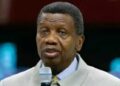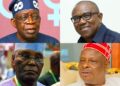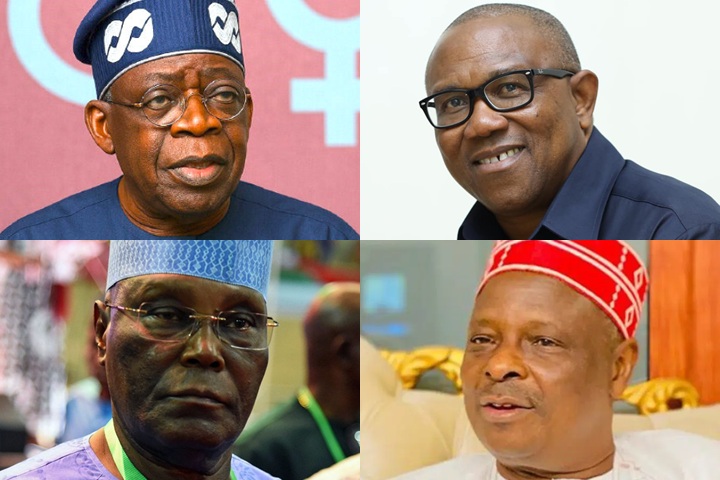

A U.S.-based Nigerian lawyer and democracy advocate, Emmanuel Ogebe, has stirred debate after revealing that several of Nigeria’s top political figures — including President Bola Tinubu, former Vice President Atiku Abubakar, Senator Rabiu Kwankwaso, and Vice President Kashim Shettima — face varying degrees of reputational or legal baggage in the United States.
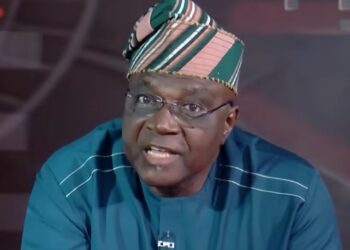
Speaking on Inside Sources with Channels TV anchor Laolu, Ogebe contrasted these leaders’ records with that of Peter Obi, whom he described as “spotless” in U.S. legal circles.
Tinubu and Atiku’s U.S. Shadows
Ogebe explained that both Tinubu and Atiku have long-standing issues in the U.S., though of different kinds:
- Tinubu: Faced an actual Department of Justice civil forfeiture case in Chicago in the 1990s, linked to alleged drug-related finances.
He surrendered $460,000 but was never criminally convicted.
Ogebe noted that Tinubu previously enjoyed political “cover” from U.S. administrations, but with the change in leadership under President Trump, that protection has weakened.
- Atiku: Was the subject of a U.S. Senate investigation in 2010 into illicit foreign funds, with his wife Jennifer Douglas cited in reports of suspicious transfers amounting to tens of millions of dollars.
- Though never charged, Atiku stopped visiting the U.S. for years.
- He was also tangentially mentioned in the William Jefferson bribery scandal, though Jefferson was the one convicted.
Kwankwaso and Shettima
- Kwankwaso: Ogebe revealed that the former Kano governor and current vice-presidential nominee for Obi’s NDC was recently flagged in U.S. Congress discussions on religious persecution in Kano State.
Though Kwankwaso has claimed his name was later removed from the list, Ogebe said he was not aware of such confirmation.
- Shettima: Tinubu’s running mate continues to attract scrutiny over his tenure as Borno governor during the Chibok abductions, with U.S. lawmakers reportedly uneasy about his role in Nigeria’s security failures.
Ogebe argued that Tinubu’s insistence on retaining Shettima on a Muslim-Muslim ticket has worsened Nigeria’s image abroad.
“You Be Thief, I No Be Thief”
Ogebe likened the corruption accusations traded between Tinubu and Atiku to Fela Kuti’s satirical song:
“You be thief, I no be thief, you be robber, I no be robber.”
He described the rivalry as a “kettle and pot contesting which one is blackest”.
He stressed that both men presided over systemic governance failures — Tinubu in Lagos and Atiku during Nigeria’s privatization era.
Diaspora and U.S. Attention
Ogebe highlighted the growing role of Nigeria’s diaspora, which remits $22 billion annually, more than NNPC’s revenues.
Despite being politically disenfranchised, diaspora Nigerians are increasingly vocal, with Obi’s 2023 campaign drawing massive town halls across North America.
He also noted that U.S. Congress has begun tying aid to Nigeria’s handling of religious freedom and human rights, with bills proposing to freeze assistance until progress is made.
Tinubu’s administration, he said, faces unprecedented vulnerability in Washington.
Human Rights Concerns
Ogebe cited disturbing cases, including the death of a 13-year-old Christian orphan, David Tafai, in Kano State custody after being forcibly converted.
He warned that such incidents reinforce Nigeria’s designation as a Country of Particular Concern (CPC) for religious persecution, complicating relations with the U.S.
The revelations underscore Nigeria’s complex intersection of domestic politics and international scrutiny.
With 2027 elections looming, Ogebe’s remarks highlight how past scandals and unresolved governance failures continue to haunt Nigeria’s political elite abroad.
His blunt assessment: until Nigeria enforces accountability at home, its leaders will remain vulnerable to exposure and pressure abroad.