



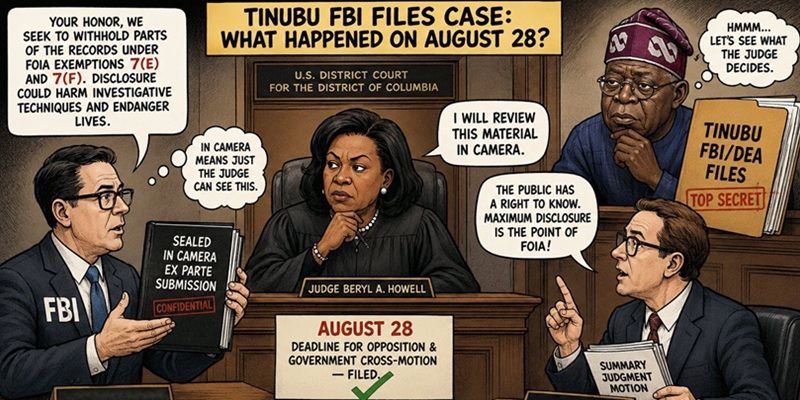

TD WASHINGTON, D.C., USA — The August 28 deadline in the long-running U.S. court battle over Federal Bureau of Investigation (FBI) and Drug Enforcement Administration (DEA) records relating to President Bola Ahmed Tinubu has passed, but it did not result in the wholesale public release of the records.
Instead, the deadline marked another significant stage in the Freedom of Information Act (FOIA) litigation before U.S. District Judge Beryl A. Howell in Washington, D.C.
The case, Greenspan v. Executive Office for U.S. Attorneys et al., No. 1:23-cv-01816, was initiated in 2023 by transparency activist Aaron Greenspan, who has been seeking records concerning Tinubu from U.S. law-enforcement agencies.
Tinubu files opposition
On August 28, Tinubu’s lawyers filed a 16-page response opposing Greenspan’s request for disclosure.
The filing argues, among other things, that releasing the records would improperly invade Tinubu’s privacy.
The court docket records the filing as a response to Greenspan’s second motion for summary judgment, with Tinubu participating in the case as an intervenor.

This distinction is important: Tinubu did not file a new lawsuit over the records.
His legal team intervened in the existing 2023 FOIA case and submitted its opposition as part of the court-ordered briefing process.
Greenspan’s requests include the FBI’s entire file concerning Tinubu and FBI Form 302 interview records relating to FBI Case No. 245-IP-71386 covering the 1992–1993 period.
Court records confirm that the FBI initially refused to confirm or deny whether such interview records existed, invoking privacy exemptions under FOIA.
FBI seeks to keep sensitive material secret
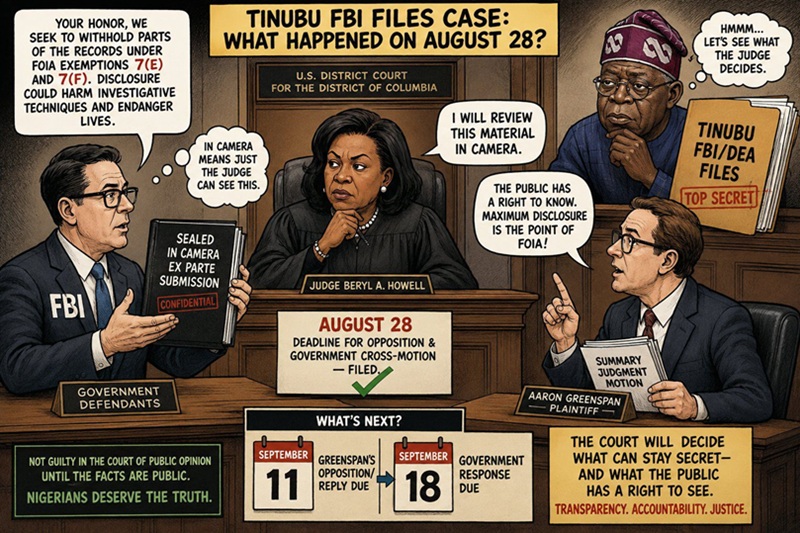
The FBI has separately asked Judge Howell for permission to submit confidential declarations ex parte and in camera — meaning the material would be provided privately to the judge rather than publicly filed.
The bureau has invoked several FOIA exemptions, including Exemptions 6, 7(C), 7(D), 7(E) and 7(F).

Of particular interest are Exemptions 7(E), concerning law-enforcement techniques and procedures, and 7(F), which protects information whose disclosure could reasonably be expected to endanger an individual’s life or physical safety.
The FBI has argued that publicly explaining the full basis for those exemptions could itself compromise the information it is seeking to protect.
That does not, by itself, establish that Tinubu was an FBI informant, that he committed a crime, or that the withheld records contain evidence of criminal conduct.
It means the FBI is asking the judge to determine privately whether its claimed exemptions are legally justified.
The $460,000 forfeiture remains part of the background
The FOIA requests also concern records associated with a 1990s investigation and a 1993 civil forfeiture involving approximately $460,000 connected to accounts in Tinubu’s name.
The publicly documented forfeiture was a civil proceeding.

Tinubu has not been shown in the public record to have been criminally convicted of drug trafficking in the United States.
Whether the unreleased FBI and DEA records contain additional information is precisely what the ongoing FOIA litigation is attempting to determine.
Why August 28 mattered
The significance of August 28, therefore, was procedural rather than a promised “document dump.”
The deadline required the parties to advance their arguments over whether the requested records should be released, withheld or redacted.
The government has also been permitted to support its position with confidential material for Judge Howell’s review.
The case has nevertheless moved substantially beyond the government’s earlier position that it could simply refuse to confirm or deny the existence of responsive records.
In 2025, Judge Howell ruled against the FBI and DEA’s blanket Glomar responses and ordered further processing of responsive records.
The central question is now increasingly whether particular portions of the records fall within legally recognized FOIA exemptions.
September deadlines loom
The litigation is expected to continue into September, with further briefing scheduled after the August 28 filings.
Greenspan is expected to respond on September 11, followed by a further government response on September 18, according to the case schedule provided in the current litigation update.
The eventual decision rests with Judge Howell.
For Nigerians following the controversy, the distinction between allegations, court filings and established facts remains critical.
The existence of FBI and DEA records concerning Tinubu’s 1990s activities is established by the FOIA litigation.
The existence of a 1993 civil forfeiture is also documented.
But the contents of the records still being withheld have not been publicly established.
Consequently, claims that the court is about to release a definitive “drug-trafficking file” — or that the records already prove criminal wrongdoing — go beyond what the public court record currently establishes.
The August 28 deadline has passed. The case, however, is far from over.
The next major question is whether Judge Howell will ultimately order the U.S. government to disclose more of the records — and, if so, exactly what those records contain.