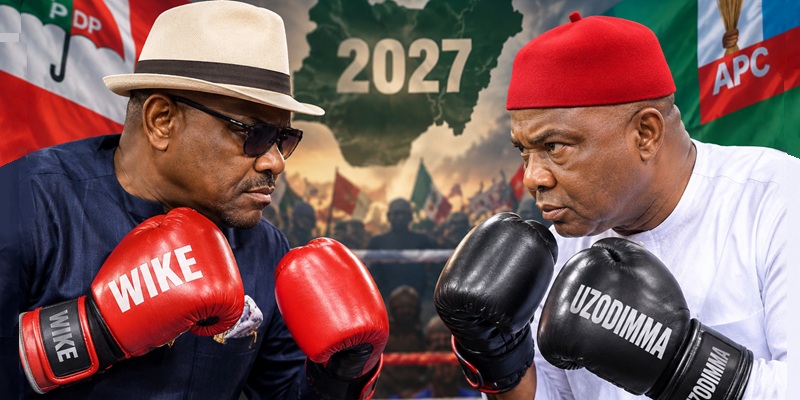
TD The Progressive Governors Forum (PGF) has drawn a sharp line in the sand ahead of the 2027 general elections, ruling out any form of support or endorsement for political coalitions outside the All Progressives Congress (APC).

The move is widely seen as a direct rebuke to the Nyesom Wike-led Rainbow Coalition, which has been gaining traction as a cross-party mobilisation platform.
Chairman of the PGF and Imo State Governor, Hope Uzodimma, announced the decision late Monday after a closed-door meeting of APC governors in Abuja.
Uzodimma stressed that the governors will not participate in any political arrangement capable of weakening President Bola Tinubu’s re-election bid.
He also condemned any arrangement that may undermine APC candidates at the governorship, National Assembly, or State Assembly levels.
“No arrangement that creates confusion, divided loyalty, or competing interests within the party will be entertained,” Uzodimma declared.
The declaration underscored the governors’ demand for total loyalty to the APC.
Despite the existence of a national campaign structure, the PGF insisted that APC governors will spearhead mobilisation efforts for Tinubu’s re-election in their respective states.
They will thus effectively position themselves as the frontline generals of the party’s 2027 campaign.
Wike Fires Back: “Politics Is Local”
Federal Capital Territory (FCT) Minister, Nyesom Wike, wasted no time in firing back at the APC governors.
He accused them of misunderstanding the purpose of the Rainbow Coalition.
“I heard some governors say the Rainbow Coalition is to reduce the votes of our President.
“Where were you when we delivered Rivers State for Tinubu in 2023 without a coalition?
“This coalition will increase Tinubu’s votes.
“If you don’t know how to do it, come and learn from us,” Wike said defiantly.
Wike clarified that his support is strictly for President Tinubu’s re-election.

However, he never promised that the Peoples Democratic Party (PDP) would refrain from fielding candidates in governorship, National Assembly, or State Assembly elections.
He argued that politics is no longer about “coming from fourth place to become governor” but about genuine mobilisation from the polling units.
He stressed that his coalition is designed to expand Tinubu’s reach across party lines.
Rainbow Coalition vs APC Governors
Wike emphasised that the Rainbow Coalition is not an APC initiative but a platform for other political parties that admire Tinubu’s leadership and wish to support his re-election.
He pointed to voting patterns in the 2023 elections.
He noted that in states like Imo, Abia, Enugu, and Ebonyi, voters supported APC candidates in senatorial elections while backing other parties in the presidential race.
“Most importantly, Rainbow Coalition has nothing to do with the APC.
“Rather, it is our way of mobilising support across political parties for Mr. President, who has done well to deserve a second term,” Wike explained.
The Battle Lines and What This Means for 2027
- APC Governors’ Position: Total loyalty to APC and Tinubu; rejection of any coalition that could dilute party strength.
- Wike’s Position: Rainbow Coalition is a cross-party mobilisation tool to boost Tinubu’s votes, while PDP and other parties remain free to contest other offices.
The clash between Wike and Uzodimma highlights a deepening fault line within the ruling party.
On one side, APC governors are determined to protect the party’s internal cohesion and prevent divided loyalties.
On the other, Wike insists that his coalition is the key to expanding Tinubu’s electoral base, even if it means empowering opposition parties in other contests.
With both camps refusing to back down, the APC faces a looming internal showdown that could shape the dynamics of the 2027 elections.
Whether Tinubu can balance these competing interests—or whether the Rainbow Coalition becomes a disruptive force within the ruling party—remains to be seen.
This escalating confrontation sets the stage for one of the most consequential political battles in Nigeria’s recent history, as loyalty, strategy, and ambition collide within the APC.