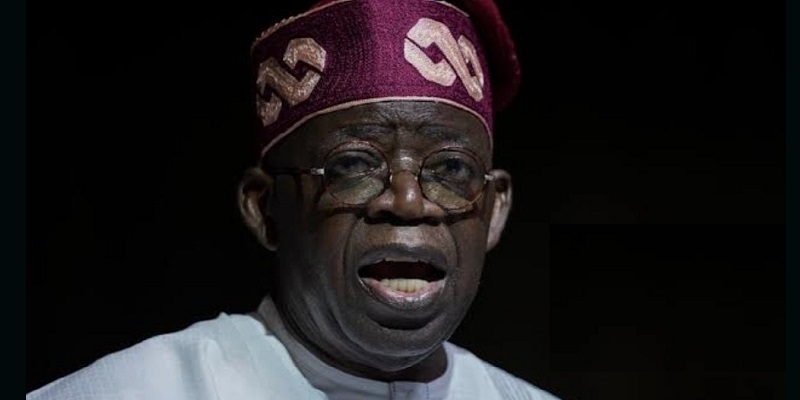
TD Lagos, Nigeria — A letter dated February 4, 2003, purportedly from the Embassy of the United States of America in Lagos, circulated by supporters of President Bola Ahmed Tinubu as evidence that he has no criminal record in the United States, has drawn the attention of Nigerian commentator Oluwakemi Oyefeso.

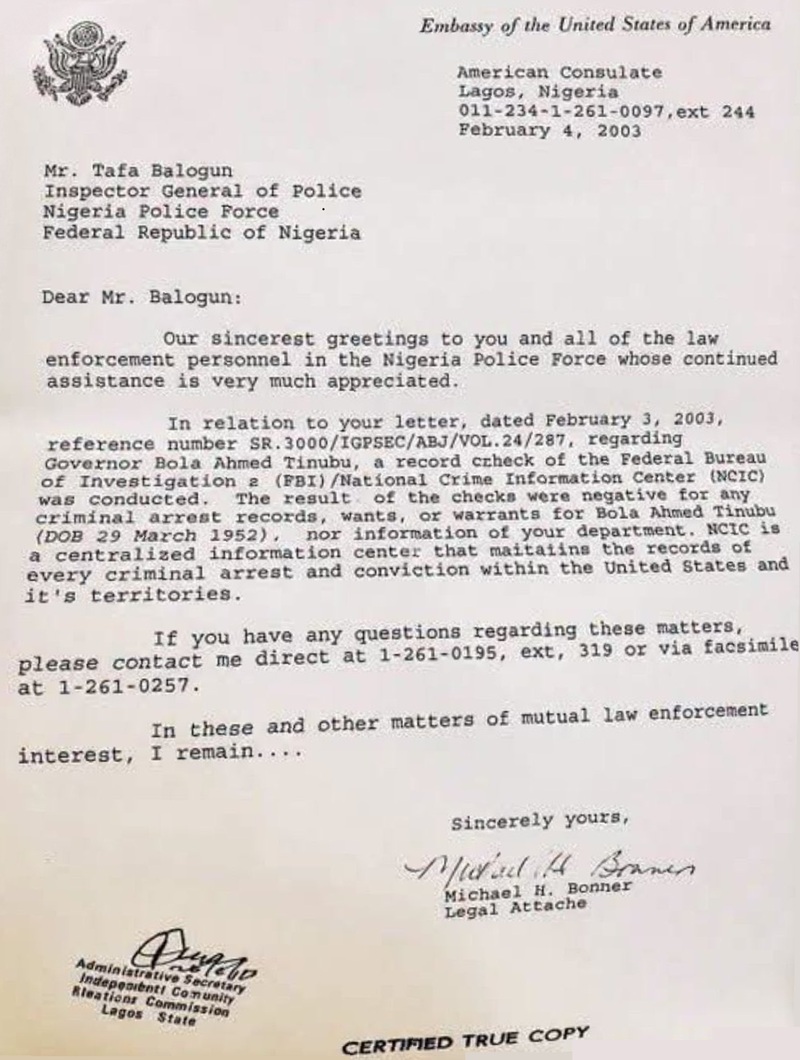
The document, signed by one “Michael H. Bonner, Legal Attaché,” claims that an FBI and NCIC check found “negative” results for any criminal arrest records, wants, or warrants for Tinubu.
But social analyst Oyefeso has raised serious doubts about the authenticity and reliability of the letter.
Oyefeso dissected its content and pointing out glaring inconsistencies that suggest it may not be genuine.
The Letter in Question
The document was addressed to then Inspector General of Police Tafa Balogun and begins with pleasantries before stating that a record check was conducted on Tinubu.
It concludes that no arrest records or warrants exist against him.
The letter bears a “CERTIFIED TRUE COPY” stamp from the Independent National Electoral Commission (INEC) in Lagos State, giving it an air of officialdom.
However, Oyefeso argues that the language and structure of the letter are inconsistent with the standards of official US government communication.
See a copy of the letter below:
Oyefeso Dissects
In her widely shared post, Oyefeso urged Nigerians to scrutinize the letter carefully before accepting it as fact.
She highlighted several unusual errors that cast doubt on its authenticity:
-
“record czheck” instead of “record check”
-
“maitaiins” instead of “maintains”
-
“it’s territories” instead of “its territories”
-
“The result of the checks were negative” — poor grammar in an official communication
-
“contact me direct” instead of “directly”
-
“nor information of your department” — an incomplete sentence
“These are unusual enough that the document should be independently verified before we accept it as genuine.
“If it is genuine, fine. If it is not, then someone has presented a fake US government document as evidence,” Oyefeso wrote.
Her analysis underscores the importance of not taking politically convenient documents at face value, especially when they contain glaring typographical and grammatical errors.
The Bigger Picture as generated by Oyefeso
Oyefeso stressed that even if the letter were authentic, it does not resolve the larger issue.
The letter only addresses arrest records, wants, or warrants — not whether Tinubu was ever investigated.
“A person can be investigated without being arrested.
“A person can be mentioned in an FBI investigation without having an arrest record.
“An FBI file can exist without the person being convicted of anything,” she explained.
This distinction is crucial because the FBI has now confirmed in US court filings that its search produced 399 pages of records concerning Tinubu.
These include material related to heroin-residue laboratory testing, controlled drug purchases, and confidential informants.
Others are grand jury activity, surveillance, undercover operations, financial seizures, and IRS criminal investigations.

Oyefeso Calls for Transparency
Oyefeso criticized the way the 2003 letter is being presented by Tinubu’s allies as “case closed.”
She argued that Nigerians deserve to see both the letter verified and the 399 pages of FBI records released to the public.
“It does not explain why the FBI now has 399 pages of investigative records connected to Tinubu.
“It does not tell us what is in those 399 pages. And it certainly does not make those 399 pages disappear,” she wrote.
Oyefeso acknowledged that Tinubu has not been convicted of drug trafficking.
However, she insisted that Nigerians have a right to know what the FBI records contain.
Her intervention reframes the debate:
“The issue is not whether Tinubu has a conviction, but whether Nigerians are being denied access to crucial information about their president’s past.
Outlook on Tinubu Versus FBI by Oyefeso
The controversy underscores the tension between political narratives and documented evidence.
On one hand, a letter — riddled with errors — is being circulated as proof of Tinubu’s clean record.
On the other, the FBI itself has admitted to holding hundreds of pages of investigative material linked to him.
Oyefeso’s intervention is a reminder that Nigerians must demand transparency, verification, and access to the records, rather than accept a single questionable document as the final word.
“Show us the documents. Verify the 2003 letter. Release whatever the law allows from the 399 pages. “Let Nigerians read them. Let Nigerians decide what they mean.” — Oluwakemi Oyefeso
This report highlights the growing demand for accountability in Nigerian politics, where contested documents and hidden records continue to fuel public mistrust.
Oyefeso’s dissection of the letter has added a sharp edge to the debate, ensuring that Nigerians will keep pressing for answers.