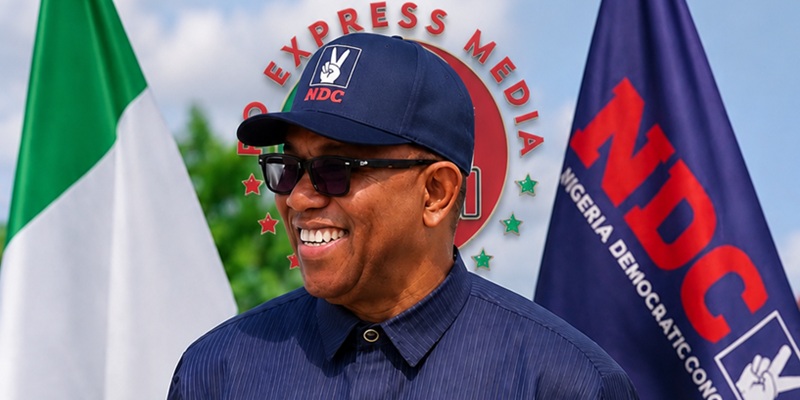
TDFact: Mr Peter Obi recently repeated his firm promise that he will serve for only one term if elected Nigeria’s president in 2027. And there have been divided opinions, especially in some parts of Northern Nigeria.
Politics in Nigeria unfortunately has earned a reputation for deception. Campaign promises are often treated as ladders to power, abandoned once authority is secured. Yet, even in politics, there still exist a few men whose integrity was not manufactured during elections but built steadily over years of public conduct.
A society cannot permanently assume that every promise will be broken simply because many have been broken before. Once citizens lose all faith in personal integrity, democracy itself gradually collapses into cynicism. We have had instances of promises kept by politicians. Late President Umaru Musa Yar’Adua made some promises and kept them.
This is why the debate on Obi’s one-term pledge deserves more honesty and less blanket suspicion.
Critics argue that the Constitution allows any president who completes a first term to seek re-election. True. But constitutions establish possibilities, not compulsory ambitions. Leadership is ultimately shaped by character.
The strongest evidence for Obi’s promise may not even lie in today’s speeches but in yesterday’s conduct.

As governor of Anambra State, Obi introduced a zoning arrangement aimed at ensuring fairness among the state’s senatorial districts. He promised power would move from Anambra Central to Anambra North after his tenure, then to Anambra South, before eventually returning to Anambra Central after sixteen years.
The resistance was fierce. “Powerful” politicians mounted enormous pressure against the arrangement. But Obi stood his ground and handed over to Willie Obiano from Anambra North, exactly as promised. Today, Anambra State practises that seamless arrangement originated by Obi.
That history matters.
Over the years, Obi has evolved with a consistency that has earned him national respect and an integrity even many critics quietly acknowledge and admire. To many Nigerians, this is a man who values his word almost as much as, if not more than, the office he seeks.
This is why dismissing his one-term pledge as mere political gimmick may itself amount to selective interpretation. If Nigerians remember broken promises by some leaders, fairness also demands remembering leaders who kept difficult promises despite political pressure.
Many sceptics understandably anchor their fears on events following the death of Umaru Musa Yar’Adua and the later decisions of Goodluck Jonathan. But justice demands avoiding the habit of transferring one politician’s perceived betrayal onto another individual without examining personal records independently.

Besides, Obi’s entire national appeal rests heavily on moral credibility and discipline. Reneging on a solemn one-term covenant after gaining office would destroy the very political identity upon which his movement stands.
Obi’s supporters even believe he would prove that modern African politics can still produce leaders willing to voluntarily relinquish power after fulfilling agreed terms, much like Nelson Mandela did in South Africa.
There is also political reality. Senator Rabiu Musa Kwankwaso, widely expected to emerge as Obi’s running mate, is not a passive political figure one manipulates easily.
Unlike the more subdued vice-presidential role played by Namadi Sambo under Jonathan, Kwankwaso possesses a powerful political base and clearly defined ambition. Any attempt to violate a solemn one-term understanding would almost certainly trigger fierce internal resistance.
Ultimately, the real question is whether Nigerians still believe integrity can exist in public life at all. If the answer is yes, then the country must also learn to recognise leaders whose conduct suggests that their words will indeed remain bankable.
This is POEM.
No propaganda! No slander! Just facts! Stay with truth.