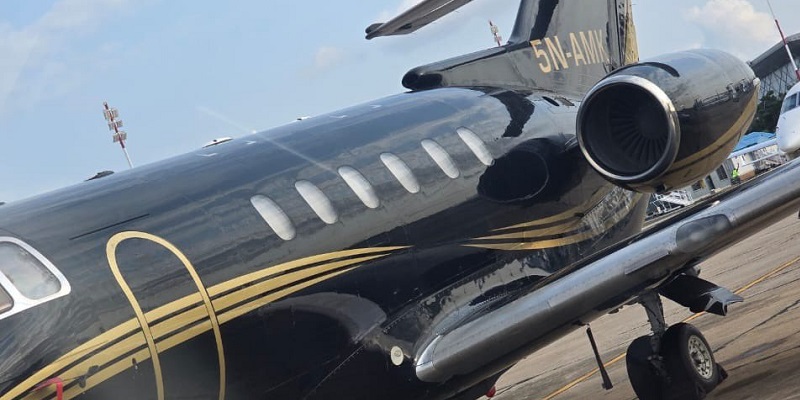
TDThe Economic and Financial Crimes Commission (EFCC) has secured a final forfeiture order against a Hawker 125 private jet linked to fraud and money laundering in the Maiduguri Emergency Power Project (MEPP).

Investigation revealed that sometime in 2021, the Nigerian National Petroleum Company Limited, NNPCL, awarded contracts under the MEPP valued at $114,148,155 (One Hundred and Fourteen Million, One Hundred Forty-Eight Thousand, One Hundred and Fifty-Five Dollars) and ₦23,172,969,904, (Twenty-Three Billion, One Hundred and Seventy-Two Million, Nine Hundred and Sixty-Nine Thousand, Nine Hundred and Four Naira).
Justice Emeka Nwite of the Federal High Court, Maitama, Abuja, on Monday ordered the forfeiture of the aircraft, with model number 800XP, serial number 258553, and registration number 5N‑AMK, to the Federal Government.
The jet was owned by Valiente Jet Limited, a company tied to Bureau De Change operator Abdulsalam Mustapha Kachallah.
Court Ruling
Delivering judgment, Justice Nwite held that Valiente Jet Limited failed to demonstrate the lawful origin of funds used to purchase the aircraft.
The judge noted that the disguised manner of acquisition, including the use of a Bureau De Change operator who denied knowledge of the transaction, reinforced the unlawfulness of the deal.
The court had earlier granted an interim forfeiture order on November 13, 2025.
It directed EFCC to publish the order in a national newspaper for interested parties to show cause.
Kachallah’s company filed affidavits to contest the forfeiture, but the EFCC’s evidence prevailed.

EFCC Investigation
According to EFCC investigator Aminu Abdullahi, intelligence revealed a conspiracy involving fraud, corruption, and money laundering tied to the MEPP.
In 2021, the Nigerian National Petroleum Company Limited (NNPCL) awarded contracts worth $114.1 million and ₦23.1 billion.
Kachallah was the then Chairman of the Borno State Rural Electrification Board and a member of the project’s steering committee.
He allegedly exploited his position to engage in illicit dealings.
Investigators found he entered unlawful agreements with China Machinery Engineering Company (CMEC), selling privileged bidding information in exchange for inducements.
CMEC was subsequently awarded three contracts valued at $52.1 million and ₦20.2 billion.
Part of the funds was routed through Afuwa Integrated Services Limited, a Bureau De Change operator falsely presented as a subcontractor.
On Kachallah’s instruction, CMEC transferred $2.07 million into Afuwa’s Stanbic IBTC account.
Forged invoices were then prepared to portray legitimate services.
The funds were later wired to a Brazilian account to purchase the aircraft from a Brazilian company.
Legal Arguments
The matter was argued on April 30, 2026, with EFCC represented by Iheanacho Ekele, SAN, and O.S. Ujam.
The prosecutors maintained that Kachallah’s actions violated Sections 8, 10, and 53 of the ICPC Act as well as provisions of the Money Laundering (Prohibition) Act.
They emphasized that Kachallah, as a public officer appointed by the Borno State Government, abused his position to facilitate illicit transactions.
Kachallah’s counsel, M.E. Oru, SAN, argued that his client was distinct from the companies involved.
Oru challenged the admissibility of some exhibits attached to EFCC’s affidavit.
EFCC’s lawyers rebutted and cited judicial precedents such as Oyebanji vs State.
The case allow courts to lift the veil of incorporation in fraud cases to expose individuals behind corporate entities. They also referenced Aondoakaa vs Obot & Anor and Musa vs Jika to affirm that documents attached to affidavits need not be further certified.
Court’s Decision
In a well‑considered judgment, Justice Nwite ruled that the EFCC had provided sufficient evidence of fraud and illegality. He held that Kachallah failed to demonstrate the lawful origin of funds used to purchase the aircraft and that the disguised transactions through Afuwa Integrated Services further confirmed the unlawful nature of the deal.
Accordingly, the court granted the final forfeiture of the Hawker 125 private jet (Model 800XP, Serial No. 258553, Registration 5N‑AMK) to the Federal Government of Nigeria.
Significance
The ruling underscores Nigeria’s determination to recover assets acquired through corruption and sends a strong message to public officials and private actors engaged in fraudulent schemes. The EFCC described the judgment as a milestone in its fight against economic crimes, particularly in projects of national importance such as the MEPP.
Significance
The EFCC hailed the ruling as a major victory in its fight against corruption.
It stressed that the forfeiture underscores Nigeria’s commitment to holding public officials accountable for abuse of office.
The case highlights how fraudulent schemes tied to strategic projects can be dismantled through coordinated investigation and judicial oversight.
Such oversight ensures that proceeds of crime are recovered for the state.