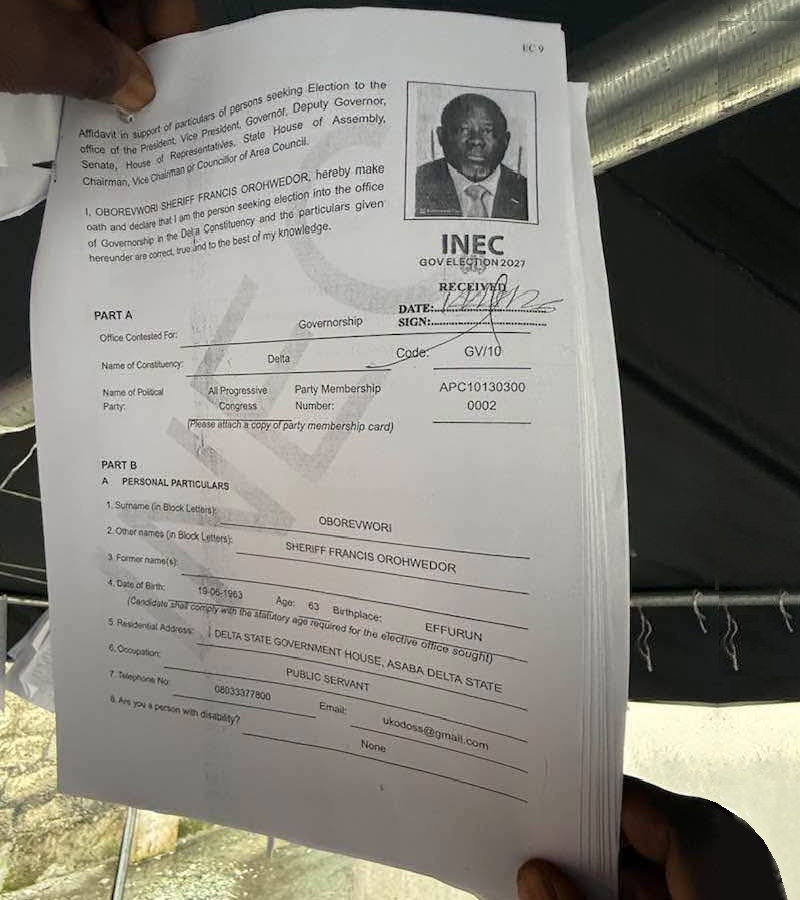
TD The Independent National Electoral Commission (INEC) has published nomination forms for candidates contesting the 2027 general elections, including those of Delta State Governor Sheriff Oborevwori.

The publication has sparked renewed debate over the documentation of educational qualifications.
Alongside President Bola Ahmed Tinubu’s EC9 form, which omitted primary and secondary school credentials, photographs of Governor Oborevwori’s filing have ignited similar scrutiny.
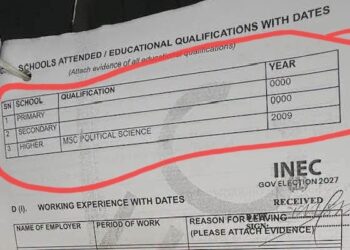
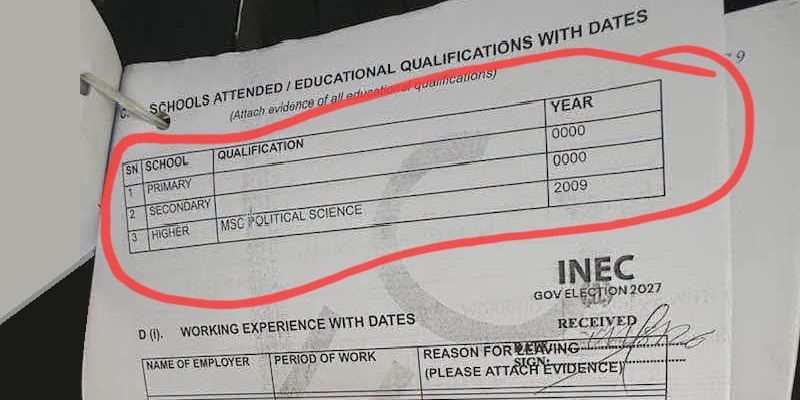
Oborevwori’s INEC Form EC9, submitted for the Delta governorship race, lists only a Master’s Degree in Political Science (2009) under the section for educational qualifications.
The spaces for primary and secondary schools are marked “0000,” with no supporting certificates attached.
The absence of a First School Leaving Certificate, West African Examination Council (WAEC) certificate, or Bachelor’s degree documentation has fueled public criticism and comparisons to Tinubu’s filing.
Candidate Background for Oborevwori
Despite the omissions in the INEC form, Oborevwori’s official biographies and public records confirm a fuller academic history.
He attended Alegbo Primary School and Oghareki Grammar School.
He earned a B.Sc. in Political Science from Ambrose Alli University in 2004 and completed an M.Sc. in Political Science at Delta State University in 2010.
He has also undertaken executive programs at the London School of Economics (LSE) and Manchester Business School.
Critics argue that the governor’s INEC filing fails to reflect this broader record, raising questions about why foundational qualifications were left blank.
Supporters counter that the omission may be clerical or procedural, noting that the constitutional requirement is only a school certificate or its equivalent.
INEC Requirements and Constitutional Standards
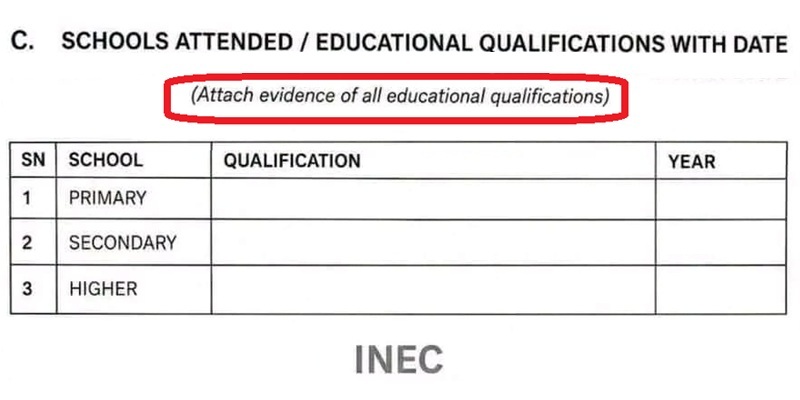
The INEC EC9 Nomination Form explicitly instructs candidates to “attach evidence of ALL educational qualifications.”
This stipulation has become the focal point of debate. Legal experts and civil society groups contend that leaving sections blank undermines compliance with electoral rules and transparency.
Nigeria’s Constitution, however, sets a modest bar: candidates must show at least a school certificate level or equivalent.
This means that advanced degrees, such as Oborevwori’s MSc, technically satisfy the requirement. The tension lies between legal sufficiency and public expectation of fuller disclosure.
Tinubu’s Filing as Context
The controversy around Oborevwori’s form mirrors that surrounding President Tinubu’s EC9 submission. Tinubu listed only a B.Sc. in Business Administration from Chicago State University (1979), leaving primary and secondary school sections blank. He attached his university degree and National Youth Service Corps (NYSC) certificate, but critics argue that the omissions reignite longstanding disputes over his educational background.
Observers note that both filings highlight a recurring issue in Nigerian politics: the gap between constitutional minimums and the public’s demand for transparency in leaders’ credentials.
Public Reaction to Submission by Oborevwori
The publication of these forms has triggered heated discussions across social media and political forums. Commentators describe the omissions as symptomatic of a governance culture that tolerates incomplete documentation. Others dismiss the uproar as politically motivated, emphasizing that both Tinubu and Oborevwori have verifiable higher education credentials.
For many Nigerians, however, the optics of leaving foundational qualifications blank reinforce concerns about credibility. “It’s not just about the degree,” one analyst remarked. “It’s about whether leaders are willing to be fully transparent with the public.”
Legal and Political Implications
Analysts suggest that if challenged, the matter could end up in court, where interpretations of INEC’s requirement for “ALL educational qualifications” would be tested against constitutional provisions.
Opposition parties may seize on the omissions to question the transparency and credibility of both Tinubu and Oborevwori as they seek reelection in 2027.
The controversies also risk becoming campaign issues, adding to the series of identity and credential disputes that have trailed Nigerian politics for decades.
Oborevwori: Bottom Line
Governor Oborevwori’s INEC form, showing only an MSc while leaving earlier qualifications blank, has drawn sharp comparisons to President Tinubu’s filing.
Both cases underscore the tension between constitutional sufficiency and public demand for accountability.
Whether these omissions constitute legal breaches or procedural gaps remains uncertain.
What is clear is that the controversies highlight the heightened scrutiny facing Nigerian leaders as they prepare for the 2027 elections — and the enduring debate over the role of education, transparency, and credibility in governance.