TDIme Obi Anambra Series — The arrival of British colonialists in Southeast Nigeria marked a profound turning point in how the Igbo people recorded their history and laws using Nsibidi.
Before the introduction of the Western alphabet, the region possessed a sophisticated and functioning system of documentation that the British did not recognize as writing.
To the colonial mind, documentation required paper, pens, and a phonetic alphabet.
Because the Igbo system relied on symbols, artefacts, and sacred societies, it was dismissed as primitive or superstitious.
This cultural blind spot led to a systematic disruption where indigenous ways of keeping records were replaced by a foreign bureaucracy, nearly erasing centuries of specialized knowledge.
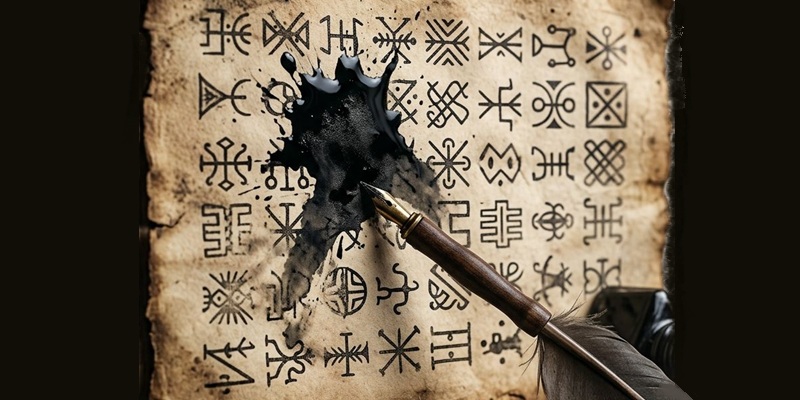
This disrupted system was centred around Nsibidi, an ancient script of pictograms and ideograms.

Unlike the English alphabet, where letters represent sounds, Nsibidi symbols represent ideas, objects, or actions.

Nsibidi
Nsibidi was a graphic literacy that allowed people from different areas to communicate through a shared visual language.
A simple drawing could signify a court case, a marriage, or a warning.
Much of this knowledge was safeguarded by elite traditional groups like the Ekpe and Okonko societies, who used the symbols to document laws and social contracts.
When the British suppressed these societies to establish their own administrative control, they effectively closed the libraries of the Igbo people.
A fascinating example of this graphic communication that endured into recent memory is the use of botanical calling cards.

If a person visited a friend or relative and found they were not at home, they would not simply leave; they would pluck a specific leaf or flower and tuck it into the thatch or the frame of the door.
To the homeowner returning later, this was not a random piece of nature.
Depending on the type of leaf used, its position, or how it was folded, the homeowner could read exactly who had visited and sometimes even the urgency of their message.
Nsibidi was a silent, effective form of documentation that required no ink or paper, yet it communicated a clear social record.
The Igbo Script
Beyond these everyday signs, the Igbo used physical objects as living documents to ensure accountability and truth.
The Ofo staff, for instance, was not just a symbol of power; it was a legal archive that connected the living to the moral authority of the ancestors.

Similarly, the Mbari houses and Uli body art were visual records of a community’s history, values, and spiritual status.
These were not merely decorations but were intentional ways of preserving information for future generations.
However, because many of these records were kept on organic materials like wood, clay, or skin, or were tied to “pagan” shrines, they were often destroyed by missionaries or lost to the humid climate during the colonial era.
Today, the idea that Igbo civilization missed out on a writing era is being challenged by a movement to reclaim these lost scripts.
Reviving this mode of documentation does not mean discarding modern English but rather integrating ancient wisdom into the digital age.
By digitizing Nsibidi into modern fonts, using Uli patterns in architecture, and teaching these symbols in schools, modern Igbo society can restore its unique visual identity.
This revival would turn what was once secret knowledge into a public source of pride, proving that the civilization never lacked a way to document its journey; it simply had its pen taken away for a season.