



TD Every nation has its weaknesses. Nigeria has three, and they are not weaknesses of geography or resources or even colonial inheritance.
They are diseases of the soul, contracted at independence and never treated, and after sixty-six years they have done what all untreated diseases do: they have found their perfect host.
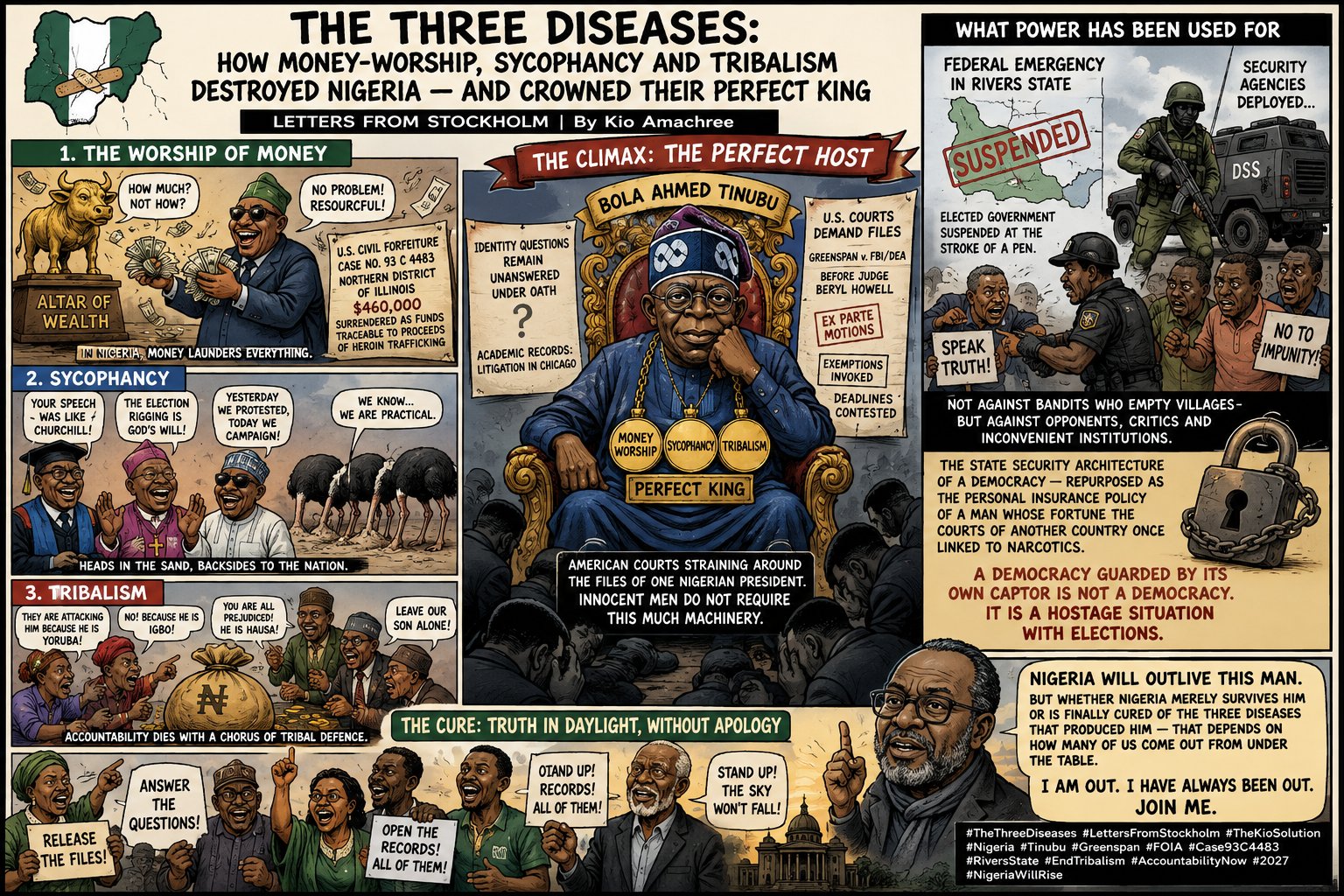
The First Disease: The Worship of Money
Nigerians do not merely love money. Many societies love money. Nigerians worship it — they have built altars to it, composed hymns to it, and organised their entire moral universe around it.
In Nigeria, the question is never “how did you make it?” The question is only “how much?”
A man can steal a state blind, and the same congregation that prayed for his arrest will spray naira at his daughter’s wedding.
Wealth launders everything. Wealth is its own testimony, its own character witness, its own acquittal.

This is why a man could arrive in Nigerian public life trailing a United States civil forfeiture — Case No. 93 C 4483, Northern District of Illinois, in which $460,000 was surrendered to the American government as funds the court found traceable to the proceeds of heroin trafficking — and rise, unimpeded, to the governorship of Lagos and then to the presidency of Africa’s largest nation.
In any serious country, that court record alone ends a career. In Nigeria, it was treated as proof of resourcefulness.
The money was there. Nobody asked the only question that matters in a civilised society: where did it come from?
The Second Disease: Sycophancy
If money-worship built the throne, sycophancy carries the king upon it. Nigeria has perfected the art of the praise-singer in agbada — the professor who compares a semi-literate speech to Churchill, the bishop who declares an election rigging “God’s will,” the union firebrand of yesterday who becomes the courtier of today, mobilising for a 2027 campaign he would have burned effigies against in his youth.
And then there are the ostriches.
The senators, the governors, the captains of industry, the “elder statesmen” — the little creatures who, at the first rumble of power, bury their heads and present their backsides to the nation.

They know. They all know. They have read the court documents. They whisper about them at dinner parties in Ikoyi and Abuja.
But in public? Silence. Under the table. Heads in the sand. They call it “pragmatism.”
History will call it what it is: cowardice in the service of a payslip.
I refuse to join them.
If the price of speaking plainly about a man’s documented record is fear, then the price is too low to matter.
My father served Nigeria when service meant something — first Solicitor-General, a builder of institutions.

I will not dishonour that inheritance by hiding under furniture.
The Third Disease: Tribalism
Tribalism is the disease that makes the first two incurable.
It is the escape hatch every thief runs to when the evidence closes in:
“They are only attacking me because I am Yoruba. Because I am Igbo. Because I am Hausa. Because I am from the South-South.”
And millions who should know better fall in line, defending their tribesman’s loot as though it were tribal patrimony, when in truth the looter’s only tribe is money and his only kinsmen are those who help him keep it.
Tribalism is how accountability dies in Nigeria. Not with a gavel, but with a chorus of “leave our son alone.”
The Climax: The Perfect Host
And so we arrive at Bola Ahmed Tinubu — the figure in whom all three diseases achieve their final, florid, terminal form.
Here is a president about whose very identity the most basic questions remain unanswered under oath.
A man whose academic records became the subject of litigation in Chicago, whose sworn statements about his own history have shifted, whose origins remain, to this day, a matter his defenders wave away rather than resolve.
Nigerians do not actually know, with documentary certainty, who governs them. Think about that. Sixty-six years after independence, we cannot produce a settled biography of our own head of state.
And when American courts — in Greenspan v. FBI/DEA, before Judge Beryl Howell in Washington — ordered federal agencies to confront their files on this man, what did we witness?
-
Ex parte motions.
-
Invoked exemptions.
-
Deadlines contested.
-
The machinery of two governments straining around records concerning one Nigerian president’s past.
Innocent men do not require this much machinery.
Worse still is what he has done with power at home.
A federal emergency imposed on Rivers State — my region, my people — with elected government suspended at the stroke of a pen.
Security agencies deployed not against bandits who empty villages, but against opponents, critics, and inconvenient institutions.
This is the ultimate obscenity: the state security architecture of a democracy — built to protect citizens — repurposed as the personal insurance policy of a man whose fortune the courts of another country once linked to narcotics.
A democracy guarded by its own captor is not a democracy. It is a hostage situation with elections.
The Cure
The cure for the three diseases is not complicated. It is the one thing Nigeria has never tried: truth, spoken in daylight, without apology.
Release the files. Answer the questions. Open the records — American and Nigerian alike.
Let the ostriches lift their heads and discover that the sky does not fall on those who stand up; it falls, eventually and always, on those who kneel.
Abacha seemed eternal too. Until one morning, he wasn’t.
Nigeria will outlive this man, as it has outlived every strongman who mistook the nation’s sickness for his own strength.
But whether Nigeria merely survives him or is finally cured of the three diseases that produced him — that depends on how many of us come out from under the table.
I am out. I have always been out. Join me.
Kio Amachree writes from Stockholm. This article constitutes fair comment on matters of urgent public interest, grounded in public court records, and is published under the press freedom protections of the Kingdom of Sweden.