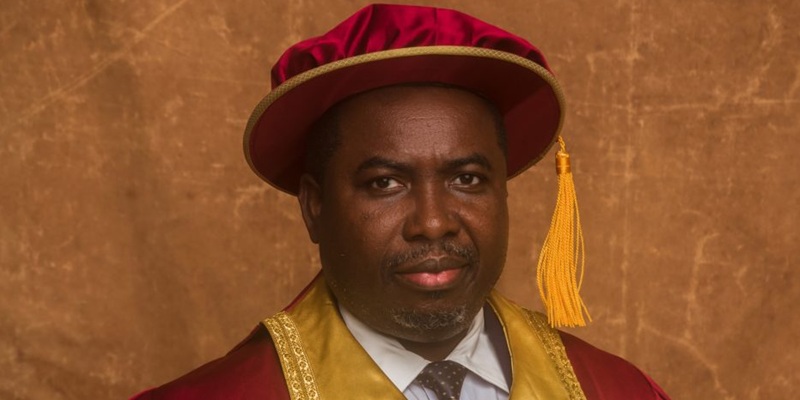

The African Democratic Congress (ADC) has reignited controversy surrounding the Chairman of Nigeria’s Independent National Electoral Commission (INEC), Professor Joash Ojo Amupitan.
The party alleged that fresh evidence links him to partisan activities and membership of the ruling All Progressives Congress (APC).
It claimed that Amupitan misled Nigerians when he denied operating an account on the social media platform X.
It also insisted that forensic findings now contradict his public statements.
The Allegations
In a strongly worded statement, the ADC accused Amupitan of dishonesty and partisanship:
- The party’s “young media forensic experts” reportedly uncovered that the phone number and email used to create Amupitan’s controversial X account—now renamed @Sundayvibe00—match those listed on his official résumé.

- This discovery, the ADC argues, undermines Amupitan’s earlier press statement in which he categorically denied ever opening an X account.
- The party described the denial as “AI‑written” and “false”.
It claimed the evidence proves Amupitan is a “dyed‑in‑the‑wool supporter of BAT” (President Bola Ahmed Tinubu) and possibly a “closet partisan member of the APC.”

The X Account Controversy
The controversy began when screenshots of posts allegedly linked to Amupitan surfaced online. Critics accused him of expressing partisan views inconsistent with the neutrality expected of Nigeria’s electoral umpire.
- Amupitan responded with a press statement denying ownership of any X account.
See a screenshot of Grok’s response to an inquiry about Amupitan denying ownership of any “X” (Twitter) account:
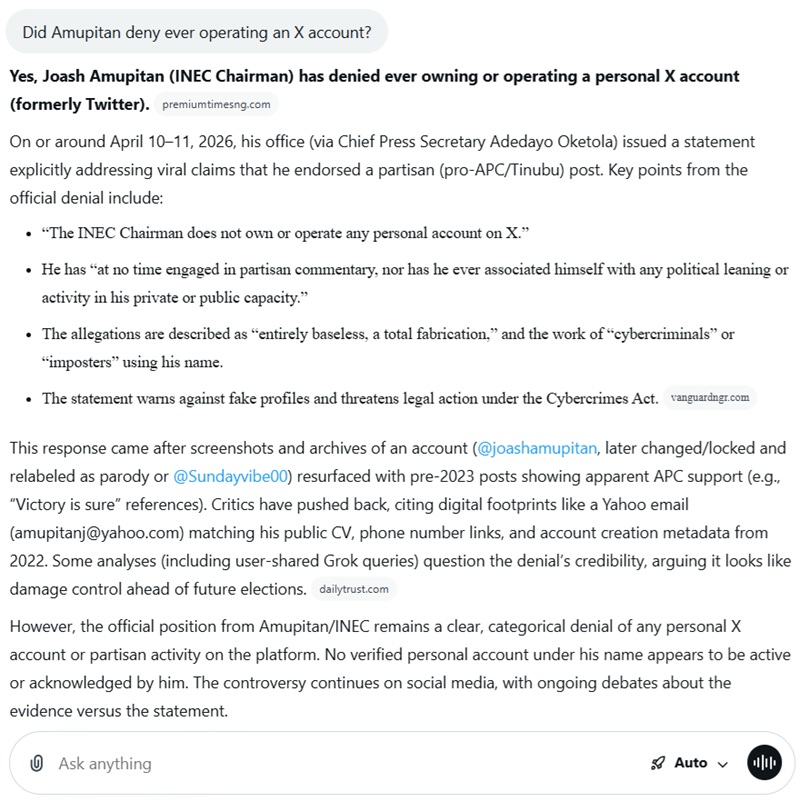
- The ADC now insists that its forensic probe has exposed the denial as a lie, citing “unimpeachable revelations” tying the account to his official contact details.
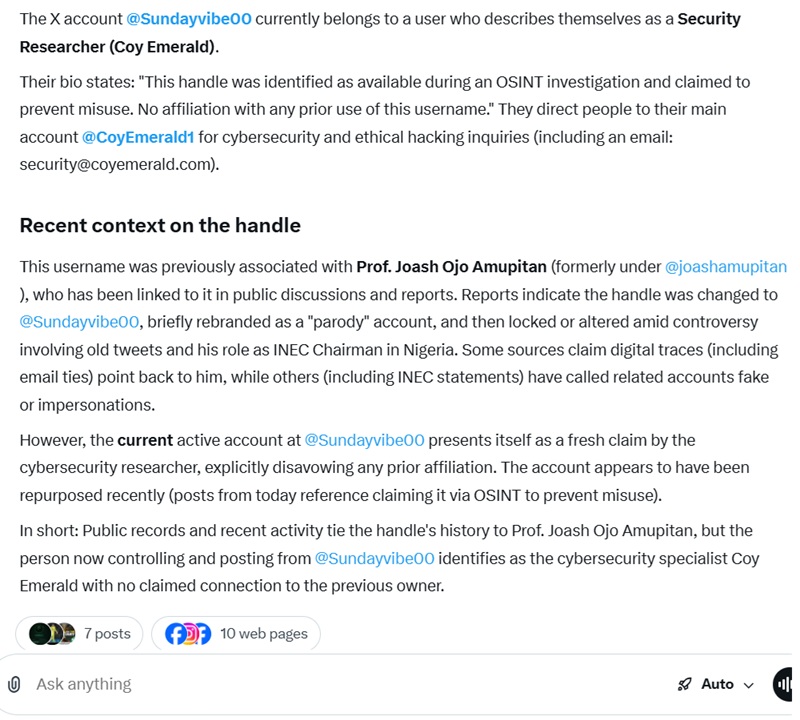
- The account has since been locked into privacy, further fueling suspicions.

See another screenshot of Grok’s response to an inquiry about the owner of the account “@Sundayvibe00″:
Public Reaction
The revelations have triggered widespread outrage among Nigerians both at home and abroad:
- Social media users have amplified the hashtag #AmupitanGate, demanding accountability.
- Civil society groups warn that the credibility of INEC is at stake, especially as the nation prepares for the 2027 general elections.
- Diaspora communities have joined calls for Amupitan’s resignation, arguing that electoral integrity cannot be entrusted to someone accused of partisanship.
One commentator described the situation as “a preventable scandal that risks undermining public confidence in Nigeria’s democracy.”
ADC’s Position
The ADC has vowed to escalate the matter to international media and political platforms if Amupitan does not resign.
“Millions of Nigerians at home and in the Diaspora are vehemently calling on Professor Amupitan to honorably resign as INEC chairman, or we are going to escalate this #AmupitanGate scandal to the international media and political frontiers,” the party stated.
The ADC insists that the revelations are not only about Amupitan’s personal credibility but also about the sanctity of Nigeria’s electoral process.
Implications for INEC
The allegations strike at the heart of INEC’s constitutional role as a neutral arbiter in Nigeria’s elections. If proven true, they could:
- Deepen mistrust in the Commission’s ability to conduct free and fair elections.
- Fuel opposition claims of institutional bias in favor of the ruling APC.
- Trigger calls for reforms to strengthen oversight of electoral officials.
Analysts note that the controversy comes at a sensitive time, with political parties already mobilizing ahead of the 2027 polls.
Outlook
The ADC’s allegations against Professor Joash Ojo Amupitan mark a new chapter in Nigeria’s ongoing debate over electoral integrity.
While Amupitan has denied operating an X account, the party’s forensic claims—linking the account to his official contact details—have intensified public scrutiny.
As Nigerians await an official response from INEC, the scandal underscores the fragile trust between citizens and electoral institutions.
Whether Amupitan resigns or fights to clear his name, the controversy is certain to shape discourse around Nigeria’s democratic future.