
ABUJA/BRUSSELS — The European Union (EU) has approved a €20 million defence assistance package for Nigeria’s Armed Forces, providing non-lethal military equipment designed to strengthen the country’s capacity to counter improvised explosive devices, hostile drones and other security threats.
The Council of the European Union adopted the assistance measure on October 19, 2026, under the European Peace Facility (EPF).
The Council described it as the first bilateral assistance measure for Nigeria under the facility.
According to the Council, the package will cover four key areas:
- counter-improvised explosive device (C-IED) equipment and training,
- counter-unmanned aircraft system (C-UAS) equipment and training,
- night-vision goggles, and,
- individual protective equipment.
The assistance is intended to improve the safety of Nigerian troops deployed within the country and strengthen their capacity to respond to armed groups, bandits and other security threats.
The Council stressed that the equipment to be financed under the measure is not designed to deliver lethal force.

First bilateral EPF Defence assistance for Nigeria
Nigeria has previously benefited from European Peace Facility support through the Multinational Joint Task Force (MNJTF) operating in the Lake Chad Basin.
However, the new €20 million allocation represents the first dedicated bilateral assistance measure for the country under the facility.
The distinction is significant: the new measure directly supports the Armed Forces of Nigeria, rather than providing assistance solely through the regional multinational framework.
The Council said the measure is part of efforts to deepen security and defence cooperation between Nigeria and the European Union.
It also aligns with priorities discussed during the first EU–Nigeria Peace, Security and Defence Dialogue held in Brussels on February 18, 2026, and the eighth Nigeria–EU Ministerial Dialogue held in Abuja on March 23.
What the €20 million Defence package will provide
The approved defence assistance covers four capability areas:

- Counter-improvised explosive devices: Equipment and training to help Nigerian forces detect, counter and respond to improvised explosive devices, which are used in attacks against military personnel and civilians.
- Counter-drone capabilities: Equipment and training to strengthen the military’s ability to respond to threats involving unmanned aircraft systems.
- Night vision: Night-vision goggles intended to improve troops’ ability to operate and maintain situational awareness in low-light conditions.
- Individual protection: Protective equipment intended to improve the safety of military personnel deployed on security operations.
The Council said the assistance is intended to reinforce the Armed Forces’ capacity to protect Nigeria’s national territory and improve security conditions for the civilian population.
Implementation and delivery
The Council’s October 19 announcement confirms that the €20 million measure has been adopted.
However, it does not provide a detailed procurement schedule, identify equipment suppliers, specify quantities or confirm that the equipment has already been delivered to Nigeria.
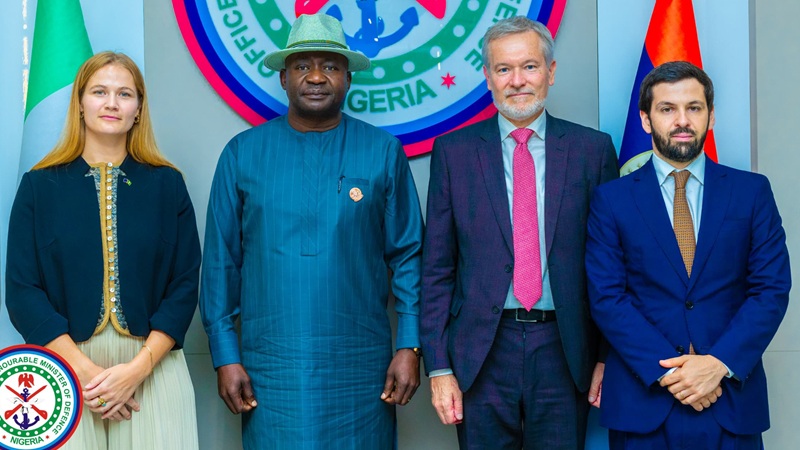
Earlier, Nigeria’s Minister of Defence, General Christopher Musa (retd.), said an EU technical delegation was expected to visit Abuja in November to discuss arrangements for delivering the assistance.
The information was contained in a statement issued by the minister’s aide, Leah Katung-Babatunde.
It follows a meeting between Musa and the EU Ambassador to Nigeria and ECOWAS, Gautier Mignot, in Abuja on October 17.

The minister reportedly identified kidnapping along major highways and attacks on isolated communities as continuing security challenges.
The planned technical discussions are expected to address implementation arrangements.
However, a confirmed equipment delivery timetable has not been published in the Council’s announcement.
Part of broader EU–Nigeria security cooperation
The new assistance measure builds on a wider security partnership between Nigeria and the European Union.
According to the European External Action Service (EEAS), EU peace, security and defence cooperation with Nigeria amounted to more than €700 million between 2015 and 2025.
The EU also reported providing an additional €500 million in humanitarian assistance over the period.
The EU remains a major contributor to the Multinational Joint Task Force, which works with countries in the Lake Chad Basin to address regional security threats.
The first EU–Nigeria Peace, Security and Defence Dialogue in February 2026 provided a platform for discussions on counterterrorism, maritime security, cyber and hybrid threats, organised crime and regional stability.
The European Peace Facility, established in March 2021, is an EU financing instrument designed to support external security and defence initiatives.
The initiatives include measures to strengthen the military and defence capabilities of partner countries.
The €20 million Nigeria measure has a 36-month implementation duration under the Council decision.
What the approval means
The approval provides Nigeria’s Armed Forces with a new European-backed assistance framework focused on troop protection, counter-IED operations, counter-drone capabilities and night-time operational visibility.
However, the approval should not be confused with confirmation that the equipment has arrived or been deployed.
The quantities, suppliers, recipient units and detailed delivery schedule have not been specified in the Council’s public announcement.
The effectiveness of the package will ultimately depend on its implementation, the suitability of the equipment supplied and the ability of Nigerian forces to integrate the new capabilities into their operations.
This Dawn News will continue to monitor developments concerning the implementation and delivery of the European Union’s €20 million assistance package.
Editorial accuracy note:
The €20 million has been formally approved; it should not be described as equipment already delivered.
The Council has not publicly specified quantities, suppliers, recipient units or a delivery date.
The November technical visit is based on the Nigerian Defence Minister’s earlier statement, not a delivery date confirmed by the Council.