TD Moscow/Kyiv — Ukrainian forces reportedly struck a Russian S-400 air-defence position near Gelendzhik on Russia’s Black Sea coast, according to Ukrainian military officials and subsequent satellite-imagery analysis.
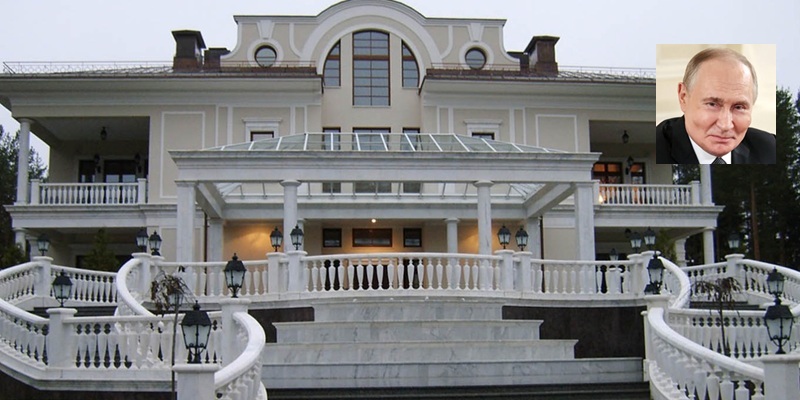
The strike has since become the subject of viral social-media posts claiming that Ukraine has “destroyed Putin’s Palace shield”.
It also claimed that the attack left the Russian president Vladimir Putin’s Black Sea residence completely unprotected.
Available evidence confirms the destruction of Russian air-defence equipment in the area.
However, it does not establish that the residence itself was struck or that its entire protective network has collapsed.
S-400 position struck near Gelendzhik
On August 9, 2026, Robert “Madyar” Brovdi, commander of Ukraine’s Unmanned Systems Forces, made an announcement.

Brovdi reported that Ukrainian drones had struck an S-400 Triumf air-defence position near Gelendzhik in Russia’s Krasnodar Krai.
Brovdi said the system had launched six missiles toward Ukraine the previous day, between 9:25 a.m. and 12:51 p.m., before being targeted by Ukrainian drones.
He said the S-400 position burned for about three hours after the attack.
Ukrainian reporting identified the location as being near the site popularly known as “Putin’s Palace.”
The strike was not an isolated attack on Russian air defences.
According to the Ukrainian Unmanned Systems Forces, Ukrainian units also struck a Tor air-defence system near Pudovoy in Rostov Oblast.

They also struck a Pantsir-S1 system near Yeysk in Krasnodar Krai, and Podlet-K1 and Kasta 2E2 radar stations in Rostov Oblast during the same operation.
Satellite imagery provides additional evidence
The August 9 assessment by the Institute for the Study of War (ISW) said satellite imagery showed the aftermath of a Ukrainian strike on an S-400 launcher in Gelendzhik.
ISW subsequently reported that imagery captured on August 9 showed damage consistent with the destruction of four S-400 launchers at the site.
The Critical Threats Project, meanwhile, reported that satellite imagery collected around the same period was emphatic.
It showed damage to a Russian Volna Kupol Garnat electronic-warfare system in Gelendzhik.
The system was assessed as likely belonging to an FSB border unit and is designed to interfere with satellite communications.

This provides stronger evidence for damage to Russian military infrastructure around Gelendzhik than the viral videos alone.
Other S-400 systems have also been targeted
Ukraine’s campaign against Russian air-defence assets has extended beyond Gelendzhik.
On July 27, Ukraine’s Defence Intelligence Directorate said its forces destroyed an S-400 launcher and a 96L6 radar station in Russian-occupied Crimea.
The Ukrainian agency released footage purporting to show the attack.
ISW reported that it also documented Ukraine’s broader campaign against Russian air-defence infrastructure.
It described it as a long-range suppression and destruction campaign targeting systems such as the S-400, Pantsir and Tor.
These strikes are significant because an S-400 battery is not simply a collection of missile launchers.
It depends on associated radar, command-and-control and other components to detect, track and engage targets.
Consequently, destroying launchers or radar equipment can reduce the capability of an individual air-defence position.
However, it does not automatically mean that an entire regional air-defence network has ceased functioning.
What about “Putin’s Palace”?
The residence commonly called “Putin’s Palace” is located on the Black Sea coast near Gelendzhik.
It has been widely associated with Russian President Vladimir Putin following investigations into the property.
The August 9 strike was reported as occurring near the residence, not against the residence itself.
The Moscow Times, Deutsche Welle and other outlets reported that the targeted S-400 position was located in the Gelendzhik area close to the property.
That distinction is important.
There is no verified evidence in the sources reviewed that the palace building itself was hit.
Nor does the destruction of one S-400 position demonstrate that all air-defence, electronic-warfare, physical-security or other protective measures surrounding the property have been eliminated.
Some media reports have nevertheless used expressions such as “Putin’s Palace is without defence” or described the residence as having been “left unprotected.”
Those formulations go beyond what the available evidence conclusively establishes.
Viral videos require caution
Social-media posts frequently combine genuine footage of explosions, Ukrainian drone strikes and Russian military equipment with much stronger claims about what the footage supposedly proves.
That appears to be happening with the current “Putin’s Palace shield collapsed” narrative.
There is credible evidence that Ukrainian forces struck Russian air-defence assets near Gelendzhik.
There is also satellite imagery supporting damage to S-400 equipment in the area.
But those facts do not establish that:
- Putin’s Palace itself was struck;
- the residence was destroyed or damaged;
- the entire air-defence network protecting the residence was eliminated;
- the property was left completely “unprotected”; or
- Putin was present at the residence when the strike occurred.
Previous viral claims involving alleged attacks on Putin-linked residences have also included misleading or fabricated material.
For example, a 2026 fact-check found that CCTV footage circulated as an alleged attack on a Putin residence was likely AI-generated after inconsistencies in the footage were examined.
What is established?
Supported by available evidence:
- Ukrainian forces reported striking an S-400 position near Gelendzhik on August 9.
- Ukrainian forces reported additional strikes against Russian Tor, Pantsir-S1 and radar systems.
- Satellite imagery independently assessed by ISW showed destruction of S-400 launchers at the Gelendzhik site.
- Ukrainian forces have separately destroyed or damaged S-400 components in occupied Crimea.
- Russian air-defence infrastructure has therefore been a significant target of Ukraine’s long-range strike campaign.
Not established by the available evidence:
- That “Putin’s Palace” itself was struck.
- That the entire defensive shield surrounding the residence has collapsed.
- That the residence is completely undefended.
- That Vladimir Putin was at the property during the strike.
Conclusion
The underlying military event is real: Ukraine did strike Russian air-defence infrastructure near Gelendzhik.
Targets include an S-400 position, and satellite imagery provides additional evidence of damage to the system.
However, the viral claim that “Putin’s Palace Shield Has Collapsed” is a substantially broader assertion than the available evidence supports.
The most accurate description is that Ukraine damaged a Russian S-400 air-defence position near the Black Sea residence popularly known as Putin’s Palace, weakening one component of the area’s military protection.
There is no verified evidence that the palace itself was hit or that the entire protective network has collapsed.