
 Rivers State was created because different peoples understood the danger of being dominated. Its tragedy today is that politicians can still persuade those same peoples to turn against one another while power is negotiated over their heads.
An argument over political control becomes an argument about ancestry. A dispute between a governor and his predecessor becomes a confrontation between communities. People who share the same neglected roads, struggling schools and uncertain livelihoods are encouraged to treat their neighbours as the enemy.
Meanwhile, the men competing for power retain their connections, their protection and their access to Abuja.
We should know better. Our history gives us every reason to know better.
On 27 May 1967, General Yakubu Gowon’s government created Rivers State from the former Eastern Region. Its original territory included what became Bayelsa State in 1996.
That achievement followed years of agitation, organisation and negotiation by people seeking greater control over their collective future. It was neither the invention nor the inheritance of any present-day political godfather.

The movement was never as simple as the sentimental version sometimes presented at anniversary celebrations. Its participants disagreed. Their interests did not always coincide. But enough of them understood that separate grievances required a common political response.
A historical account published by The Tide records the broad representation behind the Rivers Leaders of Thought memorandum: S. N. Dikibo as chairman, E. N. Kobani representing Ogoni Division, I. J. M. Fiberesima representing Degema, R. P. G. Okara representing Brass, G. B. C. Otoka representing Opobo, and N. Nwonodi representing Ahoada and Port Harcourt divisions.
Their geographical breadth matters. The demand for Rivers State crossed the boundaries that politicians now find so convenient to emphasise.
Other historical accounts recognise Harold Dappa-Biriye, Francis Alagoa, Paul Birabi, Obi Wali and others across successive stages of the struggle.
The movement had internal divisions, including disagreements involving communities whose support could not simply be assumed. Unity had to be built. It required persuasion and compromise.
That makes their achievement more significant. These men did not need identical origins to recognise a common danger.

My father, Chief Godfrey Kio-Jaja Amachree QC, a Kalabari man from Buguma, was among those who contributed to that endeavour.
A historical account in THISDAY identifies his role in the struggle and his material assistance to the emerging administration. The same account describes the early service of Ken Saro-Wiwa, an Ogoni, and Elechi Amadi, an Ikwerre, in the administration of the new state.
I invoke my father’s name because his example places an obligation on me. The state to which he contributed was larger than his hometown, his family or his ethnic identity. Its promise belonged to other people’s children as much as his own.
That is the inheritance we ought to defend.
Instead, we have allowed the language of political ownership to become ordinary. A man says he “brought” a governor, and the public is expected to accept that an elected office carries a private debt enforceable against an entire state.
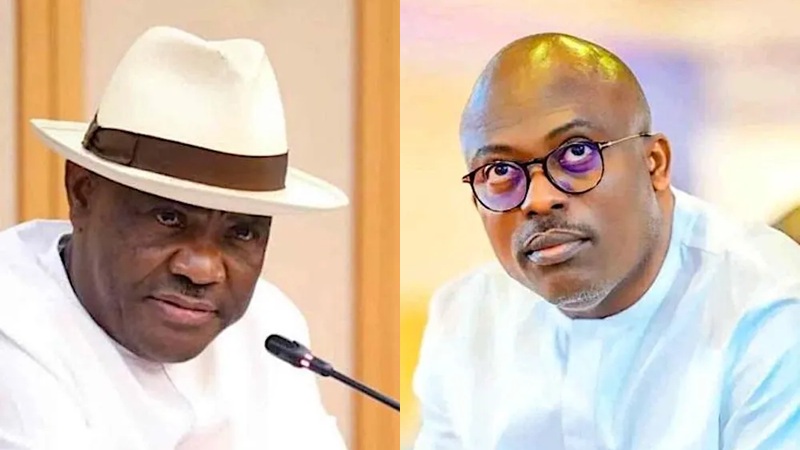
Nyesom Wike’s own words illustrate the problem.

In March 2025, while responding to threats from some Ijaw voices over the possible impeachment of Governor Siminalayi Fubara, he described the Ijaw in Rivers as a “minority of the minorities” and spoke of “our own benevolence.”
His remarks drew a public rebuke from the Ijaw National Congress.
Threats against pipelines or communities deserve unequivocal rejection. No politician’s survival justifies violence. But an answer framed around ethnic numbers and political benevolence carries its own poison.
Who bestowed this benevolence? By what authority does any individual speak as though another community’s participation in government depends on his generosity?
A governorship is a public trust. Supporting a candidate does not confer ownership of the office, the treasury or the people who voted.
This is where Wike’s politics deserves sustained criticism. When political influence is expressed through claims of personal entitlement, and disagreement is accompanied by ethnic belittlement, tribalism becomes a weapon of domination.
It teaches citizens to seek protection from powerful patrons instead of demanding protection from functioning institutions.
It also creates cover for corruption. Once scrutiny is presented as an attack on “our people,” questions about contracts, expenditure and appointments can be buried beneath communal outrage. The public argument shifts from what an official has done to where he comes from.
The beneficiaries are obvious. The costs are shared.
Yet Rivers people must resist the temptation to answer one man’s conduct with hostility towards his entire community. Wike is not the Ikwerre people. Fubara is not the Ijaw people. Neither man possesses the right to conscript an ethnic nationality into his personal political battles.
The political alignments themselves expose the weakness of that tribal explanation. Ikwerre stakeholders publicly supported Fubara during the dispute.
More recently, former Ijaw Youths Council president Udengs Eradiri argued that the feud was a political quarrel within the PDP rather than a collective Ijaw struggle. Communities are more thoughtful and more diverse than the camps claiming to speak for them.
The consequences of institutional collapse are equally plain. In March 2025, President Bola Tinubu imposed emergency rule, suspended the elected state leadership and legislature, and appointed a retired naval officer as administrator.
The Nigerian Bar Association challenged the constitutional basis of the suspensions. Emergency rule was lifted six months later.
Whatever position one takes on the competing legal and political claims, Rivers people experienced the practical result: their elected institutions were displaced while the federal executive took control.
That should trouble every community in the state.
We cannot celebrate the struggle against domination while making ourselves so divided that decisions about our government are repeatedly settled in Abuja. Rivers must not be reduced to a territory whose leaders travel to the capital to negotiate the terms on which its people may be governed.
Nor should reconciliation between politicians be mistaken for public accountability. Reports in October 2026 described renewed meetings between Wike and Fubara, followed by the Assembly’s restoration of three pro-Fubara lawmakers’ seats.
Such developments may ease immediate tensions. They do not, by themselves, establish a durable respect for institutions.
The public deserves to know what has been agreed in its name. Peace must mean more than an accommodation among powerful men.
Rivers needs a civic bargain that survives their friendships and quarrels: transparent spending, credible elections, an independent legislature, fair appointments and development that reaches communities without requiring declarations of personal loyalty.
Every ethnic nationality must feel secure within that bargain. Every officeholder must face scrutiny within it. No surname should purchase immunity, and no community should have to surrender its dignity to secure its share of public investment.
I am proud to be Kalabari. That pride gives me no reason to diminish an Ikwerre, Ogoni, Etche, Ekpeye, Ogba, Okrika, Andoni or any other neighbour. Cultural identity enriches our lives. Political tribalism impoverishes our judgment.
The men and women who struggled for Rivers State understood that their communities could achieve together what they could not secure alone. We dishonour their work whenever we let a politician turn a neighbour into an enemy.
The sooner Rivers people reject the use of tribalism as an instrument of control, the sooner they can recover the political strength that division has squandered.
We were not brought together to become anyone’s subjects.
We must stop behaving as though our future belongs to the men who divide us.