





TD The controversy surrounding Nigerian President Bola Ahmed Tinubu’s alleged heroin‑trafficking past has resurfaced in Washington, D.C., where the FBI and DEA are locked in a legal battle over whether to release hundreds of pages of investigative records.
For years, both agencies refused to confirm or deny the existence of such files.
That changed after a federal court ruled that the Justice Department had already officially acknowledged Tinubu’s criminal investigation, forcing the FBI and DEA to search for and process responsive records under the Freedom of Information Act (FOIA).
The filings now before the court are government documents — not speculation, not rumor.
They confirm that Tinubu was investigated as part of a heroin‑trafficking and money‑laundering probe in Chicago in the early 1990s.
While many pages remain withheld, the sheer volume of responsive records is staggering.

Procedural History
Plaintiff Aaron Greenspan filed FOIA requests in 2022 and 2023 targeting multiple agencies, including the FBI, DEA, CIA, IRS, and State Department.
His requests sought investigative files concerning Tinubu and several associates alleged to be part of a Nigerian heroin distribution ring active in Chicago and Hammond, Indiana.
Initially, the FBI and DEA invoked “Glomar responses,” refusing to confirm or deny the existence of records on privacy grounds.
But in April 2025, the court ruled that the Justice Department had already acknowledged Tinubu’s investigation, stripping the agencies of their Glomar shield.
The FBI and DEA were ordered to conduct searches and produce non‑exempt records.
This ruling was pivotal: it established that Tinubu was not merely mentioned in passing in civil forfeiture proceedings, but was the subject of criminal investigative files.


FBI’s Production
The FBI processed 399 pages of responsive records concerning Tinubu.
- 30 pages were released in full.
- 247 pages were released in part, with redactions.
- 63 pages were withheld entirely.
- 59 pages were deemed duplicative.
The FBI applied FOIA Exemptions 3, 5, 6, 7(C), 7(D), 7(E), and 7(F).
These cover classified material, attorney‑client privilege, personal privacy, confidential sources, investigative techniques, and risks to safety.
Crucially, the FBI stated that these records were compiled in furtherance of criminal investigations into drug‑trafficking crimes, not civil forfeiture matters.
This directly contradicts Tinubu’s narrative that his name appeared only in connection with a civil forfeiture case.
DEA’s Production
The DEA processed 240 pages of records.

- 172 pages were withheld in full.
- 50 pages were released with redactions.
- 14 pages were referred to the FBI for consultation.
- 4 pages were deemed non‑responsive.
The DEA invoked similar exemptions, citing privacy, confidential informants, investigative techniques, and risks to law enforcement personnel.
Together, the FBI and DEA produced nearly 640 pages, most of which remain hidden.
The volume alone underscores the seriousness of the investigation.
FOIA Exemptions Explained
To understand why so much remains concealed, it helps to unpack the exemptions invoked:
- Exemption 3: Protects information exempted by other statutes, such as wiretap laws.
- Exemption 5: Covers privileged communications, including attorney work product.
- Exemption 6: Shields personal privacy.
- Exemption 7(C): Protects against unwarranted invasions of privacy in law enforcement records.
- Exemption 7(D): Safeguards confidential sources.
- Exemption 7(E): Protects law enforcement techniques and procedures.
- Exemption 7(F): Prevents disclosure that could endanger life or safety.
These exemptions are the government’s shield, allowing it to argue that disclosure would compromise investigations, reveal informants, or violate privacy rights.
Legal Arguments
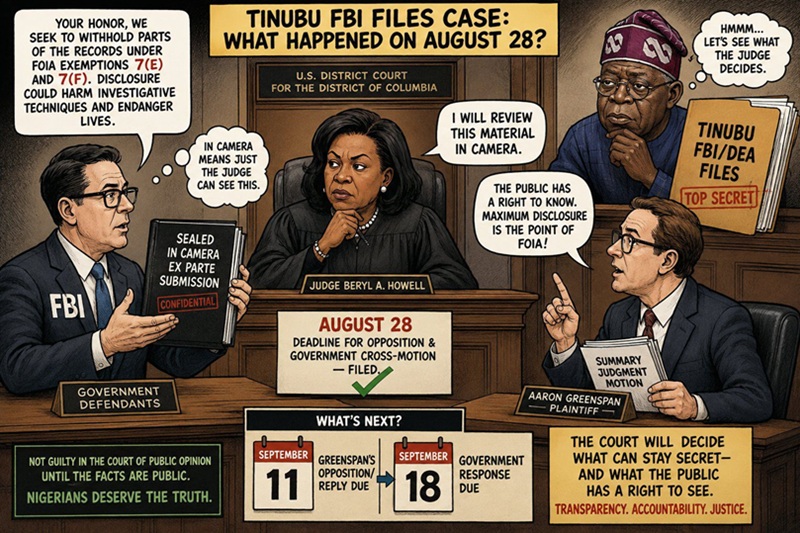
The government insists that releasing the full records would harm law enforcement interests.
Plaintiff Greenspan counters that the public interest in knowing the truth about Tinubu outweighs these concerns.
He argues that the sheer volume of responsive records proves Tinubu’s deep entanglement in U.S. drug investigations.
The court must balance privacy and law enforcement concerns against the public’s right to know.
In FOIA cases, agencies are given a presumption of good faith, but that presumption can be overcome when official acknowledgments already exist — as they do here.
Historical Context
Tinubu’s alleged involvement must be understood in the broader context of Nigerian heroin rings active in Chicago in the late 1980s and early 1990s.
U.S. law enforcement documented extensive networks importing heroin through Nigerian couriers, laundering proceeds through Chicago banks, and funneling money back to Nigeria.
Civil forfeiture cases in Illinois referenced Tinubu’s name, but the FBI and DEA filings now confirm that he was investigated as part of a criminal probe.
This places Tinubu squarely within the history of U.S. efforts to dismantle Nigerian heroin networks.
Implications for Nigeria
Tinubu is not just any subject of investigation — he is the sitting President of Nigeria.
The revelations raise profound questions about transparency, accountability, and the integrity of leadership in Africa’s largest democracy.
For Nigerians, the filings confirm long‑standing suspicions that Tinubu’s past is more complicated than official narratives suggest.
For Americans, the case underscores the tension between privacy rights and the public’s right to know when foreign leaders have been investigated for serious crimes.
Comparisons to Other FOIA Cases
FOIA battles involving sensitive investigations are not unique.
Courts have previously ordered partial disclosures in cases involving CIA covert operations, FBI informants, and DEA drug probes.
In each instance, the balance between secrecy and transparency was contested.
Tinubu’s case fits within this tradition, but with the added weight of involving a foreign head of state.
The fight over Tinubu’s FBI and DEA case files is far from over.
While the court has forced the agencies to acknowledge and process records, the majority remain hidden behind FOIA exemptions.
What has been released, however, is enough to establish beyond doubt that Tinubu was investigated for heroin trafficking and money laundering.