



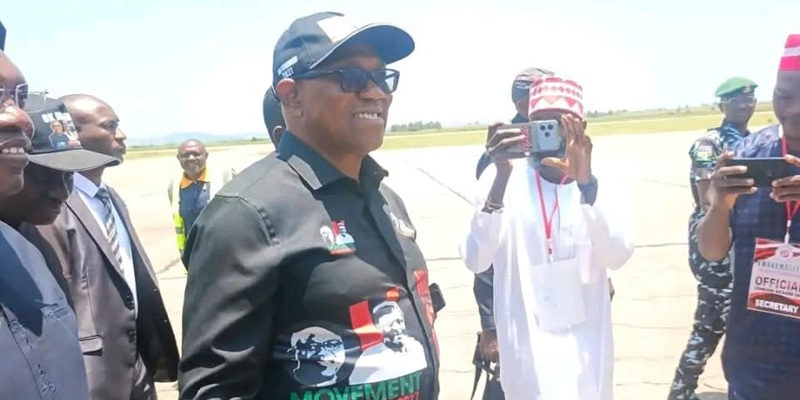

TD YELWATA, BENUE STATE — Nigerian opposition leader and 2027 presidential candidate Peter Obi has confirmed that his convoy was obstructed by hired thugs in Benue State.
Peter Obi made the confirmation on his X, formerly Twitter, handle on Tuesday, September 8, 2026.
He noted that he attempted a humanitarian visit to Yelwata to console families of victims of last year’s massacre when the incident happened.
The attack, which took place in June 2025, left around 272 people dead in one of the deadliest episodes of Fulani herdmen violence in Nigeria’s Middle Belt.
The Incident
Obi reported that as his convoy approached Yelwata around 9:00 a.m., groups of men chanting “Peter Obi, go back” blocked the road.
Videos circulating online show security forces in camouflage facing crowds, with chaotic roadside scenes of people moving near vehicles, consistent with Obi’s description of obstruction.

“This was not a political rally,” Obi wrote in a statement.
“I came to Benue not for partisan politics, but to mourn with our people, to listen to families who have lost loved ones, and to offer comfort at a moment of unimaginable sorrow,” he added.
Obi’s Message
Obi contrasted the hostility in Benue with his show of political civility in Abuja the day before.
Then, he had attended the opening of an opposition campaign office to demonstrate respect across party lines.
He emphasized that Nigeria must unite against insecurity in the following words:
“The people of Benue — and all Nigerians — deserve to sleep without fear.
“They deserve to travel without fear. They deserve to cultivate their land without fear.
“Above all, they deserve a country where the state places the protection of human life far above political expediency.”
Although unable to reach Yelwata, Obi later visited internally displaced persons (IDPs) in Plateau State.

There, he distributed aid and reinforced his campaign image as a compassionate leader prioritizing human security over partisanship.
Background: The Yelwata Massacre
The June 13–14, 2025 attack on Yelwata in Guma Local Government Area was among the deadliest in Benue’s history.
Armed assailants, widely described as suspected herder‑linked gunmen, stormed the community overnight using firearms, machetes, and arson.
Houses and market stalls were burned, and hundreds were displaced.
Death toll estimates ranged from 200 to over 270, with many victims being women, children, and IDPs.
Prosecutions of suspects on terrorism‑related charges followed into 2026, but survivors continue to demand stronger protection and justice.

The Benue Herdsmen Terrorists
Benue State, often called Nigeria’s “food basket,” has been a flashpoint in the protracted farmer‑herder conflict.
Historically, farmers and pastoralists coexisted through seasonal grazing routes and informal agreements.
But since the 2010s, population growth, climate pressures, and erosion of traditional mediation mechanisms have fueled deadly clashes.
Key drivers include:
- Resource competition: cattle destroying crops, water contamination, and grazing disputes.
- Environmental pressures: desertification and drought pushing herders southward.
- Policy friction: Benue’s 2017 anti‑open grazing law, hailed by farmers but criticized by herders as discriminatory.
- Aggravating factors: proliferation of small arms, collapse of mediation, and identity‑based polarization.
The conflict has claimed thousands of lives nationwide, displaced hundreds of thousands, and disrupted agriculture, worsening food insecurity.
Political and Humanitarian Implications
Obi’s blocked visit highlights the politicization of humanitarian gestures in Nigeria’s volatile security landscape.
His campaign has leaned heavily on themes of compassion, unity, and prioritizing human security over political expediency.
Analysts note that his emphasis on visiting victims of violence, even when obstructed, reinforces his image as a candidate focused on national healing.
The incident also underscores the fragility of Nigeria’s democracy, where humanitarian outreach can be derailed by partisan hostility.
Peter Obi’s attempted visit to Yelwata was meant to console families shattered by one of Nigeria’s worst massacres.
Instead, it exposed the deep divisions and insecurity that continue to plague Benue and the wider Middle Belt.
As Nigeria heads toward the 2027 elections, the episode serves as a reminder that beyond politics, the urgent priority remains safeguarding lives and rebuilding trust in communities scarred by violence.