TD Washington/New York/Abuja — A Washington, D.C.-based political advisory and lobbying firm, Von Batten-Montague-York, L.C. (VBMY), has raised questions over the timing of a proposed Nigeria-United States mining cooperation agreement.

The agreement was expected to be signed on the sidelines of the United Nations General Assembly (UNGA) in New York.
The firm has publicly campaigned for the release of U.S. law-enforcement records concerning President Bola Ahmed Tinubu.
It said it had alerted the administration of U.S. President Donald Trump after a Nigerian news report about the proposed agreement was published.
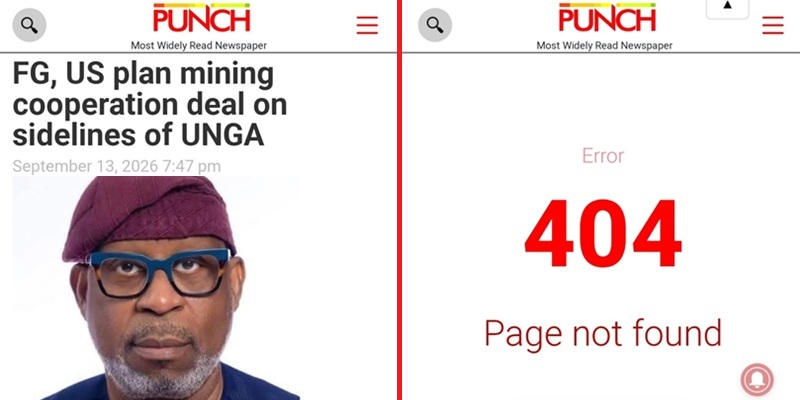
The controversy follows a report by PUNCH published on September 13.
The report stated that Nigeria and the United States were working towards signing a Memorandum of Understanding on mining cooperation during the 2026 UNGA.
The proposed agreement is intended to expand cooperation across exploration, mining, processing, value addition and refining of critical minerals.
Mining Report Subsequently Disappears
According to subsequent reporting, the Punch article was later taken offline, with its original URL reportedly returning a 404 error.
VBMY drew attention to the disappearance in a post on X.
It described the development as significant because of the proposed timing of the mining agreement and the continuing U.S. litigation over records relating to Tinubu.
The removal of the article has been reported by other outlets.
However, no evidence has emerged publicly establishing why the article was removed or that the Nigerian government ordered its deletion.
The original report said the proposed agreement followed a meeting between Nigeria’s Minister of Solid Minerals Development, Dele Alake, and U.S. Embassy Chargé d’Affaires Keith Heffern in Abuja.
It said the meeting followed an earlier high-level engagement in Washington involving Nigerian officials and the White House’s National Security Council.
It stated further that the discussions focused on securing resilient critical-mineral supply chains.
Lobbying Firm Raises ‘Appearance’ Concerns
In its latest statement, VBMY said it supports a minerals agreement that advances U.S. economic and strategic interests.
Nevertheless, it objected to what it described as the appearance created by the timing of the proposed signing.
The firm said: “We support a U.S.-Nigeria minerals agreement that advances American interests.”
However, it argued that a legitimate economic agreement should not create a wrong impression.
It should not create the impression that mineral or oil concessions could be connected to access to President Trump.
It should not also influence the outcome of the FOIA litigation involving U.S. law-enforcement records.
VBMY also claimed that it had informed the Trump administration immediately after the mining article was published.
The firm’s statements, however, represent its own political advocacy and allegations, rather than an official position of the Trump administration.
There is currently no independent evidence establishing that the Trump administration has linked the proposed mining agreement to the Tinubu records case or that it has agreed to any such arrangement.
‘Settled the Americans with Mining Deal’ Claim
VBMY separately alleged that people associated with the Nigerian Presidency had privately claimed that they had “settled (paid off) the Americans” with a mining deal.
According to the firm, presidency sources boasted that the FBI records concerning Tinubu would not be released.
The firm also alleged that a meeting between Tinubu and Trump at the UN General Assembly would take place.
Importantly, VBMY itself stated that it had not independently verified those alleged statements.
The claims therefore remain allegations and should not be treated as evidence that any payment or improper agreement occurred.
The firm said its concern was not opposition to U.S.-Nigeria economic cooperation.
Rather, it is the possibility that the timing of the proposed agreement could create questions about the integrity of U.S. decision-making.
What the FOIA Case Actually Says
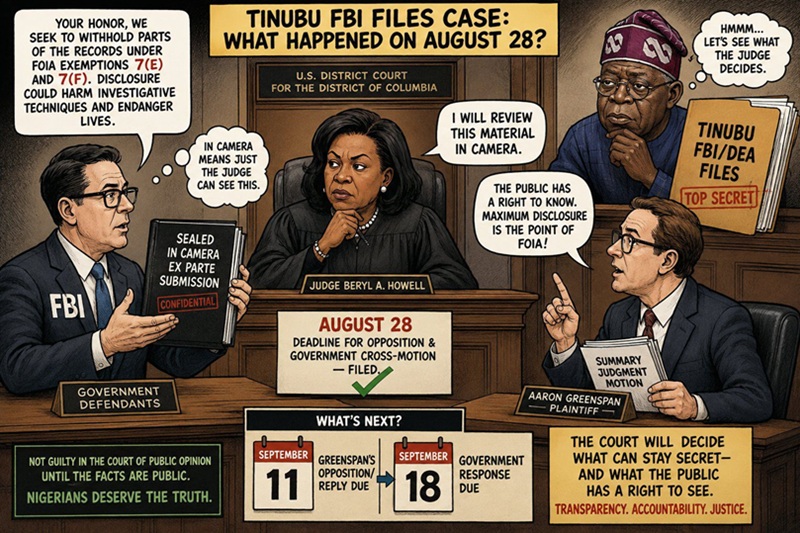
Before the mining deal controversy, there exists an ongoing federal FOIA litigation in Washington, D.C., involving requests for FBI and DEA records concerning Tinubu.
The case, Greenspan v. Executive Office for U.S. Attorneys et al., No. 1:23-cv-01816, was filed by transparency activist Aaron Greenspan.
It was initiated after U.S. agencies initially issued “Glomar” responses refusing to confirm or deny whether certain records existed.
In an April 2025 ruling, U.S. District Judge Beryl A. Howell ordered the FBI and DEA to search for and process non-exempt records responsive to Greenspan’s FOIA requests.
The court’s ruling concerned access to government records; it was not a criminal finding against Tinubu.
The records sought relate to a U.S. federal investigation in the early 1990s involving a Chicago-area heroin trafficking and money-laundering investigation.
Court documents describe the FOIA requests as seeking records concerning several individuals, including Tinubu.
The case also involves records associated with a 1993 civil forfeiture of approximately $460,000.
Recent proceedings have continued to focus on whether particular FBI and DEA records can be released under FOIA exemptions and privacy protections.
Tinubu’s legal team has intervened in the case and argued against disclosure of the records.
Presidency Says FOIA Case Is Not a Criminal Case
The Nigerian Presidency has previously pushed back against descriptions of the litigation as a criminal case against Tinubu.
In a September 4 clarification, the Presidency said the matter is a civil records-disclosure dispute under the U.S. Freedom of Information Act.
It insisted that it is not a criminal prosecution and stressed that no court had found Tinubu guilty of criminal wrongdoing.
That distinction is important because the existence of an investigation or requested law-enforcement records does not, by itself, establish that a person committed a crime.
Presently, the mining deal is merely fanning the embers of the FOIA controversy.
Proposed Mining Deal
The proposed Nigeria-U.S. agreement itself is part of Abuja’s broader effort to attract investment into the country’s largely underdeveloped solid-minerals sector.
According to the Nigerian government’s account, discussions cover geological exploration, mining, processing, refining and value addition.
It paid particular attention to critical minerals needed for global energy and technology supply chains.
The government has also said it is engaging major international mining companies, including Fortescue, Glencore and BHP.
Meanwhile, it is working to digitise Nigeria’s geological data to make mineral information more accessible to investors.
The proposed MoU is therefore economically significant independently of the political controversy surrounding the FOIA case.
No Evidence of a Link
At present, the available evidence establishes three separate developments:
- Nigeria and the U.S. are pursuing a mining cooperation agreement;
- a report about the proposed deal was subsequently taken offline; and,
- a U.S. FOIA case concerning records relating to Tinubu remains active.
What has not been established is a causal connection between those events.
There is no publicly verified evidence that the proposed mining agreement:
- was offered in exchange for suppression of FBI or DEA records,
- that any payment was made to U.S. officials, or,
- that the Trump administration conditioned a presidential meeting on Nigerian mineral concessions.
VBMY’s allegations and concerns have, therefore, become part of the political debate surrounding the proposed agreement.