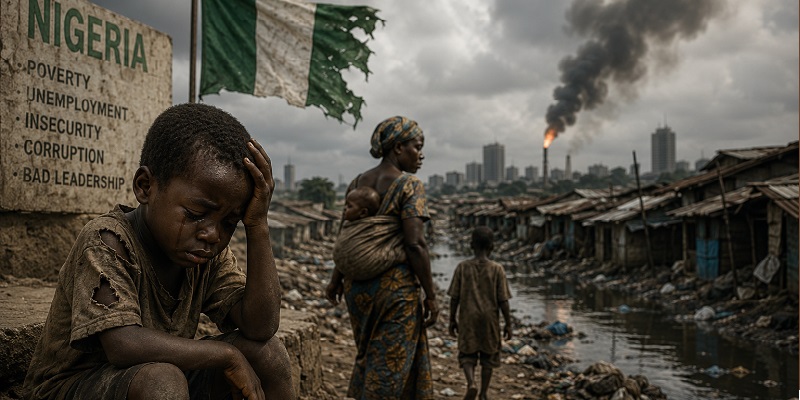

 ABUJA, Nigeria — Nigeria is facing renewed scrutiny over its housing and electricity challenges following figures published by World Population Review that estimate the country’s homelessness at 24.4 million, alongside World Bank data showing that tens of millions of Nigerians remain without access to electricity.
The figures have renewed concerns about the scale of deprivation in Africa’s most populous country.
Inadequate housing, unreliable electricity supply and limited access to essential services continue to affect households, businesses and communities in the country.
World Population Review’s Homelessness by Country 2026 ranking places Nigeria first by estimated absolute number, with 24.4 million people listed as homeless.
Nigeria’s 24.4 Million Homelessness Estimate
The World Population Review database lists Nigeria’s estimated homeless population at 24.4 million, substantially higher than the figures shown for other countries in its ranking.
Syria’s homelessness is listed at 5.37 million, Bangladesh at five million and Egypt at three million.

The figure is striking, but it requires context.
There is no universally applied international definition of homelessness.
Depending on the country and dataset, the term may refer to:
- people sleeping on the streets,
- living in emergency shelters,
- residing in temporary accommodation, or,
- lacking secure and adequate housing.
The Organisation for Economic Co-operation and Development (OECD) has issued stern warnings.
It warned that differences in national definitions and data-collection methods make homelessness estimates difficult to compare across countries.
The United Nations Human Settlements Programme has also highlighted the difficulty of capturing people living in unsafe or temporary accommodation.

Consequently, the World Population Review figure should be treated as an estimate rather than a definitive, independently harmonised global count.
Nevertheless, the estimate underscores the need for updated national housing data and effective policies.
Such data and policies should address homelessness, housing insecurity and inadequate living conditions.
Nigeria’s Electricity Deficit Remains Among the World’s Largest
The electricity situation presents a second major development challenge after homelessness.
World Bank figures indicate that Nigeria had approximately 86.6 million people without electricity access in 2023.
The figure places it among the countries with the largest electricity-access deficits globally.

The World Bank’s 2026 development data analysis identifies Nigeria, the Democratic Republic of Congo and Ethiopia as accounting collectively for around one-third of the global population without electricity access.
A World Bank dataset published through its country-data platform puts Nigeria’s electricity-access rate at 62.5 per cent in 2024.
This measure includes electricity from sources beyond the national grid, such as solar home systems and mini-grids.
It does not mean that everyone counted as having access enjoys a reliable or affordable supply.
The distinction is important in Nigeria, where households and businesses connected to the grid frequently experience outages.
These may depend on petrol or diesel generators, inverters and solar systems to maintain power.
The World Bank has identified unreliable electricity as a constraint on economic activity and service delivery, with implications for education, healthcare, employment and productivity.
For families, the cost of alternative power can consume a significant share of household income.
For businesses, it raises operating expenses, complicates production and can discourage investment.
Homelessness, Housing Insecurity and Energy Poverty
The housing and electricity figures describe different problems, but both point to gaps in access to essential infrastructure and services.
Housing insecurity can expose families to overcrowding, unsafe buildings, inadequate sanitation and displacement.
A lack of electricity can limit children’s ability to study after dark, disrupt healthcare services and prevent small businesses from operating efficiently.
The challenges can compound one another, particularly for low-income households that struggle to afford decent accommodation while paying for basic energy needs.
However, the available figures do not establish that all people counted in the homelessness estimate also lack electricity.
Nor should every resident of an informal settlement automatically be classified as homeless.
Reliable analysis requires clearly defined categories and comparable data.
Is Population Growth Part of the Problem?
Nigeria’s rapid population growth adds pressure to the provision of housing, electricity, water, sanitation, healthcare, education and employment.
The World Bank has previously noted that population growth has outpaced progress in expanding electricity access, contributing to the country’s large access deficit.
However, population growth alone does not explain the scale of the challenges involving homelessness and electricity deficit.
Infrastructure investment, economic opportunities, urban planning, governance, household incomes and the efficiency of public spending also affect whether essential services keep pace with demand.
Calls to impose a cap on births raise significant human-rights and public-policy concerns.
Coercive birth limits would raise questions about reproductive autonomy and enforcement.
On the other hand, it may potentially fail to address the underlying causes of inadequate housing and electricity.
A more sustainable response would combine voluntary family-planning services and reproductive-health education with investment in infrastructure, job creation, affordable housing and stronger social protection.
What Could Help Address the Crisis?
Policy responses would need to address both immediate needs and long-term structural weaknesses.
Affordable housing: Expand access to low-cost housing, improve urban planning, upgrade unsafe settlements and strengthen support for people facing displacement or homelessness.
Electricity expansion: Accelerate grid improvements while expanding renewable energy, mini-grids and solar home systems for underserved communities.
Reliable power supply: Improve generation, transmission and distribution, reduce technical and commercial losses, and strengthen the financial sustainability of the electricity sector.
Better data: Conduct regular, transparent assessments of homelessness and housing insecurity, with clearly stated definitions and methods that allow meaningful comparisons over time.
Population and social policy: Expand access to voluntary family planning, maternal healthcare, education and economic opportunities, enabling families to make informed decisions about their futures.
Accountability: Publish measurable targets for housing delivery and electricity access, disclose progress regularly and ensure that public investment produces verifiable benefits.
A Development Challenge Requiring Urgent Attention
The figures published by World Population Review and the World Bank highlight the scale of Nigeria’s housing and electricity challenges.
The central question is not simply whether Nigeria ranks first in homelessness global table.
It is whether the country can expand access to safe housing, reliable electricity and other essential services quickly enough to meet the needs of its population.
Addressing these challenges will require sustained investment, reliable data, effective planning and policies that protect human dignity while expanding economic opportunities.