THIS DAWN — This paper revisits the well-known folklore of the “Naked King” through the lens of political philosophy, strategic intelligence, and classical theories of power.

Departing from the conventional moralistic interpretation that frames the tale as a critique of vanity and collective delusion, the study advances an alternative thesis: that the king’s nakedness may function as a deliberate strategic decoy rather than an inadvertent exposure.
Drawing on insights from Sun Tzu’s doctrine of deception, Clausewitz’s theory of misperception and intent, and modern power psychology, the paper argues that apparent vulnerability can serve as a mechanism of perception management, elite testing, and narrative diversion.
In this reading, public ridicule and symbolic “truth-telling” operate less as instruments of accountability and more as distractions—akin to flies drawn away from the king’s dining table—while real power, intention, and institutional control remain undisturbed.
The study contends that political power is often preserved not by concealment, but by strategic misdirection, wherein controlled exposure redirects attention away from decisive arenas of authority.
Ultimately, the paper challenges the assumption that visibility equates to weakness, proposing instead that ridicule may coexist with consolidation, and that appearing exposed can be a sophisticated strategy for remaining unread.
Introduction
Political philosophy has long concerned itself with the relationship between appearance and reality, power and legitimacy, truth and deception.
From Plato’s Allegory of the Cave to Machiavelli’s counsel to princes, thinkers have repeatedly warned that what the public sees is rarely what governs political outcomes.
Within this tradition, the familiar folktale of the “naked king” is usually interpreted as a moral lesson about vanity, conformity, and the courage to speak truth to power. Yet such a reading may be philosophically incomplete.
When examined through the lenses of strategic thought and intelligence theory, the story can be reinterpreted not as a parable of foolishness, but as an allegory of deliberate misdirection—a case study in how power may weaponize appearance.
This alternative reading raises a deeper philosophical question: What if political weakness is sometimes performed rather than suffered?
Deception as a Philosophical Foundation of Power
The idea that deception is intrinsic to power is not a modern invention. Sun Tzu’s Art of War offers one of the earliest systematic articulations of this principle: “All warfare is based on deception.”
Though framed in military terms, Sun Tzu’s insight transcends the battlefield. Politics, like war, is a contest of wills under conditions of uncertainty, where perception often matters more than brute force.
If deception is foundational, then power does not merely conceal itself; it shapes the field of interpretation. To appear weak when strong, or foolish when calculating, is to manipulate the cognitive environment of rivals and observers alike.
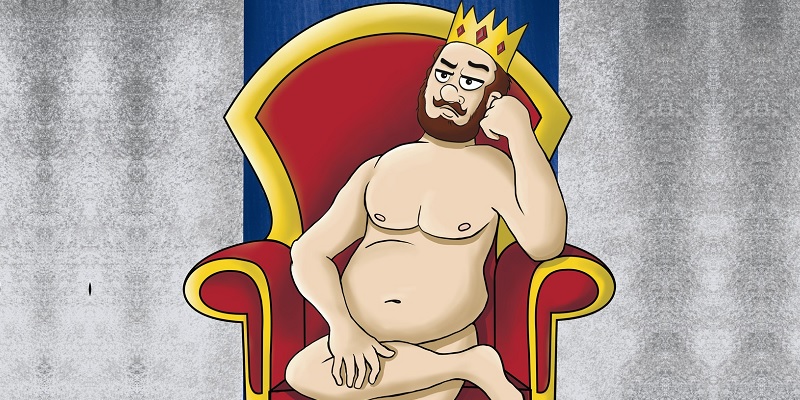
In this sense, the naked king—if acting deliberately—would not be exposed but masked. His apparent vulnerability would function as a screen behind which real power consolidates.
This view challenges a moralistic understanding of politics and replaces it with a tragic one: truth does not necessarily liberate, and exposure does not necessarily weaken power.
Clausewitz and the Misreading of Intent
Carl Von Clausewitz deepens this analysis by introducing the concepts of fog and friction.
In ‘On War’, he argues that political and military actors operate under conditions of radical uncertainty, where intentions are often misunderstood and actions misread.
He famously observes that “Everything in war is very simple, but the simplest thing is difficult.”
Applied philosophically, this suggests that clarity about appearances can coexist with blindness about intent.
The crowd in the naked king story believes it has achieved moral clarity—the king is naked—yet this clarity may obscure the more important question: What is the king doing while we are looking?
Clausewitz’s warning is not merely tactical but epistemological. Political actors routinely mistake visible symbols for centers of gravity. In doing so, they misallocate attention and energy, attacking surfaces rather than structures.
The naked king, if strategic, exploits this epistemic weakness. He allows the public to believe it has “seen through” him, thereby inducing complacency and misdirection.
Robert Greene and the Psychology of Power
Where Sun Tzu and Clausewitz address structure and strategy, Robert Greene focuses on psychology. In The 48 Laws of Power, Greene argues that power operates most effectively when it manipulates perception rather than confronts opposition directly.
His injunction to “play a sucker to catch a sucker” captures a brutal insight: people who believe themselves intellectually superior often become careless.
From this perspective, the naked king becomes a psychological mirror. The crowd’s laughter is not merely ridicule; it is self-congratulation.
They believe they have unmasked power, and in doing so, they relax vigilance. Greene repeatedly warns that humans confuse emotional satisfaction with strategic victory. Feeling morally superior does not equate to possessing power.
Philosophically, this exposes a paradox at the heart of democratic sensibilities: the belief that mockery and exposure weaken authority may itself be a form of ideological comfort that leaves deeper structures untouched.
The Politics of Appearing Stupid
Modern political history provides numerous examples of leaders who were underestimated because of style, speech, or comportment, only to outmaneuver more polished opponents.
The strategic use of apparent incompetence—whether through silence, simplification, or performative awkwardness—can function as a form of camouflage.
This does not imply that all perceived foolishness is strategic. Political philosophy must resist cynicism as much as naïveté.
Yet it must also acknowledge that appearing unintelligent is not the same as being unintelligent, and that power has often survived ridicule precisely because ridicule absorbs attention without dismantling institutions.
In this sense, the naked king story becomes a meditation on the limits of exposure politics. Not all truths destabilize power; some merely entertain the crowd.
Truth, Cynicism, and the Moral Cost
A philosophical reinterpretation of the naked king as a decoy is unsettling because it destabilizes the comforting belief that truth inevitably triumphs over power. If power can afford to be mocked, then moral clarity alone is insufficient for political transformation.
This does not mean that truth-telling is futile, but that truth must be coupled with structural understanding. The child’s declaration may be ethically pure, but it is politically inconsequential if it does not alter the distribution of power.
Political philosophy, therefore, must distinguish between symbolic truth and operative truth—between what is said and what changes outcomes.
Conclusion: Power and the Discipline of Misreading
Reinterpreted as a decoy, the naked king story ceases to be a children’s tale and becomes a cautionary allegory for political thought. It warns against confusing exposure with victory, ridicule with resistance, and moral satisfaction with strategic success.
Sun Tzu teaches that deception is foundational. Clausewitz warns that intent is easily misread. Greene explains why human psychology makes such misreading likely. Together, they suggest a sobering conclusion:
Power is not undone by being seen. It is undone by being correctly understood.
The true danger, then, is not that the king is naked, but that the crowd believes nakedness is the point.