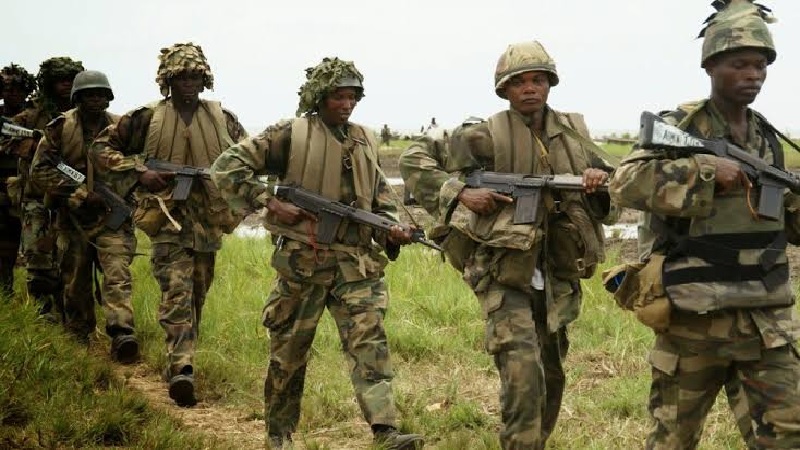

Nigeria’s military has reported a major breakthrough against insurgents following a series of air strikes across the Northeast.
The operations reportedly neutralised 103 Islamic State West Africa Province (ISWAP) fighters between October 10 and 18.
The Joint Task Force, Operation Hadin Kai, also reported destroying several logistics hubs and storage facilities.
According to military authorities, the operations targeted terrorist positions, leadership structures, and supply networks across Borno and Adamawa states.
The announcement comes amid continuing security challenges in northeastern Nigeria.
Military Conducts Seven Precision Air Strikes
The Joint Task Force (North East) confirmed the operations in a statement attributed to its Acting Military Information Officer, Captain Mohammed Goni.

The statement said the military conducted seven precision air strikes during the eight-day campaign.
The operations involved Nigerian Army Aviation, the Nigerian Army Remotely Piloted Aircraft Regiment, and other air component assets.
Military authorities said intelligence gathering played an important role in identifying the targets.
The strikes focused on locations believed to support ISWAP fighters and their operations.
The military reported that the campaign disrupted terrorist activities and weakened several logistical networks.
However, independent verification of the reported casualty figures was not immediately available.

Borno State Records Several Military Strikes
Several of the reported operations targeted locations across Borno State, which remains a major hotspot for insurgent activity.
The military identified Gudumbali, Badu, Mairari, and Arina Woje among the targeted areas.
Gudumbali, in Guzamala Local Government Area, was targeted on October 10.
Another strike reportedly targeted Badu, within Monguno Local Government Area, on October 11.
On October 13, military aircraft struck terrorist positions around Mairari and an area east of Badu.
The campaign continued with further operations against suspected terrorist locations.

The military said these strikes formed part of its broader effort to disrupt insurgent movements.
It also aimed to destroy facilities used to store equipment and supplies.
Security officials believe that weakening these networks can limit the operational capabilities of armed groups.
Adamawa Also Records Air Strike Operation
The military campaign extended beyond Borno State into Adamawa.
According to the statement, an air strike targeted suspected terrorist elements around Duste Uku in Gombi Local Government Area on October 16.
The operation formed part of the wider campaign against ISWAP fighters.
Military authorities said coordinated air operations were designed to weaken terrorist concentrations and disrupt their activities.
The latest announcement highlights the military’s continuing efforts to tackle insecurity across the Northeast.
However, residents in affected areas still face concerns about attacks, displacement, and the disruption of daily activities.
Security operations remain important to efforts aimed at restoring stability and protecting vulnerable communities.
Strike Targets ISWAP Commander’s Alternative Residence
One of the campaign’s major operations reportedly occurred on October 18.
The military said an air strike targeted the alternative residence of Abu Saleem, identified as ISWAP’s Wali of South Lake Chad.
The location was in the Arina Woje area of Monguno Local Government Area, Borno State.
According to Captain Goni, intelligence, surveillance, and reconnaissance activities helped identify the target.
The military subsequently reported that intelligence gathered after the strike confirmed the deaths of two prominent ISWAP members.
They were identified as Jindullah, reportedly Abu Saleem’s chief security guard, and Abul Kissa, a member of the group’s Shura Council.
Other fighters were also reportedly killed during the operation.
The military said the targeted structure was completely destroyed.
It added that the strike destroyed nine boat engines and several motorcycles stored at the location.
These assets were reportedly part of the group’s logistical resources.
Military authorities said the operation weakened the group’s ability to use the location as a safe haven.
However, the statement did not independently establish Abu Saleem’s fate.
Earlier Strike Reportedly Killed About 30 Fighters
The military also provided details about an operation conducted on October 13.
According to the statement, an aerial surveillance asset tracked 16 suspected terrorists from the Mairari axis.
The group reportedly moved towards a gathering of more than 100 fighters.
Several motorcycles were also observed at the gathering.
The location was approximately 23 kilometres east of Badu and 19 kilometres west of Monguno.
The military said a subsequent precision strike killed an estimated 30 fighters.
However, the extent of damage to the motorcycles remained unconfirmed.
The operation formed part of the wider campaign against terrorist concentrations and their logistical networks.
Military authorities said the combined operations resulted in 103 reported terrorist deaths.
Military Seeks to Disrupt Terrorist Supply Networks
Beyond targeting fighters, the military said its operations focused on destroying logistics hubs and storage facilities.
Such facilities can support the movement of supplies, equipment, and personnel.
The reported destruction of these assets could make it harder for insurgents to maintain operations.
The military also said the strikes targeted leadership structures within the terrorist group.
Disrupting command networks can affect coordination between fighters operating in different locations.
However, the long-term impact will depend on continued security operations and the ability to prevent armed groups from rebuilding their networks.
The military has emphasised cooperation between its aviation units, remotely piloted aircraft teams, and ground forces.
It says this approach supports intelligence-led operations and improves coordination across the theatre.
Northeast Nigeria Continues to Face Security Challenges
Northeastern Nigeria has experienced years of insurgency involving Boko Haram and ISWAP.
The violence has caused deaths, displaced families, and disrupted farming, education, and commercial activities.
Many communities continue to face threats from armed groups despite repeated military operations.
Displacement has also placed pressure on host communities and humanitarian organisations.
Restoring lasting peace requires more than military action alone.
Effective intelligence gathering, civilian protection, humanitarian support, and the rebuilding of affected communities remain essential.
Local cooperation can also help authorities identify security threats and respond more effectively.
The latest military announcement provides an update on ongoing efforts to weaken insurgent networks.
However, the wider security situation requires continued monitoring.
Conclusion
Nigeria’s military says seven air strikes between October 10 and 18 neutralised 103 ISWAP fighters.
The operations reportedly destroyed several logistics facilities across parts of Borno and Adamawa states.
A major strike also targeted an alternative residence associated with a senior ISWAP leader.
Military authorities say the campaign weakened terrorist networks and disrupted their operational resources.
Nevertheless, independent confirmation of the reported casualty figures remains unavailable.
The lasting success of these operations will depend on sustained security efforts and improved protection for vulnerable communities.
ThisDawn News will continue monitoring security developments across Nigeria and reporting verified updates as they emerge.