



• Acerca de This Dawn
  • Contáctanos
  • Política de privacidad
  • TD
This Dawn
Anuncio
Sin resultados
Ver todos los resultados
Sin resultados
Ver todos los resultados
This Dawn
Sin resultados
Ver todos los resultados
Inicio Opinión

From Ancient Forges to Atlantic Shores: The Rise, Resilience, and Transformation of Igbo Civilization

By Ogbuefi Ndigbo

Ogbuefi Ndigbo, Senior Correspondent por Ogbuefi Ndigbo, Senior Correspondent
August 4, 2026
en Opinión
0 0
0
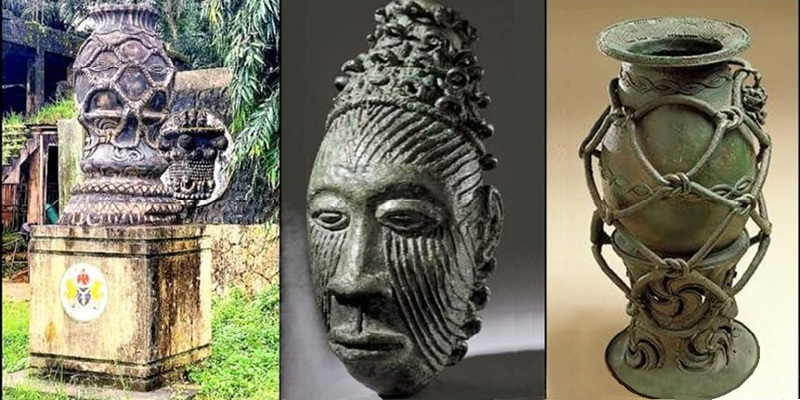
Igbo bronze artifacts discovered at Igboukwu

Igbo bronze artifacts discovered at Igboukwu

0
COMPARTIDOS
9
VISTAS

TD For centuries, the narrative of pre-colonial Africa was often framed as a void of technological advancement, a continent waiting to be “discovered” or “civilized” by outsiders.

However, the archaeological discoveries in Igboland, present-day southeastern Nigeria, paint a radically different picture—one of deep indigenous innovation, sophisticated metallurgy, and complex social organization.

The history of this region, stretching from the prehistoric iron smelting at Lejja to the intricate bronzes of Igbo-Ukwu, and through the demographic catastrophe of the Atlantic slave trade, reveals a civilization of tremendous resilience that did not vanish but was profoundly transformed by immense external pressures.

The story of technological achievement in Igboland begins in the deep past, far earlier than the famous bronzes.

Prehistoric evidence of iron smelting in the Nsukka area, particularly at sites like Lejja and Opi, pushes the timeline of West African metallurgy back to an astonishing era.

Radiocarbon dates from Lejja have been calibrated to around 2000 BC, with Opi dating to approximately 750 BC.

This establishes the region as one of the earliest independent centers of iron smelting in West Africa, if not the world.

The scale of this industry is staggering; at Lejja’s village square alone, over 800 massive slag blocks, each weighing between 34 and 57 kilograms, remain in situ as silent testaments to a bustling industrial past.

The presence of shaft and pit furnaces indicates a technological evolution, and critically, the lack of any foreign precursors and the local abundance of iron ore strongly suggest that this technology was an autochthonous invention—a homegrown advancement that arose from local ingenuity rather than diffusion from North Africa.

This long tradition of metallurgical expertise culminated centuries later in the extraordinary bronze and copper artifacts of Igbo-Ukwu, which date to the 9th century CE.

Accidentally discovered in 1938 by farmer Isaiah Anozie, and later professionally excavated by Thurstan Shaw, these objects represent the oldest known bronzes in West Africa.

Thousands of intricate artifacts, including elaborate ritual vessels, ornate staffs, and thousands of glass beads, point to a wealthy, highly stratified ceremonial center with sophisticated trade networks.

This was not a primitive society but one capable of technically demanding lost-wax casting, artistic expression, and long-distance commerce.

Together, the iron smelting sites and the Igbo-Ukwu bronzes prove that the region was a hub of human activity and innovation for millennia.

Given this deep history of large-scale industry and complex society, a significant historical puzzle emerges: why was the area of apparently low population around 300 years ago, in the 18th century?

The answer lies not in the collapse of the civilization but in its catastrophic demographic depletion due to the Atlantic slave trade.

By the 18th century, the Igbo heartland had become one of the primary sources of human cargo from the Bight of Biafra.

Conservative estimates suggest that hundreds of thousands, and possibly up to 5.6 million people, were forcibly exported from this region.

This scale of forced migration represented a demographic hemorrhage that hollowed out communities, creating a direct and devastating population decline.

The “low population” 300 years ago is a direct statistical reflection of this violent extraction of human life.

However, demography does not tell the whole story.

The nature of Igbo political organization profoundly influenced how the region responded to, and was affected by, these shocks.

Unlike the powerful, centralized kingdoms of the savanna, such as Oyo or Benin, the Igbo operated under a decentralized, village-based system governed by councils of elders, age grades, and titleholders like the Ọzọ.

This “kingless” system, while democratic and resilient in normal times, made it exceedingly difficult to mount a unified military defense against the slave raiders or to negotiate as a single political bloc with European powers.

This political fragmentation made the region more vulnerable to the external shock, as there was no central authority capable of stemming the tide of exploitation.

Furthermore, the ancient technological and cultural landscape itself underwent a profound shift.

The ancient iron-smelting industry that had thrived for over 3,000 years eventually became extinct in places like Lejja.

While the massive slag blocks are preserved by local taboo, the active knowledge of smelting is no longer practiced by any community members.

This loss of specialized technical knowledge represents a significant cultural and economic transformation.

Similarly, the arrival of colonialism and Christian missions in the 19th century led to the abandonment of many traditional religious and social institutions, including the sacred elements of the Ọzọ title system.

These practices were later reconstructed, often stripped of their spiritual components, as a way to survive and adapt to the new colonial reality.

In conclusion, the civilization of Igboland did not “disappear.” Instead, it underwent a dramatic transformation driven by immense external pressures.

The ancient forges fell silent, the population was ravaged by the slave trade, and traditional institutions were reshaped by colonialism.

Yet, the people endured.

The 800+ slag blocks remain in the village squares as physical anchors to a glorious industrial past, and the resilient, democratic social structures that allowed the community to survive the chaos of the slave trade persist to this day.

The story of Igboland is not one of extinction, but of survival, adaptation, and the enduring continuity of a people whose deep history stands as a testament to African technological ingenuity and resilience.


Share this:

  • Share on Facebook (Opens in new window) Facebook
  • Share on X (Opens in new window) X
Previous Post

More Trouble for Tinubu as INEC Form Demands Evidence of All Educational Qualifications

Next Post

Controversy Erupts Over Circulated NYSC Photograph of Tinubu

Ogbuefi Ndigbo, Senior Correspondent

Ogbuefi Ndigbo, Senior Correspondent

Next Post
President Bola Ahmed Tinubu during his National Youth Service Corps (NYSC) days or Olamide Salami Kayode?

Controversy Erupts Over Circulated NYSC Photograph of Tinubu

Stay Connected test

  • 398 Followers
  • 24k Followers
  • 99 Subscribers
  • Trending
  • Comments
  • Latest
Personal de la Policía nigeriana

EXCLUSIVE: Over 600 Police Officers Transferred from Edo to Kogi State Threaten to Abandon the Job Over Poor Welfare

21 de agosto de 2026
Ex candidato del Partido Laborista por North East Hampshire, Amran Hussain

Hussain: Reino Unido encarcela a político por título universitario forjado de Oxford

7 de agosto de 2026
Tribunal, Mazo, Justicia

Tribunal falla a favor de presidentes estatales en medio de crisis de ADC

1 de mayo de 2026
Presidente chino Xi Jinping contra el presidente estadounidense Donald Trump

Taiwán: China advierte a EE. UU. sobre venta de armas por 11.000 millones de dólares

19 de diciembre de 2025
Líder del Pueblo Indígena de Biafra (IPOB), Mazi Nnamdi Kanu

RADIOGRAFÍA: Cómo Nnamdi Kanu manipuló al IPOB

0
Presidente Donald Trump de los Estados Unidos contra el presidente Bola Ahmed Tinubu de Nigeria

Trump critica a Tinubu por visita al Reino Unido mientras Nigeria arde

0
Ex candidato presidencial del Partido Laborista, Peter Obi

Peter Obi reacciona al enfrentamiento entre Wike y un oficial naval

0
Activista de derechos humanos, Omoyele Sowore, contra el senador Ned Nwoko

Sowore desentierra el pasaporte de Regina, alega que Ned Nwoko se casó con ella siendo menor

0
CEO of the lobbying firm Von Batten-Montague-York, L.C., Karl Von Batten

Von Batten: Trump Appoints Atiku’s Lobbyist in Tinubu’s Drug Case to Presidential Committee

3 de septiembre de 2026
Former Vice President Atiku Abubakar versus President Bola Ahmed Tinubu

Atiku Fires Back at Presidency: “We’re Past Denials, the Issue Is What’s Inside the 399 Pages”

3 de septiembre de 2026
Asesor Especial del Presidente de Información y Estrategia, Bayo Onanuga

Presidencia aclara caso de FOIA en EE. UU. sobre supuestos archivos de narcotráfico de Tinubu

3 de septiembre de 2026
Gobernador del estado de Akwa Ibom, Pastor Umo Eno

Gobernador Umo Eno: Cuando un gobernador que vende akara no debería mentir

3 de septiembre de 2026

Noticias recientes

CEO of the lobbying firm Von Batten-Montague-York, L.C., Karl Von Batten

Von Batten: Trump Appoints Atiku’s Lobbyist in Tinubu’s Drug Case to Presidential Committee

3 de septiembre de 2026
Former Vice President Atiku Abubakar versus President Bola Ahmed Tinubu

Atiku Fires Back at Presidency: “We’re Past Denials, the Issue Is What’s Inside the 399 Pages”

3 de septiembre de 2026
Asesor Especial del Presidente de Información y Estrategia, Bayo Onanuga

Presidencia aclara caso de FOIA en EE. UU. sobre supuestos archivos de narcotráfico de Tinubu

3 de septiembre de 2026
Gobernador del estado de Akwa Ibom, Pastor Umo Eno

Gobernador Umo Eno: Cuando un gobernador que vende akara no debería mentir

3 de septiembre de 2026

Estamos preparados para brindarle lo mejor en noticias verificadas, confiables, fácticas y objetivas. Visite nuestra página de inicio.

Síguenos

Explorar por Categoría

  • Economía
  • Entretenimiento
  • Asuntos Legales
  • Noticias
  • Opinión
  • Política
  • Seguridad
  • Reportaje Especial
  • Deportes
  • Sin Categoría
  • Vídeos
  • Mundo

Noticias recientes

CEO of the lobbying firm Von Batten-Montague-York, L.C., Karl Von Batten

Von Batten: Trump Appoints Atiku’s Lobbyist in Tinubu’s Drug Case to Presidential Committee

3 de septiembre de 2026
Former Vice President Atiku Abubakar versus President Bola Ahmed Tinubu

Atiku Fires Back at Presidency: “We’re Past Denials, the Issue Is What’s Inside the 399 Pages”

3 de septiembre de 2026

¡Bienvenido de nuevo!

Inicia sesión en tu cuenta a continuación

¿Has olvidado tu contraseña?

Recuperar tu contraseña

Por favor, introduce tu nombre de usuario o dirección de correo electrónico para restablecer tu contraseña.

Iniciar sesión

Añadir Nueva Lista de Reproducción

Desarrollado por
►
Las cookies necesarias permiten funciones esenciales del sitio como inicios de sesión seguros y ajustes de preferencias de consentimiento. No almacenan datos personales.
Ninguno
►
Las cookies funcionales admiten funciones como compartir contenido en redes sociales, recopilar comentarios y habilitar herramientas de terceros.
Ninguno
►
Las cookies analíticas rastrean las interacciones de los visitantes, proporcionando información sobre métricas como el número de visitantes, la tasa de rebote y las fuentes de tráfico.
Ninguno
►
Las cookies de publicidad ofrecen anuncios personalizados basados en sus visitas anteriores y analizan la efectividad de las campañas publicitarias.
Ninguno
►
Las cookies no clasificadas son cookies que estamos en proceso de clasificar, junto con los proveedores de cookies individuales.
Ninguno
Desarrollado por
Sin resultados
Ver todos los resultados
  • Acerca de This Dawn
  • Contáctanos
  • Política de privacidad

This Dawn