
 I am increasingly disturbed by the political role Oluremi Tinubu is carving out for herself. Nigerians elected her husband President. They did not elect his wife to share his authority, and they did not elect his children to form an additional layer of government.
The title of First Lady carries visibility and influence, but it comes with no independent executive powers under our Constitution.
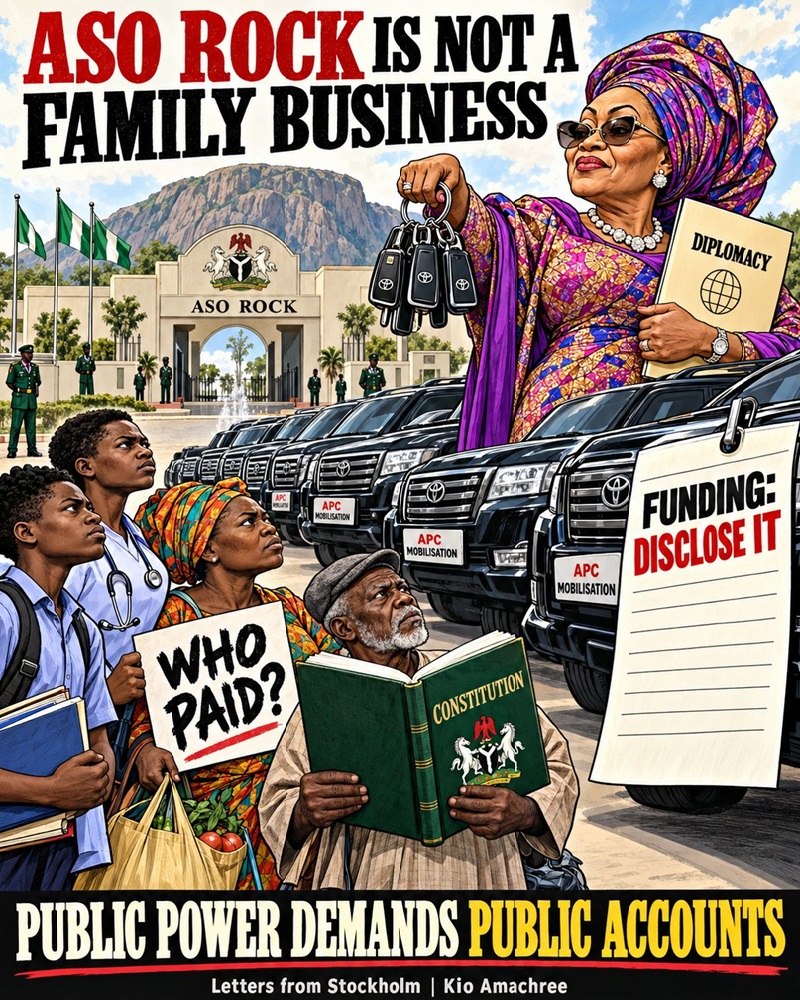
That distinction matters when the President’s wife is discussing international affairs with ambassadors and supplying vehicles for the ruling party’s election machinery.
On 22 October, Mrs Tinubu met China’s ambassador, Yu Dunhai. China’s Foreign Ministry says their discussion covered bilateral relations, trade concessions, African security issues and mining cooperation.
These are serious subjects involving Nigeria’s economic and strategic interests.
I have no objection to an ambassador paying her a courtesy visit. What I want explained is the capacity in which she speaks when the conversation moves into foreign policy. Was she conveying an authorised government position? Was our Foreign Ministry involved? What record exists of the discussion?

That meeting alone does not prove she was standing in for her husband. But Nigerians should not have to guess where her personal influence ends and the authority of their government begins.
The vehicles raise an even more immediate question.
Mrs Tinubu has confirmed donating vehicles to the APC youth wing for mobilisation ahead of the 2027 election. Seven new Toyota Prado SUVs were displayed by the party’s youth leader, Dayo Israel, in a post he subsequently deleted. Her meeting with the youth leaders took place at the State House.
I find this spectacle offensive. People are struggling to feed their families, keep children in school and pay for treatment, yet the governing party can parade expensive vehicles for its political organisers.
The same Nigerians being told to endure hardship are watching those close to power enjoy another round of privileges.
Where did the money come from?

The exact cost and funding arrangements have not been publicly disclosed. I will therefore not pretend that estimates circulating online are verified accounts, or claim that the vehicles were bought with stolen public money.
But Mrs Tinubu should publish the facts. Who purchased them? Who donated them? What did they cost? Who now owns them?
If private donors paid, Nigerians should know their identities and whether they have business before this government. A gift channelled through the President’s wife may carry expectations, even when nobody says so publicly.
Disclosure would allow the public to examine those relationships instead of being expected to take everything on trust.
If public resources were involved, the Presidency must explain the legal authority and public purpose. Party mobilisation is APC business. Any use of government money, staff or facilities to support it deserves scrutiny.
There is also a correction we must make to the claim that the First Lady has “no budget”. Her position has no independent constitutional executive mandate, but money has nevertheless been appropriated for it.

In 2023, the National Assembly approved ₦1.5 billion for vehicles for her office. That allocation does not explain the funding of these latest vehicles, but it demonstrates why Parliament cannot escape responsibility for the spending surrounding her activities.
How much public support does the First Lady’s operation receive across the relevant government accounts? What expenditure is authorised, who approves it, and where can Nigerians examine the results?
These are reasonable questions about public money. Neither a charitable initiative nor the prestige of the presidential household should place anyone beyond them.
My deeper concern is the influence of the Tinubu family within Aso Rock. I suspect Mrs Tinubu and her stepson, Seyi Tinubu, wield more power than their publicly stated roles would justify.
I cannot prove that they jointly run the government. But I want to know whether ministers and officials receive instructions from family members, and whether access to the President is being used to exercise authority without responsibility.

I remain concerned about the President’s health. I cannot establish a diagnosis from public appearances, nor prove that illness has made his wife the effective head of government.
My fear is that uncertainty about his capacity may create room for unelected relatives to exercise greater influence. That concern should be answered through openness about how decisions are made.
If a President becomes unable to discharge his duties, the Constitution provides a process. His wife does not become President. His son does not acquire a share of the office.
I consider this blurring of family influence, government prestige and party campaigning unacceptable. Mrs Tinubu has every right to support her husband and campaign for the APC. She should also expect searching questions when she uses the standing of First Lady to do so.
The National Assembly should demand the relevant accounts and scrutinise any public expenditure. The Presidency should explain her diplomatic mandate. The APC should disclose how these campaign vehicles were financed.
Nigeria has capable diplomats, public servants and constitutional officeholders. They must be allowed to do their jobs through institutions whose decisions can be questioned and whose spending can be examined.
I want a country governed openly, where an official’s authority comes from law and where the President’s family is subject to the same scrutiny as everyone else.
Aso Rock belongs to Nigerians. The Tinubu family are temporary occupants, and they should never be allowed to forget it.