
 There are moments in the history of a democracy when ordinary citizens remind the political establishment that power does not belong to presidents, billionaires, political parties or wealthy financiers. It belongs to the people.
The American midterm elections of November 3 have produced one such moment.
The Democratic Party has staged a remarkable comeback, winning extraordinary Senate victories in Texas and South Carolina, making significant gains in the House of Representatives and challenging the political dominance of Donald Trump and the Republican Party.
The results are particularly remarkable because of the enormous sums of money invested in preserving Republican control of Washington.

Nowhere was this more apparent than in Texas. For decades, Texas has been considered a Republican stronghold.
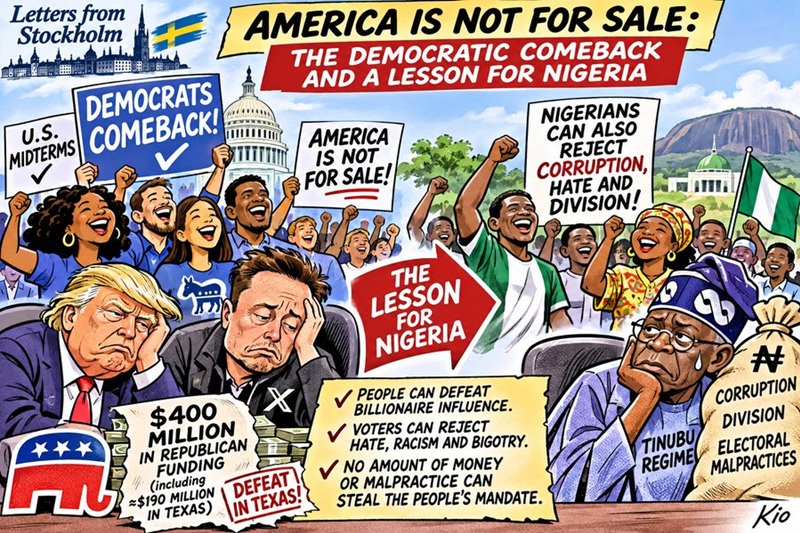
Yet Democrat James Talarico defeated Republican Ken Paxton in a Senate contest that attracted extraordinary financial intervention from Elon Musk, the world’s wealthiest man.

Musk reportedly committed nearly $190 million to the Texas Senate contest, while his nationwide political spending exceeded $400 million during the midterm campaign.
Think about that for a moment.
Hundreds of millions of dollars poured into American politics by one extraordinarily wealthy individual, yet the voters of Texas demonstrated that financial power does not guarantee electoral victory.
There is something profoundly encouraging about that result.
It challenges the increasingly dangerous assumption that modern democracy is simply an auction in which the highest bidder purchases the government.
A billionaire may purchase advertising, political influence and an army of campaign consultants. He cannot automatically purchase the conscience of a nation.

The wider election results have raised serious questions about the direction of the Trump presidency.
American voters have expressed deep concerns about the cost of living, government accountability, political division and the concentration of power.
Exit polling indicated substantial dissatisfaction with the country’s direction and strong public support for greater congressional checks on presidential authority.
The administration and its supporters will undoubtedly offer their own explanations for these defeats. That is their democratic right.
But the results have demonstrated that political loyalty is not unconditional and that even the most powerful political movements remain answerable to the electorate.
There is a lesson here that extends far beyond America’s borders.

FROM WASHINGTON TO ABUJA
I have watched political developments in Nigeria with increasing concern, particularly the growing influence of money, political patronage and the extraordinary privileges enjoyed by those close to power.
Under President Bola Ahmed Tinubu, Nigerians continue to debate serious questions about corruption, public spending, political accountability, electoral credibility and the widening distance between the governing elite and ordinary citizens.
These concerns deserve answers, not intimidation or political propaganda.
The parallels with America are worth examining, although the two countries have very different political institutions and electoral histories.
In both societies, citizens are entitled to ask whether their governments serve the public interest or the interests of powerful political and financial networks.
They are entitled to demand that public office be treated as a responsibility rather than an opportunity for private enrichment.
And they are entitled to reject attempts to divide communities along ethnic, racial or religious lines for political advantage.
Nigeria’s political class should study what happened in Texas.
The electorate cannot be treated indefinitely as a commodity to be bought, manipulated or taken for granted.
THE POWER OF THE ORDINARY CITIZEN
Democracy is not merely the privilege of voting every four years. It is the continuing right of citizens to question their leaders, investigate their conduct and remove them peacefully through credible elections.
The American midterms have illustrated how public dissatisfaction can translate into electoral consequences, even against candidates supported by extraordinary wealth.
That does not mean money has ceased to influence American politics. Far from it. The scale of campaign spending remains a legitimate cause for concern.
Nor does an electoral defeat automatically establish wrongdoing by those who financed the losing campaign.
But it does establish something important: financial resources alone cannot determine every election.
For Nigeria, the challenge is to build institutions capable of protecting that principle.
Independent electoral administration, transparent campaign financing, impartial courts, freedom of expression and security agencies that serve the constitution rather than political officeholders are essential to any credible democracy.
No political party should assume that its access to government resources gives it permanent ownership of the country.
No president should confuse the privileges of office with a personal mandate to govern without accountability.
And no wealthy political sponsor should imagine that an entire population can be reduced to a collection of purchasable votes.
A MESSAGE OF HOPE FOR NIGERIA
I have always believed that Nigeria possesses the human talent, resources and democratic potential to become one of the world’s most successful nations.
What Nigerians need is not another wealthy political godfather promising salvation, but institutions that protect their rights and leaders who understand the obligations of public service.
The American elections provide a timely reminder that political fortunes can change dramatically when citizens organise, participate and insist upon accountability.
Nigeria’s future must be determined by Nigerians themselves, through peaceful democratic participation and elections whose results genuinely reflect the public will.
Electoral malpractice, intimidation and vote-buying must be confronted through the law, independent institutions and vigilant public scrutiny.
The message from America is not that democracy has suddenly been perfected. It is that democracy retains the capacity to correct its course.
And that is a message worth celebrating.
The wealthy may finance political campaigns. Presidents may command enormous institutions. Political parties may build formidable electoral machines.
But none of them owns the nation.
America is not for sale. Nigeria should not be for sale either.
The ballot belongs to the citizen, the government belongs to the people, and the future belongs to those prepared to defend their democratic rights.
That is the enduring lesson of November 3.
Reporting behind the article: Reuters reports Democratic Senate victories in Texas and South Carolina and major House gains, although final control of Congress was not yet settled in the reporting reviewed.
Reuters, The Guardian documented approximately $446 million in Musk’s nationwide midterm spending, while the Texas Tribune traced nearly $190 million to the Texas Senate contest.