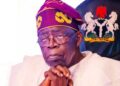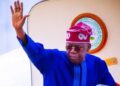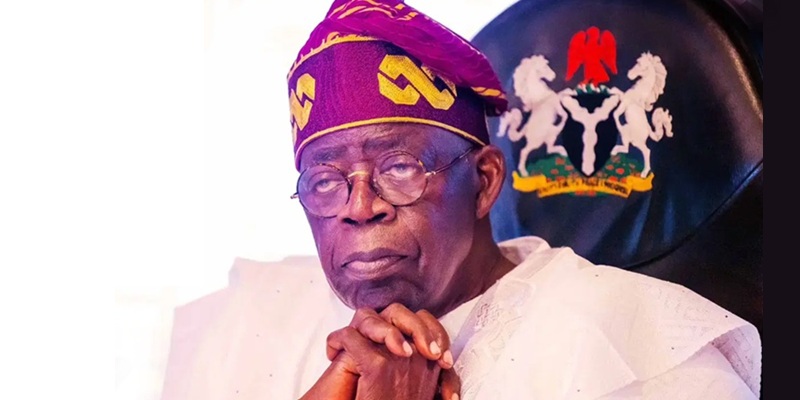
TD President Bola Ahmed Tinubu came into office on May 29, 2023, promising what he described as fundamental economic and institutional reforms.
Here are twelve of the most consequential controversies surrounding Tinubu and his presidency.
1. Economic Hardship
Few decisions have defined the Tinubu presidency more than the removal of the petrol subsidy announced on May 29, 2023.
Tinubu’s declaration that “subsidy is gone” immediately changed the economics of petrol distribution.
The price of petrol rose sharply from below ₦200 per litre to over ₦1,000 per litre same year, while the subsequent foreign-exchange reforms weakened the naira and increased the domestic cost of imported goods, transportation and production.
The World Bank said the reforms were economically significant but acknowledged their immediate social cost.
Its December 2023 Nigeria Development Update reported that retail gasoline prices had risen by an average of 163 per cent, while the naira had depreciated by about 41 per cent in the official market and approximately 30 per cent in the parallel market.

The World Bank also warned that without adequate compensation, many households could be pushed into poverty by higher petrol prices and might respond by withdrawing children from school or avoiding healthcare.
By September 2026, petrol prices had again climbed dramatically. Reports show prices of roughly ₦1,400 per litre in Lagos and Abuja and up to ₦1,500 in northern Nigeria, amid a fresh rise in international crude prices.
The administration and international financial institutions have defended the reforms as necessary to remove costly distortions and rebuild fiscal space.
The World Bank estimated that subsidy removal could save the government more than ₦11 trillion cumulatively by the end of 2025.
But the political and social controversy has centred on a basic question: have the savings and longer-term macroeconomic gains translated quickly enough into improved living conditions for ordinary Nigerians?

The IMF reported in June 2026 that poverty had reached an estimated 63 per cent of the population in 2025, while 27 million Nigerians were estimated to have experienced food insecurity in the autumn of that year.
That figure, with the attendant inflation, food prices, global commodity conditions, insecurity and other structural factors all matter.
It demonstrates the scale of the hardship accompanying the administration’s economic transition.
2. Insecurity and Rising Death Toll
Security remains another defining controversy of the administration.
Nigeria entered the Tinubu era with pre-existing insurgency, banditry, kidnapping, communal violence and separatist conflicts.

The administration promised stronger security and repeatedly announced military operations against armed groups.
Nevertheless, significant violence has continued.
An analysis published by The ICIR using Mass Atrocities Tracker data reported that 19,980 people were killed across Nigeria between 2023 and April 2026, while 12,362 people were abducted during the same period.
The reported annual death figures were:
- 2023: 4,416
- 2024: 5,353
- 2025: 6,518
- January–April 2026: 3,693
The same dataset recorded 12,362 kidnappings during the period.
Other datasets produce different totals because they use different definitions and methodologies.
ACLED data cited by the European Union Agency for Asylum recorded 21,504 fatalities from security incidents in Nigeria during 2024–2025 alone.
Amnesty International separately reported in May 2025 that at least 10,217 people had been killed in attacks by armed groups in two years in seven states it examined.
The controversy is therefore not simply about one particular death toll.
It is about whether government security measures have produced sufficient improvement against the scale of the threat.
The crisis remains visible in 2026.
On September 21, residents in Niger State protested after hundreds of people were abducted in a mass kidnapping, with local estimates putting the number at roughly 600–700, although authorities had not confirmed the exact figure.
The administration maintains that its military and security operations are making progress.
The continuing attacks demonstrate that the security challenge remains unresolved.
-
PFIPC — The “Fake Agency” Scandal
One of the most extraordinary institutional controversies of 2026 involved the Presidential Foreign Intervention Promotion Council (PFIPC).
The Presidency itself said the organisation was fictitious and had never been established by the Federal Government.
Yet the controversy became serious because the purported agency appeared in the 2026 Appropriation Act with a ₦1.3 billion allocation.
The Presidency subsequently ordered the Independent Corrupt Practices and Other Related Offences Commission (ICPC) to investigate how the organisation had been able to operate, allegedly use government documents and establish bank accounts while claiming official status.
Investigations revealed that the purported council had gone considerably further than simply appearing on paper.
According to the investigation, it secured a ₦1.3 billion budget allocation, operated accounts with the Central Bank of Nigeria, obtained approval to recruit more than 300 staff and held meetings with government officials, diplomats and lawmakers.
The House of Representatives subsequently investigated the matter.
In September 2026, the House committee said it had identified 58 bank accounts and 12 agencies or entities allegedly linked to Adeniyi Adeyemi, the disputed director-general of the organisation.
The committee, however, specifically cautioned that it had not concluded that every account, entity or transaction was unlawful.
The established controversy is that a body which the Presidency says never legally existed nevertheless appeared in the national budget and was sufficiently embedded in government systems to trigger a presidential investigation.
The central question is how such a body passed through the federal government’s administrative, budgetary and legislative safeguards.
-
The ₦33.75 Billion Cash-Transfer Controversy
Nigeria’s social-transfer programme was designed to cushion vulnerable citizens from economic hardship.
But an Auditor-General’s report has raised serious questions about whether billions of naira actually reached the intended beneficiaries.
The Office of the Auditor-General for the Federation reported that it could not find sufficient evidence showing that ₦33.75 billion transferred to 3,295,207 households in 35 states during 2023 reached genuine beneficiaries.
Officially, the finding appeared in the Auditor-General’s 2024 Annual Report on Non-Compliance/Internal Control Weaknesses.
It involved eight audit queries concerning the National Cash Transfer Office.
The problem identified by the Auditor-General was one of verification and documentary evidence: the government could not adequately demonstrate to auditors that the money had reached genuine beneficiaries.
For a programme specifically designed to help Nigerians experiencing extreme economic hardship, that is a significant accountability problem.
It also creates a difficult contradiction for the administration.
The government has repeatedly argued that social transfers are an important component of its response to the economic consequences of subsidy removal and other reforms.
The IMF reported in 2026 that 9.2 million households had been enrolled in Nigeria’s cash-transfer system, with 15 million targeted, but said enrolled households had received no more than three ₦25,000 payments since 2023.
-
₦110 Billion Vehicles and Allowances for National Assembly
The Tinubu era has also been marked by controversy over spending by the National Assembly.
In May 2026, the Federal High Court in Lagos declared unlawful the National Assembly’s controversial ₦110 billion expenditure package, comprising:
- ₦40 billion for 465 vehicles, and,
- ₦70 billion in support allowances for lawmakers elected in 2023.
Justice Yellim Bogoro ruled that the expenditure breached procurement laws and constitutional obligations and conflicted with principles of public trust.
The case was brought by the Socio-Economic Rights and Accountability Project (SERAP).
The ruling is particularly significant because it transformed what had previously been a political and public-spending controversy into a judicial finding.
The court ordered the National Assembly’s leadership to ensure that future procurement and expenditure complied with due process, transparency, accountability and value-for-money requirements.
The episode has consequently become part of the wider debate over whether government institutions are exercising sufficient restraint while households face inflation and declining purchasing power.
-
2025 Forged Tax-Law Controversy
The administration’s tax reforms generated another major constitutional and legislative controversy.
Four major tax laws were passed by the National Assembly and assented to by President Tinubu.
But questions emerged after differences were identified between versions of the laws passed by Parliament and versions subsequently gazetted and circulated.
The controversy became serious enough for the House of Representatives to release Certified True Copies (CTCs) of the four Acts in January 2026.
The documents included:
- Nigeria Tax Act, 2025;
- Nigeria Tax Administration Act, 2025;
- National Revenue Service (Establishment) Act, 2025; and,
- Joint Revenue Board (Establishment) Act, 2025.
The House said the release was intended to settle questions over the authenticity of the versions circulating publicly.
A House Minority Caucus subsequently said its comparison of the documents confirmed that provisions had been altered in the gazetted versions.
The caucus characterised the alleged alterations as a constitutional breach and an infringement on the legislative authority of Parliament.
This remains an area where terminology matters.
The existence of discrepancies and the subsequent release of certified copies are documented.
Claims that particular individuals deliberately altered the laws unlawfully require separate proof.
The controversy nevertheless struck at a fundamental constitutional question: what exactly is the law that Parliament passed, and how did the versions circulated after presidential assent come to differ from it?
-
₦8.4 Billion Almajiri Commission Road-Building Saga
Another 2026 budget controversy involved the National Commission for Almajiri and Out-of-School Children’s Education.
The commission was established to address educational exclusion, particularly among Almajiri and out-of-school children.
Yet the 2026 Appropriation Act allocated ₦8.4 billion for road construction under the commission, according to reports examining the budget.
The projects covered roads in Ogun, Ekiti and Katsina states, despite road construction falling outside the commission’s core statutory mandate.
The controversy intensified when the commission clarified that it did not originate the projects.
According to the commission, the projects were constituency interventions inserted by the National Assembly and assigned to the commission for implementation.
The episode consequently illustrates a broader problem in Nigeria’s budgeting system: projects can be allocated to agencies whose statutory mandates do not naturally correspond with the projects assigned to them.
Human-rights lawyer Femi Falana subsequently criticised such budgetary practices and argued that the President has constitutional powers to veto unlawful provisions.
The controversy therefore goes beyond the ₦8.4 billion itself.
It raises questions about constituency-project insertion, legislative-executive checks and whether public money is being channelled through the institutions best equipped to execute the projects.
-
₦37.64 billion Presidential Travel, SUVs, Et Al
Another major controversy has concerned the cost of running the Presidency and other public institutions while citizens face economic hardship.
An analysis of GovSpend records showed that the Presidency spent approximately ₦37.64 billion on presidential trips, travel logistics, foreign-exchange transactions and related expenses between June 2023 and April 2026.
The reported breakdown was:
- June–December 2023: ₦9.19 billion
- 2024: ₦25.27 billion
- 2025: ₦2.71 billion
- January–April 2026: ₦477.45 million
The same analysis put Tinubu’s foreign travel at approximately 52 trips and 261 days outside Nigeria.
The expenditure figure, though, encompasses presidential travel-related costs and should not automatically be interpreted as the personal cost of every trip.
The First Lady’s overseas travel has also attracted scrutiny, with records cited by the reports showing approximately ₦700.7 million in foreign exchange released for five overseas trips between 2023 and 2024.
The 2026 budget generated another controversy.
Tracka’s analysis identified ₦15.13 billion for 39 SUVs, alongside ₦947.70 billion for 2,579 empowerment projects, producing a combined figure of approximately ₦962.83 billion for the two categories.
The figures have fuelled criticism over public-sector expenditure priorities.
They do not, by themselves, establish that the purchases or travel expenditures were illegal.
The controversy is principally about value for money, transparency and appropriateness of spending priorities during a period of severe household economic pressure.
-
₦44.8 billion Sadiya Umar-Farouq/NSIPA Scandal
The controversy surrounding former Humanitarian Affairs Minister Sadiya Umar-Farouq became one of the major financial investigations confronting the Tinubu administration after it took office in May 2023.
The Economic and Financial Crimes Commission (EFCC) opened an investigation into alleged financial irregularities in the Ministry of Humanitarian Affairs, Disaster Management and Social Development during Umar-Farouq’s tenure under former President Muhammadu Buhari.
At the centre of the initial investigation was an alleged ₦37.17 billion money-laundering scheme.
Reports at the time said investigators were examining approximately ₦44.8 billion allegedly moved from NSIPA accounts into private and corporate accounts.
The EFCC reportedly froze accounts containing about ₦30 billion in connection with the investigation.
-
Betta Edu/Humanitarian Affairs Ministry Scandal
One of the earliest major corruption controversies to hit President Bola Ahmed Tinubu’s administration erupted in January 2024 around then-Minister of Humanitarian Affairs and Poverty Alleviation, Dr Betta Edu, after a government payment instruction involving ₦585.19 million became public.
The controversy centred on a leaked letter dated December 20, 2023, in which Edu instructed the Accountant-General of the Federation, Oluwatoyin Madein, to transfer ₦585,189,500 meant for grants to vulnerable groups in Akwa Ibom, Cross River, Lagos and Ogun states into the bank account of Oniyelu Bridget Mojisola, identified in the correspondence as a project accountant.
The revelation immediately generated questions over why such a large amount of public money intended for beneficiaries was being directed to an individual’s private bank account.
-
₦76.3 Billion CNG Programme Scandal
The government’s flagship CNG programme was promoted as a response to the subsidy removal, has faced questions over spending and implementation.
A 2026 BusinessDay investigation reported that ₦76.3 billion was disbursed over 31 months for CNG buses, tricycles, conversion kits and related contracts.
Yet conversion centres and refuelling facilities remained unavailable or non-functional in several states.
BusinessDay reported that only about 120,000 vehicles had been converted against a government target of one million by 2027.
The controversy has intensified questions about the programme’s cost, reach and effectiveness.
-
$460,000 Forfeiture, CSU Records and Fake Certificate Controversy
President Tinubu faces longstanding controversy over a $460,000 forfeiture in the United States, involving funds in accounts that became the subject of a 1993 civil forfeiture proceeding linked by US authorities to suspected narcotics proceeds.
The controversy later intensified over Tinubu’s Chicago State University (CSU) records, including allegations concerning an academic identity and the authenticity of a diploma submitted to INEC.
CSU confirmed that Tinubu attended the university and graduated in 1979, but its counsel said the university could not independently verify whether the particular diploma submitted to INEC was authentic.
Nigerian petitioners subsequently alleged that inconsistencies in CSU records—including documents bearing the name “Bola Tinubu” and gender-related discrepancies—raised questions about whether some records belonged to another person.
Those allegations were presented as evidence before the Presidential Election Petition Court, which admitted the documents but ultimately did not disqualify Tinubu on those grounds.
Multiple litigations are ongoing respecting the various aspects of the controversies both in Nigeria and in the United States.
The saga, meanwhile, combines:
-
a documented US forfeiture,
-
allegations concerning narcotics proceeds,
-
disputed academic records, and,
-
unresolved public controversy over the authenticity and provenance of Tinubu’s CSU certificate.
NOTA BENE:
Some of these controversies are court findings, some are auditor’s findings, some are ongoing investigations, while others are policy disputes.
But collectively they provide a substantial record against which the Tinubu presidency can be examined:
-
economic reform versus household hardship;
-
spending versus accountability;
-
institutional authority versus administrative control; and,
-
government assurances versus measurable outcomes.
NEXT EPISODE: Major scandals involving President Tinubu and His Family