
TD In Nigeria’s political theatre, power is often measured not by titles or offices but by the silent gestures that reveal who commands respect.

Handshakes, bows, and body language tell stories that words cannot conceal.
And in this story, one man stands out: Peter Obi.
Across countless photographs, past and present governors, ministers, and political heavyweights are seen bending low, bowing, or clasping his hand with reverence.
Nyesom Wike, Adams Oshiomhole, Dave Umahi, and others once instinctively acknowledged Obi’s stature.
These images are not staged—they are spontaneous acts of recognition.
Nigerians know that respect cannot be faked. By their handshakes alone, the people discern the real boss.
Yet, irony abounds. Many of those who once bowed now pretend not to see him.
They have joined what critics call the “structure of criminality,” trading integrity for convenience, and in doing so, they deny the very seniority they once acknowledged.
But photographs do not lie. They remain as permanent reminders of who truly commands respect in the corridors of power.
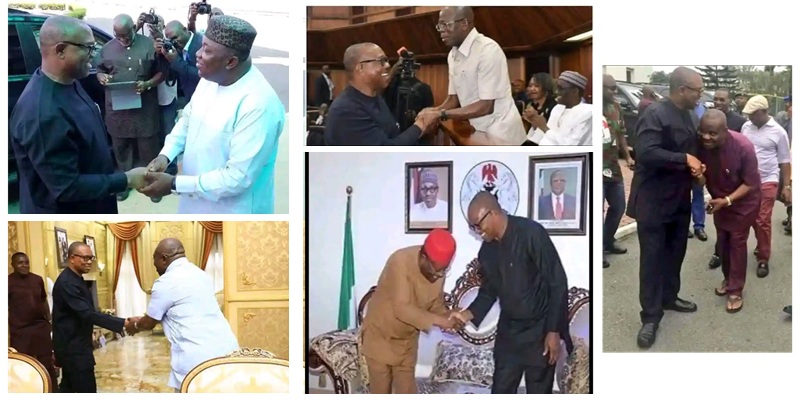
The personnel seen in the image collage bowing low to greet Peter Obi include:
- Immediate past Governor of Enugu Stat, Ifeanyi Ugwuanyi.
- Immediate past Governor of Abia Stat, Okezie Ikpeazu.
- Former Governor of Edo Stat, Adams Oshiomhole.
- Immediate past Governor of Ebonyi State, Dave Umahi, and,
- Immediate past Governor of Rivers State, Ezenwo Nyesom Wike.
Obi’s aura is not built on wealth or intimidation. It is built on authenticity, integrity, and grace.
When someone carries the real stuff, coupled with superb grace, he lacks disgrace.
Even from figures like Festus Keyamo, the bow comes naturally, unplanned, and unforced.
It is the body’s unconscious recognition of moral authority.
This is why Obi unsettles the establishment. He does not need to shout, bribe, or bully to be relevant.
His presence alone compels acknowledgment. Those who once bent low now try to dismiss him, but Nigerians remember.
They remember the bows, the handshakes, the instinctive gestures that revealed who the true leader was.
The truth is simple: legitimacy cannot be manufactured, respect cannot be bought, and grace cannot be denied.
Obi embodies a kind of leadership that transcends political structures.
He represents the possibility of a new Nigeria, one built not on corruption but on credibility.
As the nation looks toward the future, these images of governors and ministers bowing before Obi will continue to circulate.
It will continue to remind Nigerians that leadership is not about occupying office—it is about commanding respect.
And in that respect, Obi stands tall.
As Peter Obi himself will always say, a new Nigeria is not just a dream—it is POssible.
And in that Nigeria, handshakes will no longer symbolize hypocrisy but genuine honor.
For now, the pictures speak louder than words: OK is okay.