



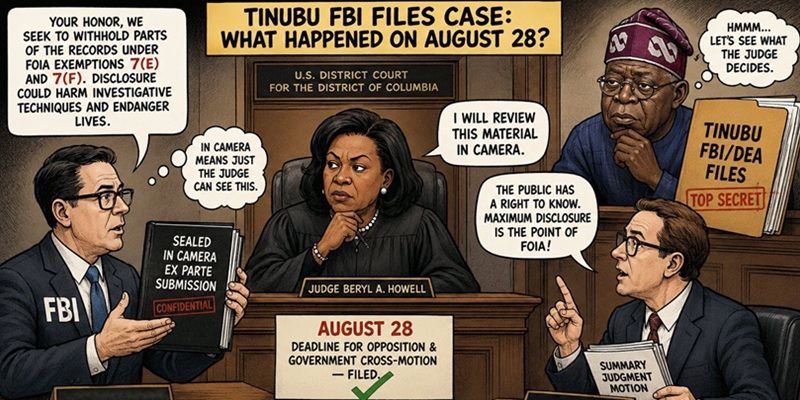

WASHINGTON, D.C. — Von Batten‑Montague‑York, L.C., a Republican‑aligned lobbying firm based in Washington, has announced that its filings have been officially docketed in the high‑profile FOIA lawsuit Greenspan v. Executive Office for U.S. Attorneys (Case No. 1:23‑cv‑01816‑BAH).
The case revolves around requests for FBI and DEA records from a 1990s Chicago heroin trafficking and money laundering investigation that referenced Nigerian President Bola Ahmed Tinubu.
The firm’s announcement, made via its X account, emphasized that both its motion to file an amicus brief and supplemental evidentiary exhibits are now formally part of the court record.
This development adds another layer of complexity to a case already drawing international attention.
What “Amicus Curiae” Means
The Latin phrase amicus curiae translates to “friend of the court.”
In everyday terms, it refers to someone who is not a direct party to a lawsuit, but who seeks permission to provide information, arguments, or evidence that may assist the judge in reaching a more informed decision.

Imagine a courtroom where two sides are locked in battle.
An amicus curiae is like a knowledgeable outsider stepping in to say: “Here’s some context you should consider before ruling.”
Courts often accept such briefs in cases with broad public interest, complex legal questions, or significant policy implications.
The Firm’s Argument
Von Batten‑Montague‑York’s filings contend that Tinubu’s privacy claims under FOIA are undermined by the Nigerian government’s own public statements.
The firm points to a September 3, 2026, statement from the Nigerian Presidency that directly addressed the litigation and the law‑enforcement records at issue.
In their words:

“You cannot demand privacy in a U.S. federal court while publicly litigating the same controversy and attacking those advocating for disclosure.”
By submitting evidentiary exhibits, the firm aims to show that Tinubu’s privacy interests — invoked under FOIA Exemption 7(C) — have been diminished by his government’s public engagement with the case.
Background of the Case
Plaintiff Aaron Greenspan has pursued FBI and DEA records tied to Tinubu and associates allegedly involved in heroin trafficking in Chicago during the early 1990s.
For years, the agencies refused to confirm or deny the existence of such records, a stance known as a “Glomar response.”
In 2025, however, the court ruled that official acknowledgments already existed, compelling the FBI and DEA to process non‑exempt records.
Since then, hundreds of pages have been identified.
While some have been released, many remain withheld under FOIA exemptions covering privacy, confidential sources, and sensitive law‑enforcement techniques.

Why This Matters
The acceptance of Von Batten‑Montague‑York’s filings means the court will now consider their evidence alongside submissions from the government and the plaintiff.
Even if the judge ultimately denies the motion, the materials are part of the official docket and available for review.
For Nigerians, the filings highlight how Tinubu’s past continues to reverberate internationally, raising questions about transparency and accountability.
For Americans, the case illustrates the tension between privacy rights and the public’s right to know, especially when foreign leaders are implicated in U.S. law‑enforcement records.
By officially docketing the lobbying firm’s amicus curiae brief, the court has widened the lens on a case already steeped in controversy.
Whether or not the filings sway the judge, they ensure that public statements by Nigerian officials are part of the record.
This underscores a broader principle: in matters of public interest, outside voices — the “friends of the court” — can play a decisive role in shaping how justice is understood and delivered.