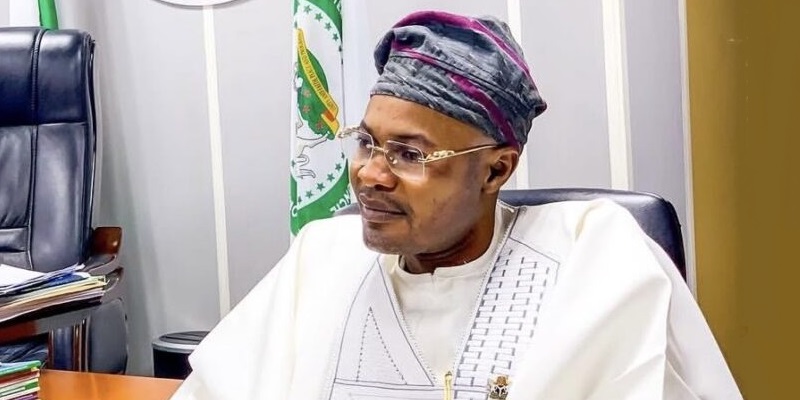
Nigerians have been thrown into deep disappointment after news surfaced that the so-called PFIPC, the Presidential Foreign Intervention Promotion Council, was a fake governmental agency.
Operated by Mr. Adeniyi Mathew, PFIPC was allegedly created with forged signed documents.
Yet, it somehow secured office space inside the Federal Secretariat in Abuja and even found its way into the 2026 national budget with about ₦1.3 billion in allocation.
This information is shocking enough.
But beyond the headlines and public outrage lies a far bigger question that many Nigerians have been asking: How did this happen?
This scandal should be treated as more than just governmental oversight or an individual act of fraud but rather as a revelation of what appears to be a failed and broken system in the government.

Let us break it down a little.
For an agency to be created under the Nigerian government, it must ordinarily pass through rigorous processes involving multiple institutions and layers of approval.
A federal ministry first identifies a gap and develops the necessary policy framework. That proposal then goes through legal scrutiny before becoming a bill.
The bill must be debated and passed by both chambers of the National Assembly before it reaches the President for assent.
Once signed into law, it is officially published through the Office of the Secretary to the Government of the Federation (SGF) and reflected within the Civil Service structure.

It is a process deliberately designed to prevent exactly this kind of situation.
Yet, according to reports, on March 8, 2024, Mr. Mathew Adeniyi resumed office as the Director-General of PFIPC.
The agency reportedly operated like every other legitimate government institution.
It had a website, maintained social media pages, projected itself as a federal agency responsible for attracting foreign investment, occupied office space within the Federal Secretariat, and even appeared in the 2026 budget with a proposed allocation running into billions of naira.

Then, almost overnight, Nigerians were told that the agency never legally existed and had allegedly been created with forged documents.
The question is no longer simply how one man allegedly forged documents.
The bigger question we should be asking is how an institution that supposedly did not exist managed to function so well within the government.
The PFIPC fake agency may have attracted fresh attention, but it is no different from the pattern of institutional failures that has repeatedly played out across government offices over the years.
For instance, former Central Bank Governor Godwin Emefiele is currently standing trial over alleged $4.5 billion and ₦2.8 billion fraud-related charges.
In January 2024, Humanitarian Affairs Minister Betta Edu was suspended after leaked memos exposed her directive to transfer ₦585 million meant for poverty alleviation grants into a private bank account, triggering a federal investigation.
Former Aviation Minister, Hadi Sirika was also arraigned alongside family members on charges bordering on fraud and abuse of office.
Sirika was also accused of renting an Ethiopian Airlines aircraft for the launch of the proposed Nigeria Air project and awarding contracts worth about ₦19.4 billion to companies linked to his relatives.
In 2022, former Accountant-General of the Federation Ahmed Idris was arrested and suspended for allegedly siphoning ₦109 billion from the federation’s treasury through a network of proxies and fake consultancy contracts.
When you look at the figures, you realize they’re far greater than the PFIPC”s ₦1.3 billion budget allocation.
While each case has its own facts and legal circumstances, together they paint a troubling picture of weak oversight and institutional failures.
In a sane country, headlines such as these should be rare and treated as national emergencies and not become recurring stories that citizens have almost come to expect.
Yet, this has sadly become the reality of the Nigerian state, where each new scandal reduces public trust in the government and raises questions about accountability.
While fraud stories have become all too familiar, a fake government agency receiving official recognition, operating from government premises, and making its way into the national budget is of an entirely different magnitude.
This is what makes the PFIPC scandal such a difficult one to ignore.
It is difficult to think of another case in Nigeria’s history that has exposed institutional weaknesses so publicly.
Asking how PFIPC was created and how Mr. Mathew Adeniyi allegedly forged signed documents are very important questions and Nigerians deserve answers.
But perhaps we are asking the wrong questions. The bigger issue is not just who allegedly forged the documents, but who accepted them.
- How many civil servants reviewed those files?
- How many offices processed the paperwork without verifying its authenticity?
- How many approvals were given before PFIPC secured office space, operated as a government agency, and even found its way into the national budget?
At every stage, there should have been checks, verification, and accountability.
If a fake agency was able to move through multiple layers of government without being stopped, then this is no longer just the story of one Mr. Mathew Adeniyi.
It is a story about institutions that failed to perform their most basic duty.
Until those failures are honestly identified and addressed, Nigeria may only be punishing an individual while leaving untouched the systemic weaknesses that made the entire scandal possible.

One difficult truth the PFIPC fake agency exposes is that too many government officials only sit in offices to occupy space and mark attendance without effectively carrying out the responsibilities entrusted to them.
If the institutions responsible for verification and accountability had performed their duties diligently, it is difficult to imagine how an agency that allegedly had no legal foundation could have operated within government structures for so long.
This is perhaps one of the reasons allegations of fraud, corruption, and embezzlement have become common features of Nigerian headlines.
Every now and then, Nigerians wake up to another report of missing public funds, inflated contracts, diversion of government resources, or financial misconduct by public officials.
The question is no longer whether another scandal will emerge, but for how long this continues before genuine accountability becomes the norm.
The PFIPC scandal should be seen as more than a fraud. It should be studied as a case study of the systemic failures within the Nigerian government.
From everything that has emerged so far, it appears as though the various government offices involved in processing or interacting with PFIPC operated in isolation rather than as parts of a coordinated system.
If there had been effective communication, proper verification, and genuine due diligence at every stage, it is difficult to imagine how an agency that allegedly lacked any legal foundation could have progressed as far as it did.
It should never have reached institutions as significant as the National Assembly, let alone secured office space within the Federal Secretariat or appeared in the national budget.
This suggests that somewhere along the line, people compromised, scrutiny either failed or was not exercised to the standard Nigerians should expect.
Whether through negligence, weak verification systems, poor coordination, dishonesty, the processes appear to have been compromised.
A scandal like this should not end with the investigation of one individual alone.
Every government office and public official who handled, reviewed, approved, or failed to question the documents at any stage should also be held accountable, because public trust is restored not by finding one culprit, but by fixing the system that allowed the failure to happen in the first place.
The real damage of this scandal goes beyond the ₦1.3 billion in budget allocation or the embarrassment of discovering that a fake government agency allegedly operated within the system.
Its consequences extend from distrust at home to international embarrassment and damage.
The truth is scandals like this continue to weaken the confidence Nigerians have in their government.
Nigerians expect that their government institutions should, at the very least, be able to distinguish between legitimate agencies and fake ones.
If they cannot, it naturally raises questions about whether some officials were complicit and a part of the scheme or whether the system itself is deeply broken.
When the basic expectation of the government is called into question, public trust suffers.
Every new scandal reinforces the belief that government institutions are poorly coordinated, lack proper oversight, and are unable to carry out even their most fundamental responsibilities.
Beyond Nigeria’s borders, the implications are even more damaging.
Foreign governments, international organisations, development partners, and foreign businesses closely watch the strength and credibility of a country’s public institutions before deciding to deepen partnerships or commit resources.
A scandal of this nature inevitably raises questions about the integrity of Nigeria’s administrative systems and the reliability of its institutions.
If a body that allegedly had no legal foundation could operate under the appearance of official government recognition, it naturally creates uncertainty about the effectiveness of the country’s regulatory and governance structures.
While Nigeria remains a country with enormous economic potential, incidents like this undermine the confidence needed to attract long-term investment.
Investors are drawn not only to market opportunities but also to stable, transparent, and accountable institutions.
When confidence in those institutions begins to erode, so does confidence in doing business with the state also.
The solution to the PFIPC scandal should not end with arrests, investigations, or the prosecution of those found culpable.
While justice must take its course, punishing individuals without fixing the institutions that enabled the fraud would only prepare the ground for another scandal in the future.
If the government is serious about restoring public confidence, it must move beyond identifying who is responsible and begin addressing why the system failed in the first place.
This means embracing reforms that strengthen transparency, accountability, and verification across every level of government.
Every federal agency should be digitally verified and recorded in a centralized system.
Before any new agency is recognised or allowed to operate, there should be mandatory cross-agency verification to ensure that every legal and administrative requirement has been met.
In addition, every office involved in reviewing, processing, or approving official documents should have a clear process on how to verify their authenticity before moving them to the next stage.
More importantly, there must be real accountability when these responsibilities are neglected.
Public officials who ignore due process or fail to carry out basic verification should not simply move on without consequence.
Accountability should extend beyond those who commit fraud to those whose negligence allows fraud to succeed.
The lesson from the PFIPC scandal is that strong institutions are not built by assuming everyone will act honestly, but by creating systems that make dishonesty difficult to succeed.
Finally, the PFIPC fake agency scandal should therefore serve as more than another headline that dominates the news for a few weeks before fading away.
It should be a wake-up call for the Nigerian government to confront the institutional weaknesses that have allowed scandals like this to happen again over the years.
Until this happens, Nigerians will continue to lose confidence in public institutions, foreign partners will continue to question the credibility of the Nigerian state, and future scandals will continue to make headlines.
The true measure of accountability is not how many people are arrested, but whether the government is able to build institutions strong enough to ensure that a scandal like the PFIPC fake agency never happens again.
Author
Angwaomaodoko, the founder of Ejuchegahi Angwa Foundation, and a scholar at Kean University, writes via ejuchegahi.angwaomaodoko@gmail.com.