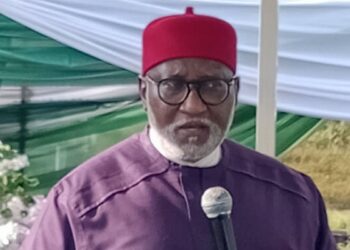
TD Former Anambra Secretary to the State Government, Hon. Oseloka H. Obaze, has called for a fundamental reset of Nigeria’s governance system, urging citizens and political leaders to work together to rebuild trust, strengthen national unity and create a country where Nigerians can live securely and prosper.
Obaze made the call on Sunday, October 4, 2026, while delivering a keynote address titled “Beyond Independence: Building the Nigeria We Want” at the Naija @66 Unity Independence Fest held at the Military Cantonment, Onitsha.
The event was organised as part of activities marking Nigeria’s 66th Independence Anniversary.
Obaze, who is the Managing Director/Chief Executive Officer of Selonnes Consult and a former Secretary to the Anambra State Government, said Nigeria’s 66-year journey had been remarkable, but largely for the wrong reasons.
He said the country was facing a serious trust deficit arising from poor governance, political divisions, insecurity, economic hardship and the failure of citizens to consistently hold public officials accountable.
‘Country is hard’
Using an anecdote to illustrate the economic difficulties confronting Nigerians, Obaze recalled a conversation between two friends who had not seen each other for a long time.

According to him, when one asked, “How country?”, the other replied that the country was hard and that Nigerians were struggling to make ends meet.
The response, he said, was that some Nigerians had gone beyond trying to make ends meet and were now “trying to make ends see each other from a distance.”
Obaze said the anecdote captured the harsh economic reality confronting many Nigerians.
“Country is hard!” he declared.
He argued that although bad leadership had become a dominant narrative about Nigeria, citizens must also recognise their responsibility in rebuilding the country.
“If as Nigerians we acknowledge that our country is in trouble, then we must respond accordingly to fix it,” he said, adding that Nigerians could not depend on outsiders to solve the country’s problems.

Nigeria must move beyond independence
Obaze questioned whether Nigerians were genuinely building the country they wanted, despite decades of political independence.
He said Nigeria had become increasingly fractured and polarised, while citizens had lost confidence in both their leaders and one another.
According to him, the country’s biggest challenge was no longer simply political independence but the need to establish institutions and systems capable of guaranteeing security, economic opportunity, justice and equal rights.
He described nation-building as a long-term process requiring “commitment, sacrifice, inclusivity and tolerance.”
He called for greater religious, ethnic, political, gender and class tolerance, stressing that Nigerians must recognise their shared citizenship regardless of their backgrounds.
‘We need a working country’
Obaze said Nigerians across different parts of the country would likely give similar answers if asked what kind of country they wanted.

He said most Nigerians wanted “a better and working country,” which he described as a nation where government provides basic public goods, economic stability and the rule of law.
He listed food, clean water, affordable housing, healthcare, education, physical security and financial stability among the basic conditions that should be guaranteed to citizens.
According to him, financial security does not necessarily mean becoming wealthy.
Rather, it means Nigerians should not be forced to choose between buying food and purchasing medicine or paying school fees.
“No child should go to bed hungry,” he said, stressing the need for government-backed social safety nets.
Citizens must enjoy equal rights
The former Anambra SSG also stressed the importance of the rule of law and peaceful coexistence.
He argued that every Nigerian should have the freedom to live, work and conduct legitimate business anywhere in the country without discrimination based on ethnicity or state of origin.
Using examples involving herders, traders and other Nigerians who travel across the federation, Obaze said citizens should be free to pursue legitimate economic activities anywhere in Nigeria, provided they respected the law and the rights of others.
He also called for the protection of non-indigenes by state governments and said Nigerians posted for the National Youth Service Corps should be able to serve anywhere in the country without fear for their safety.
“Every man, woman and child must enjoy equal rights and equal protection under the law,” he said.
Citizens must defend their rights
Obaze identified the “office of the citizen” as the highest office in the country, arguing that Nigerians possess constitutional rights and instruments that can be used to demand better governance.
However, he said citizens had frequently surrendered those rights through passivity, tribal loyalty, religious considerations and failure to challenge injustice.
“We face a Catch-22 situation,” he said, arguing that citizens had also abandoned their responsibility to hold public office holders accountable.
According to him, the failure of governance is partly sustained because Nigerians often defend leaders from their ethnic or religious groups even when those leaders fail in their responsibilities.
He warned that such behaviour would continue to widen the distrust between political leaders and citizens.
“Bad things also happen when good men do nothing,” Obaze said.
Insecurity, inflation and poverty threaten Nigeria
Obaze said Nigerians were currently experiencing the consequences of what he described as a broken system.
He cited insecurity, kidnapping, bloodletting, corruption, impunity, inflation, high food and fuel prices, naira depreciation, poverty and what he described as state capture among the country’s major challenges.
“Traveling in Nigeria is now hazardous,” he said, adding that Nigerians were experiencing “weariness” and a growing sense of hopelessness.
Despite the challenges, Obaze said Nigerians should not abandon hope.
He referenced the national anthem’s message that “Though tribe and tongue may differ, in brotherhood we stand,” describing it as an important foundation for genuine nation-building.
Calls for transformative leadership
In his recommendations, Obaze called on future Nigerian leaders to adopt a transformative mindset and place national interests above personal, ethnic and political considerations.
He said such leaders must reduce the cost of governance and the cost of living while confronting corruption, waste, financial leakages and the theft of public resources.
He also advocated a return to export-driven manufacturing, which he said could create jobs and stimulate economic growth.
Other priorities he identified included uninterrupted electricity, a strategic fuel reserve and stronger protection of citizens.
“Nigeria is still a rich but mismanaged country,” Obaze said, maintaining that the country possessed the human capital and ideas required to achieve good governance.
‘Hope is not lost’
Obaze concluded by urging Nigerians not to lose hope in the country.
He said nations thrive when they achieve peace, unity, prosperity and tangible legacies, arguing that Nigeria could still achieve those objectives.
“Hope is not lost and should not be lost,” he said.
He also urged Nigerians to reject vote-selling and dependency on political handouts, arguing that citizens had a responsibility to contribute to national development.
Quoting former United States President John F. Kennedy, Obaze said Nigerians should ask themselves not only what the country could do for them but also what they could do for the country.
He called for Nigerians to recognise one another as compatriots regardless of tribe, language, religion, gender or political affiliation.
“To realise the Nigeria we want, there should be no ‘us’ and there should be no ‘them’,” he said.
Obaze maintained that rebuilding Nigeria was a shared responsibility requiring citizens to contribute positively in their respective fields and engage government constructively.
He called for equity, patriotism and collective action to place Nigeria on a sustainable path to development.