
 ABUJA, Nigeria — The Nigerian Army has commenced the deployment of 600 personnel to India for specialised jungle and mountain warfare training aimed at strengthening the combat capabilities of troops and improving their effectiveness in challenging operational environments.
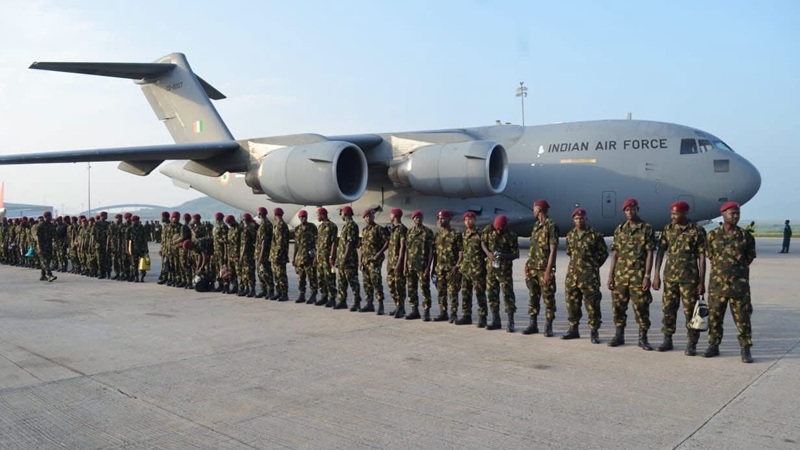
The first batch of 300 personnel departed the Nnamdi Azikiwe International Airport, Abuja, on Thursday, October 22.
They left aboard two Indian Air Force aircraft — a C-17 military transport aircraft and an Airbus A321.
The deployment is being undertaken under the leadership of the Chief of Army Staff (COAS), Lieutenant General Waidi Shaibu.

General Shaibu noted that it’s part of efforts to develop a more professional, adaptable and combat-ready force capable of addressing Nigeria’s evolving security threats.
The remaining 300 personnel were expected to be airlifted to India, bringing the total number scheduled for the specialised training to 600.

Training Targets Operations in Difficult Terrain
The programme is designed to equip participating Army personnel with specialised skills for conducting military operations.
Targetted areas include dense forests, mountainous areas and other difficult terrains where conventional combat approaches may be less effective.
The training is expected to improve tactical proficiency, mobility, adaptability and ability of troops to operate under demanding environmental conditions.
These capabilities could support Nigerian military operations against terrorists, insurgents and other armed criminal groups.
Such exploit forests and remote locations as hideouts and operational bases.
The Army has identified realistic training, personnel development, operational effectiveness and combat readiness as key priorities under Shaibu’s command philosophy.

Nigerian Army Seeks Improved Combat Readiness
The deployment forms part of broader efforts to strengthen the professional capacity of Nigerian Army personnel.
This it hopes to achieve through specialised military instruction and exposure to different operational environments.
The troops are expected to acquire advanced jungle and mountain warfare skills.
They are expected to enhance their ability to navigate difficult terrain, manoeuvre effectively and carry out assigned missions in complex environments.
However, the practical impact of the programme will depend on a host of factors.

These include how the skills acquired are integrated into operational planning, field exercises and deployments after the personnel return to Nigeria.

The training is intended to complement ongoing efforts to improve the Army’s capacity to confront security threats and protect the country’s territorial integrity.
Nigeria–India Defence Cooperation
The deployment also highlights defence cooperation between Nigeria and India, particularly in military training and capacity development.
The use of Indian Air Force aircraft to transport the first batch of personnel underscores the logistical arrangements supporting the programme.
The initiative is expected to contribute to the long-term objective of Nigerian Army.
It hopes to build a resilient, adaptable and mission-ready force capable of responding to a range of security challenges.
The Army has maintained that professional development and combat preparedness remain essential to its responsibility to defend Nigeria’s sovereignty and protect lives and property.
The first batch of 300 personnel has departed for the programme.
Arrangements for the movement of the remaining 300, meanwhile, are expected to complete the planned deployment.