TD There are political scandals, and then there are financial systems so vast, so opaque and so intertwined with political power that they demand a national accounting.
The Alpha Beta affair is one of them.
For decades Nigerians have asked the same question about Bola Ahmed Tinubu:
Where did the money come from?
The question followed him from Chicago to Lagos and eventually into Aso Rock.
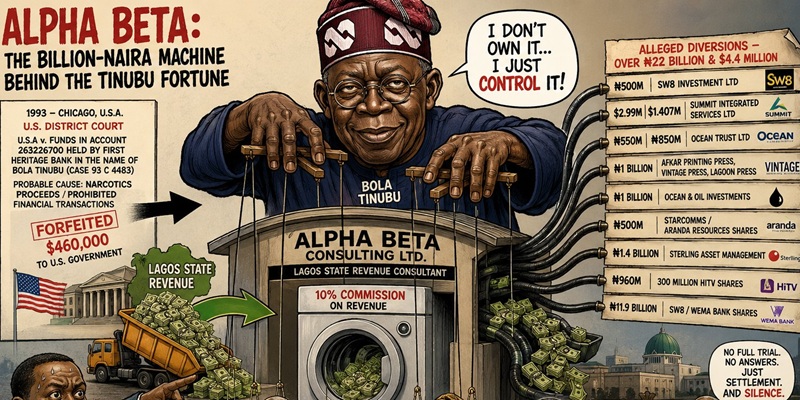
In 1993, the United States government brought a civil forfeiture action in the United States District Court for the Northern District of Illinois against funds held in accounts associated with Bola Tinubu and related entities.
The case was United States of America v. Funds in Account 263226700 Held by First Heritage Bank in the Name of Bola Tinubu, Case 93 C 4483.

The American authorities alleged probable cause to believe the funds represented proceeds of narcotics trafficking or property involved in prohibited financial transactions.
The case ended in a settlement under which $460,000 held in an account in Bola Tinubu’s name was forfeited to the United States government.
Tinubu was not criminally convicted in that proceeding.
But the forfeiture became the beginning of questions that have followed his fortune ever since.
Then came Lagos.

After Tinubu became governor in 1999, a private consultancy named Alpha Beta Consulting emerged at the heart of Lagos State’s internally generated revenue system.
According to court proceedings later brought by Alpha Beta’s former managing director and chartered accountant Oladapo “Dapo” Apara, he developed a proposal around 2000 to use technology to track and reconcile Lagos State revenue.
Apara alleged that Tinubu agreed to the project on condition that 70 per cent of the company belonged to persons nominated by him.
Alpha Beta Consulting Limited was subsequently incorporated.
According to Apara’s pleadings, the original ownership structure included:

Olumide Ogunmola — 40 per cent
Adegboyega Oyetola — 30 per cent
Dapo Apara — 30 per cent
Apara alleged that Oyetola’s interest was later transferred to Tunde Badejo on Tinubu’s instructions and that the shareholders holding the controlling interest were effectively acting on Tinubu’s behalf.
Then came the government contract.
Alpha Beta became a major revenue consultant to Lagos State.
The company was paid a percentage of internally generated revenue collected through the system it helped administer.
Apara stated in his court action that the consultancy fee averaged approximately 10 per cent.
Think about what that meant.
One of Africa’s richest state governments was paying a private company a percentage of the public revenue flowing into Lagos.
According to Apara, Alpha Beta participated in generating approximately ₦1.5 trillion in Lagos State revenue between 2002 and 2018.
At that scale, even a fraction of the revenue represented an extraordinary private income stream.
Then the relationship inside Alpha Beta collapsed.
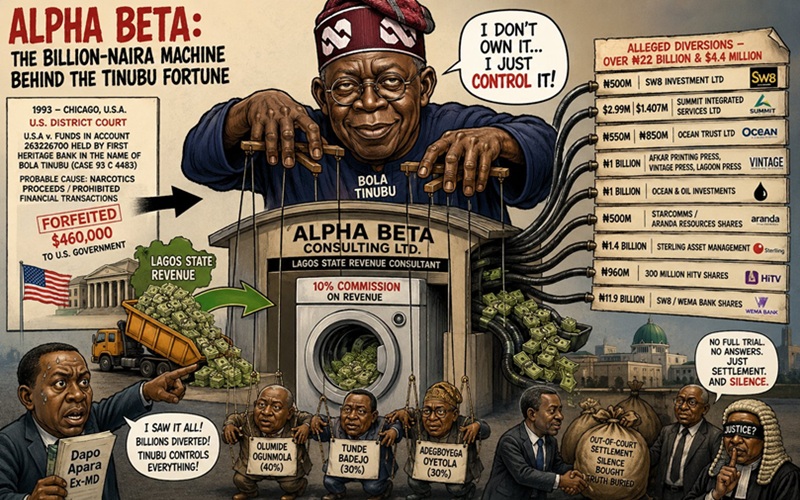
Apara began making explosive allegations concerning what was happening to the company’s money.
His court papers alleged that enormous sums were being transferred out of Alpha Beta through investments, companies and transactions that he said were not properly accounted for.
Among the transactions identified in reporting on the litigation were:
₦500 million to SW8 Investment Ltd
approximately $2.99 million to Summit Integrated Services Ltd
another approximately $1.407 million to Summit Integrated Services Ltd
₦550 million to Ocean Trust Ltd
another ₦850 million to Ocean Trust Ltd
approximately ₦1 billion involving Afkar Printing Press, Vintage Press and Lagoon Press
approximately ₦1 billion involving Ocean and Oil Investments
₦500 million connected to Starcomms and Aranda Resources shares
approximately ₦1.4 billion involving Sterling Asset Management
approximately ₦960 million involving 300 million HITV shares
and approximately ₦11.9 billion connected with SW8 and Wema Bank shares.
Contemporary reporting calculated the disputed transactions described in the litigation at more than ₦22 billion and approximately $4.4 million.
These were not rumours whispered at a beer parlour.
They were allegations emerging from a man who had been inside the company.
A chartered accountant.
A former managing director.
A shareholder.
A man claiming first-hand knowledge of Alpha Beta’s financial operations.
And one name kept appearing in the controversy:
Bola Ahmed Tinubu.
Apara alleged that Tinubu exercised effective control over Alpha Beta despite not appearing publicly as its owner.
He alleged that money belonging to Alpha Beta was diverted through investments and companies for Tinubu’s benefit.
He alleged that Tunde Badejo acknowledged that funds had been diverted through supposed joint ventures.
He alleged that when he attempted to investigate Alpha Beta’s finances more closely, his access to information was obstructed.
He alleged that Akin Doherty, a former Lagos State Commissioner for Finance, was brought into Alpha Beta’s operations.
He further alleged that financial records were inadequate to explain substantial amounts of money earned by the company.
Then came an allegation that should have shaken Nigeria’s anti-corruption establishment.
Apara alleged that Tinubu warned him against taking the matter to the Economic and Financial Crimes Commission, claiming that the then EFCC chairman Ibrahim Magu would protect him.
Alpha Beta denied the allegations.
The company described Apara as a disgruntled former executive and accused him in turn of financial misconduct.
Alpha Beta alleged that Apara improperly converted $5 million purportedly paid for cloud computing services that it claimed were worth far less.
Apara denied wrongdoing.
This should have produced one of the most important financial trials in Nigerian history.
Bank records could have been subpoenaed.
Directors could have been questioned under oath.
Beneficial ownership could have been established.
Lagos State contracts could have been examined.
Every commission paid by the state could have been traced.
Every disputed transfer could have been followed.
Every company receiving Alpha Beta money could have been forced to identify its real owners.
Instead, the case disappeared into settlement negotiations.
By 2022, the parties told the Lagos High Court that they were discussing an out-of-court settlement.
The case was eventually withdrawn following an undisclosed agreement, and Apara relinquished his Alpha Beta shares.
And with that, the Nigerian public lost its opportunity to hear the evidence tested fully in open court.
But settlement does not erase questions.
It merely prevents answers.
Who really owned Alpha Beta?
Who were the beneficial owners behind its controlling shares?
Who decided that Alpha Beta should receive a percentage of Lagos State revenue?
How much money did Lagos State ultimately pay Alpha Beta?
Where are the complete audited accounts?
Who benefited from the payments to Ocean Trust?
Who benefited from SW8 Investment?
What happened to the millions paid to Summit Integrated Services?
Why did Alpha Beta money reportedly move through transactions involving Vintage Press?
Who benefited from the investments in Wema Bank, HITV and other companies listed in the litigation?
And why has there never been a comprehensive public forensic accounting of the entire operation?
The significance becomes even greater when viewed against Tinubu’s earlier American financial history.
A man who surrendered $460,000 to the United States government in a narcotics-related civil forfeiture proceeding later became governor of Nigeria’s richest state.
During that governorship, Alpha Beta became deeply embedded in the machinery collecting Lagos State revenue.
Years later, the company’s own former managing director went to court alleging that Tinubu secretly controlled Alpha Beta through nominees and that billions of naira were diverted through companies and investment vehicles for his benefit.
These are not trivial questions about political gossip.
They concern public money.
They concern political power.
They concern the extraordinary accumulation of private wealth by a man who has spent much of his political career inside government.
Nigeria deserves an answer far more sophisticated than telling citizens to move on.
Open the Alpha Beta books.
Publish every Lagos State contract with Alpha Beta.
Publish every percentage commission paid to the company.
Identify every beneficial owner from the beginning of the company until today.
Publish every payment involving Ocean Trust, SW8, Summit Integrated Services, Vintage Press, Lagoon Press, Afkar Printing Press and the other companies named in the litigation.
Trace every billion.
Trace every dollar.
Put the directors under oath.
Put the bankers under oath.
Put the accountants under oath.
And let the documents speak.
Because the Alpha Beta affair is ultimately about something much bigger than one accounting company.
It is about whether political power in Nigeria can be converted into private wealth behind a wall of nominees, consultants, shell companies, settlements and silence.
And when the man at the centre of those questions becomes President of the Federal Republic of Nigeria, demanding answers is no longer opposition politics.
It is a democratic obligation.