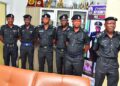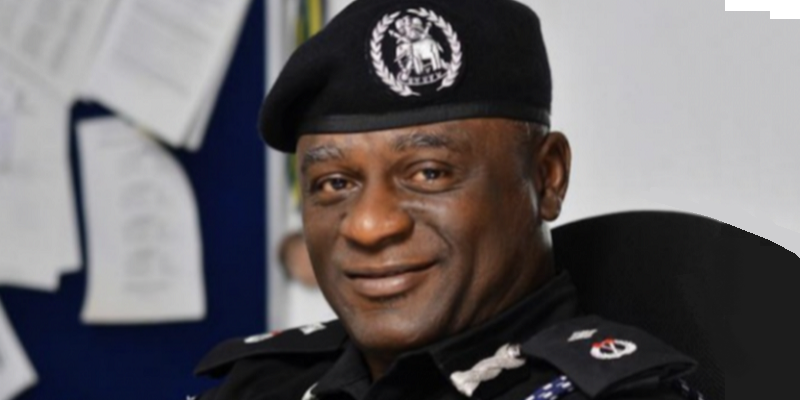

Olatunji Rilwan Disu, simply known to folks as Tunji Disu or TeeJay, was born in Lagos on April 13, 1966.
For two reasons, Disu is an undeniably lucky man. No doubt, he sees himself as one, and so do all the people around him. First, because hitting the age of 60 in a world increasingly plagued by tribulation, and in a chosen career that puts him perpetually in the line of fire, is no mean achievement.
Many of his colleagues and friends have long since dropped into obscurity, or out of existence altogether.
And second, with an age-induced retirement as a police officer already at his doorstep, not to mention the discomfort from anxieties of an imminent private life, fortune suddenly dropped on his laps.
Some forty-eight days to his statutory exit from the Nigeria Police Force, and just when he had begun a gradual clearing of his table and emptying the drawers, President Bola Tinubu announced Disu, then an assistant inspector general of police, as acting inspector general of police, replacing Kayode Egbetokun.
He had only spent two weeks in his new posting as the AIG in charge of Force Criminal Investigation Department (Annex) in Lagos. The rest, pardon the cliché, is history.
Was Disu expecting this sudden flip in his professional path? Less likely than not. Was it a transformation he prayed to God to gift him? Absolutely. Disu is by no means a second-rater.
No professional imbued with his kind of insight and understanding would not pray to whatever they believe in to someday lead them to the pinnacle of their calling. And in fact, if there’s any of Tinubu’s innumerable appointments in the last three years that correctly hits the bull’s eye, it is Disu’s.
Because for sure, he’s not one of those officers often settling for safe, middle-of-the-road results. The man knows his job, and he does it well. Indeed, very few public officers in the country at the topmost level come to their job as prepared and experienced as Disu.
Forged in the combustive furnace of Ajegunle, a densely populated, vibrant but often struggling neighborhood of Lagos bustling with life and talent, Disu knew he had to come into his own on this challenging turf.
He grew up on Boyejo Street, and from his tween years had many bruising, physical fights with his mates and often prevailed across that chaotic environment.
That was how he began to grow the physical, mental and psychological resilience he needed to operate effectively under extreme pressure and life-threatening conditions.
Disu got into St Gregory’s College, Obalende, Lagos, and for himself and friends, routinely stood up to bullies in the school and thugs operating around Obalende. It was no surprise when he got into boxing and started training with Richard Rodriguez in Alakoro, a well-known boxing hub in Lagos Island.
Richard was one of the finest boxers of the time. One day he sparred with Disu, and landed a blow to his right eye, and tears started flowing from the left one. That was the day Disu hung the gloves and quit boxing. But he didn’t stop fighting.
At the Lagos State University where he graduated in English (Education), he joined the taekwondo club. Disu was already making wave in the sport when he pivoted to judo, succumbing to pressure from devotee who wanted him to be part of them.
Today, he’s a well decorated judoka, having represented Lagos State and the police in local and international competitions where he won medals, bringing fame and honour to his state, country and its police.
He’s a master of fundamental throws and grappling techniques. No wonder he’s a yudansha, a black belt holder in the sport.
Disu has judo to thank for everything, for the idea of an enlistment into the Nigeria Police Force kicked off upon walking out of a judo mat after a fight with an opponent who instantly became a friend, and convinced him that a career in the police is worth a shot.
Since passing out from the Police Academy in Kaduna in 1993, he has risen through the ranks to get to where he is today.
Disu’s career is one defined by specialized law enforcement. He has commanded special anti-robbery squads in Ondo and Oyo states, led the anti-kidnapping squad in Rivers State, as well as special anti-robbery and counter-terrorism units in Nigeria.
His priority was handling special robbery cases and complex investigations.
There are so many high points in his operational years but two readily stick out. The first, and the more outstanding in terms of impact, was when he commanded the Rapid Response Squad (RRS) in Lagos, where he transformed a strategic police unit into a model that inspired a nation.
The RRS operatives were popularly known as “The Good Guys” in the whole of Lagos because of the way they responded to crime and related with the people.
As the commander, Disu implemented the philosophy of policing by consent, a theory that has gained acceptance across the world. It’s a simple principle that enjoins the police to be friendly to the people, educate before arrest, and recognize that the community and the police are one.
He knew that if he could change the policemen in RRS, he could change policemen in Lagos State. And if he could change policemen in Lagos State, he could change policemen everywhere in Nigeria.
The second achievement of high significance was in Rivers State where he was commissioner of police.
He had led a special operation that resulted in the neutralization of Gift Okpara, alias General 2Baba, the henchman of the ruthless Iceland secret cult notorious for their criminal activities in Ahoada West Local Government and its environs.
In September 2023, the police launched a massive manhunt for General 2Baba, following his group’s gruesome murder of Bako Angbashim, a superintendent of police and divisional police officer of Ahoada Division. Disu ensured General 2Baba and many of his members paid for this heinous crime.
The new IGP recognizes that respecting the fundamental human rights of the people is important for building trust and improving crime prevention.
Last week, he met with the civil society and human rights community in Abuja and gave assurance that under his watch, police work in Nigeria would be much better.
It is only an IGP who knows his onions and one who is self-assured that can have such open and frank discussion with the third sector known for its watchdog role in holding the government, public institutions and public officers accountable.
The meeting discussed a number of issues, including state police, something IGP Disu considers a necessity and priority, the commercialization of bail, the abuse of the power of law enforcement officers by some highly-placed Nigerians, and impunity by some police officers.
Others are the rights of citizens arrested by the police, relationship with the media and journalists, the welfare of police officers, their roles during elections, and the case of Mubarak Bello, a police whistleblower in the Katsina State police command, who is facing retaliation that has left him fearful for his life.
The rest are the controversial and notorious Tiger Base unit in Owerri, Imo State, that has given the police a bad name, and the need to ensure constant interaction with citizens.
IGP Disu and his management team committed to addressing these issues. It was refreshing and reassuring coming from the leadership of an institution that Nigerians love to hate, understandably so.
Happy birthday IGP Tunji Disu. May you succeed in your new role.
Chido Onumah and Godwin Onyeacholem are with the African Centre for Media & Information Literacy (AFRICMIL).