TD A fresh theory has emerged over why the United States Federal Bureau of Investigation (FBI) is continuing to withhold portions of its historical investigative records concerning Nigerian President Bola Ahmed Tinubu more than three decades after the underlying investigation.

The theory was advanced by U.S.-based writer and researcher Mike Arnold.
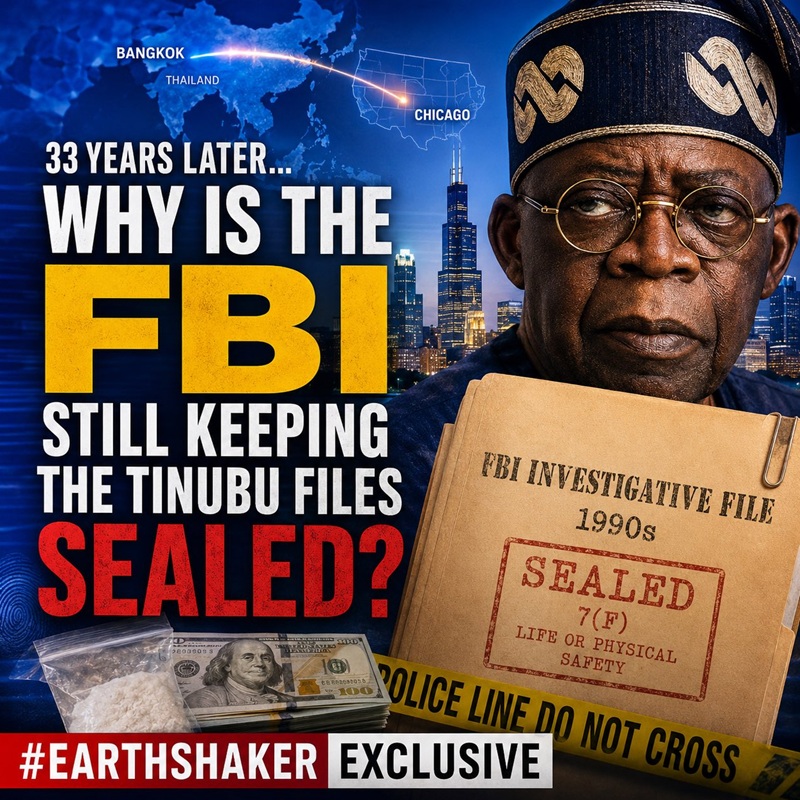
Arnold argues that the FBI’s reliance on Freedom of Information Act (FOIA) Exemption 7(F) may indicate that the records contain information involving protected sources or individuals whose identities could still carry security risks.
The Exemption protects information whose disclosure could reasonably be expected to endanger an individual’s life or physical safety
Arnold’s argument comes amid a renewed legal battle over the release of FBI and other U.S. law-enforcement records relating to investigations from the early 1990s.
In a filing dated August 20, 2026, the FBI asked U.S. District Judge Beryl Howell to allow it to provide confidential declarations ex parte and in camera.
Ex parte and in camera means privately and under seal, explaining why some of the records should remain withheld.
The agency cited several FOIA exemptions, including Exemptions 7(E) and 7(F), relating respectively to law-enforcement techniques and threats to physical safety.
The latest development follows a ruling in the long-running FOIA case brought by transparency activist Aaron Greenspan.
Greenspan’s requests include Tinubu’s FBI file and interview records from 1992–1993.
Arnold’s theory centres on alleged cooperation
In his latest commentary, Arnold proposes that the continuing invocation of the life-safety exemption could be connected to information allegedly provided by individuals who cooperated with U.S. investigators during the Chicago heroin investigation.
He links the theory to an early-1990s investigation involving Nigerian nationals and a heroin distribution network operating between the United States and overseas suppliers.
Arnold specifically alleges that Tinubu may have provided information to U.S. authorities during the investigation.
He also alleges that such cooperation could explain why certain information remains sensitive decades later.
However, this remains Arnold’s theory and has not been established by the FBI, a U.S. court or publicly released records.
There is currently no public evidence establishing that Tinubu acted as a government informant or that his alleged cooperation is the reason for the FBI’s invocation of Exemption 7(F).

Court records confirm investigation into Chicago heroin network
Publicly available U.S. court records do establish that federal investigators in the early 1990s investigated a Chicago-area heroin organization involving Adegboyega Mueez Akande, Abiodun Agbele and Lee Andrew Edwards, among others.
A sworn affidavit filed in a 1993 federal forfeiture case described an investigation conducted by the FBI, IRS and DEA into a Chicago heroin ring.
The affidavit identified Tinubu among individuals whose records investigators examined.
The same court material states that Agbele was arrested after selling an ounce of white heroin to an undercover law-enforcement officer in November 1990.
Agbele subsequently agreed to cooperate with investigators concerning Akande’s distribution network.
The investigation eventually resulted in the forfeiture of funds associated with Tinubu.
Tinubu was not criminally charged or convicted in that case, a distinction that remains important when reporting the historical allegations.

Operation Global Sea adds another layer
Arnold also connects the historical Tinubu investigation to Operation Global Sea, a major multinational anti-narcotics operation launched in the mid-1990s.
U.S. government records confirm that Operation Global Sea targeted a Nigerian-run heroin network stretching from Thailand to the United States.
The operation involved the DEA, FBI, U.S. Customs Service and law-enforcement authorities in several countries.
According to the DEA’s historical account, the 18-month operation resulted in the seizure of 55.5 kilograms of heroin with an average purity of 80 percent.
It also resulted to the arrest of 44 defendants in Bangkok, Chicago, New York, Detroit and Pakistan.
A 1997 congressional record similarly described the operation as targeting a Nigerian-run organization.
The organization was allegedly responsible for moving multi-kilogram quantities of heroin from Thailand to Chicago.
44 arrests and seizures valued at between $20 million and $25 million on the U.S. street market were made by authorities.
The historical evidence therefore confirms that sophisticated Nigerian-linked Southeast Asian heroin trafficking networks existed during the period in question.
What remains unproven, however, is Arnold’s assertion that those networks explain the FBI’s current decision to keep particular Tinubu records secret.
Judge to examine FBI’s confidential explanation
The latest court proceedings could provide an important clue.
Judge Howell has permitted the FBI to present its sensitive justification privately.
Meanwhile, the government and other parties have been given until August 28, 2026, to make their arguments concerning the release of the disputed records.
The significance of the development is that the FBI is no longer merely refusing to discuss the existence or contents of the records.
It is asking the judge to examine confidential explanations for why particular information remains protected.
For now, the public does not know what information the sealed declarations contain.
Theory remains unproven
Arnold’s central question—what could remain dangerous about an investigation that is more than 30 years old?—is likely to remain at the centre of public debate as the FOIA case proceeds.
Possible explanations could include confidential sources, investigative methods, identities of individuals who assisted authorities, or other information protected under federal law.
The FBI has not publicly specified which individuals or information it believes could face a safety risk.
Consequently, claims that the records prove criminal wrongdoing by Tinubu, or that he cooperated with U.S. authorities in exchange for immunity, should not be presented as established facts.
The coming court review may determine whether the FBI’s reliance on the life-safety exemption is legally justifi.
It may potentially shed further light on what remains hidden inside the decades-old Tinubu files.