



 A United States congressional hearing on Nigeria’s security crisis has raised fresh concerns about the Tinubu administration’s response to violence and preparations for the 2027 presidential election.
The hearing, titled “One Year Later: Assessing Nigeria’s Efforts to Protect Christians and Secure the Middle Belt,” took place on Thursday, November 12, 2026.
It was organised by the Africa Subcommittee of the US House Foreign Affairs Committee.
Republican Congressman Chris Smith chaired the session in Washington, DC.
One of the witnesses was Frank Garcia, Assistant Secretary of State for African Affairs.
Garcia warned that Nigeria’s January 2027 presidential election could trigger additional violence.

He also identified significant weaknesses in Nigeria’s security and judicial institutions.
According to Garcia, Nigeria’s security architecture remains stretched. He added that judicial reach into the Middle Belt remains limited.
He further acknowledged that resources available to support Nigeria’s security challenges were finite.
Garcia stated:
“Nigeria will hold presidential elections in January, which could spur violence. In addition, Nigeria’s security architecture remains stretched.
“Its judicial reach into the Middle Belt remains limited, and the resources we can bring to bear are finite.

But when American diplomacy is engaged, when our demands are specific, and when we hold partners accountable in private and public, we achieve results no one else can deliver.”
US Raises Pressure Over Nigeria’s Security Crisis
The hearing examined Nigeria’s progress since President Donald Trump redesignated the country as a Country of Particular Concern (CPC) on October 31, 2025.
The designation followed concerns about religious freedom violations and attacks against Christian communities.
Garcia acknowledged that violence had continued despite diplomatic engagement between Washington and Abuja.
He cited attacks on Christian communities in Kaduna State and killings in Plateau State.
He also outlined several measures undertaken by the United States.

These include police training, equipment support and expanded biometric information sharing.
Washington has also worked with Nigerian financial institutions to disrupt terrorist financing networks.
Garcia, however, said Nigeria must demonstrate greater progress.
He specifically highlighted civilian casualties, displaced persons’ return and transparency in humanitarian assistance.
Chris Smith Demands Accountability
In his opening remarks, Congressman Chris Smith expressed concern over continuing attacks against Christian communities.
He questioned the Nigerian government’s effectiveness in protecting vulnerable populations.
Smith also advocated stronger diplomatic pressure and targeted sanctions against perpetrators.
He disclosed that Congress had developed the Nigeria Religious Freedom and Accountability Act of 2026.
The proposed legislation is intended to strengthen accountability following Nigeria’s religious freedom designation.
Smith urged the US State Department to ensure that diplomatic engagements produce measurable results.
Von Batten Calls for Sanctions Against Tinubu
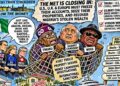
Following the hearing, Washington-based Republican lobbying firm Von Batten-Montague-York, L.C., published a video highlighting Garcia’s testimony.
The post, shared through its @batten_von account, criticised President Bola Tinubu’s administration.
It accused the Nigerian government of corruption and complicity in the country’s security challenges.
The firm also raised concerns about the credibility of Nigeria’s forthcoming presidential election.
It argued that the United States should consider punitive measures against Tinubu and individuals associated with his administration.
Among its demands were sanctions, seizure of accounts and confiscation of assets.
The post specifically called for accountability involving the President, his family, associates and alleged agents.
These demands represent the firm’s position. They were not announced as decisions or policies adopted by the US government during the hearing.
Nigeria’s 2027 Election Under International Scrutiny
Nigeria’s presidential election is scheduled for January 16, 2027, according to the Independent National Electoral Commission (INEC).
Garcia’s warning has added an international dimension to concerns about election-related violence.
His testimony also highlighted the need for stronger security arrangements and effective judicial institutions.
Meanwhile, the lobbying firm’s intervention has introduced allegations of possible electoral manipulation into the wider debate.
However, the hearing did not establish that President Tinubu or his administration was planning to rig the election.
The congressional proceedings instead focused on religious freedom, insecurity, accountability and the effectiveness of US-Nigeria cooperation.
Nigeria’s government faces growing expectations to protect citizens, strengthen security institutions and guarantee credible elections.