
The number of Jehovah’s Witnesses imprisoned in Ukraine for refusing military service has risen to 18, following the detention and sentencing of four more men in late February and March.
The cases highlight ongoing tensions between constitutional rights to alternative civilian service and wartime mobilization requirements.
Jehovah’s Witnesses in Detention in Ukraine
February 25: Serhii Myniov Detained in Odesa
On February 25, the Peresypskyi District Court of Odesa ordered Serhii Myniov, 48, into pretrial detention, rejecting his request for bail.
Despite the ruling, Serhii expressed resilience, saying: “I view this criminal case as an opportunity to give a thorough witness.”
His case underscores the judiciary’s hardline stance on conscientious objection during wartime, even as defendants cite constitutional protections.
March 2: Ruslan Khramtsov Detained in Lviv
Less than a week later, on March 2, the Lychakivskyi District Court of Lviv placed Ruslan Khramtsov, 39, in pretrial detention, also denying bail.
Ruslan emphasized the spiritual strength he draws from his faith:
“Prayer and Bible reading help me to see Jehovah’s hand. This builds my endurance and strengthens my faith.”
His words reflect the determination of many conscientious objectors who view imprisonment as a test of faith rather than defeat.
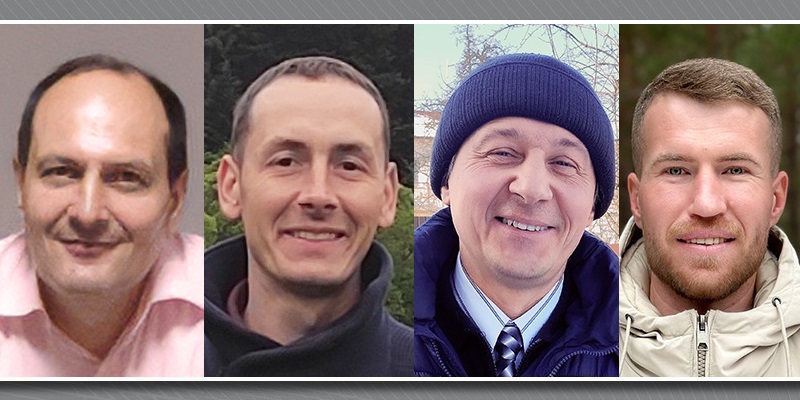
March 11: Dmytro Petrov Sentenced
On March 11, Dmytro Petrov, 49, began serving a three-year prison sentence.
The Starosambirskyi District Court of Lviv Region had convicted him in November 2025.
It ruled that his request for alternative civilian service amounted to “evasion of mobilization.”
His appeal was denied.
Before entering prison, Dmytro remarked:
“The examples of faithful servants of God from both the past and the present help me to remain steadfast.
“I am confident that these trials are temporary.”
March 18: Dmytro Prodan Sentenced
A week later, on March 18, Dmytro Prodan, 32, also began serving a three-year sentence.
He had requested alternative civilian service under Ukraine’s Constitution.
However, the Yampil District Court of Vinnytsia Region convicted him of evading military service in November 2025.
His appeal was likewise denied.
His case illustrates the growing pattern of courts rejecting constitutional claims in favor of strict enforcement of mobilization laws.
Broader Context for Jehovah’s Witnesses
Ukraine’s Constitution guarantees the right to alternative civilian service for those who conscientiously object to military duty.
However, amid the ongoing war, courts have increasingly interpreted the requests by Jehovah’s Witnesses as evasion.
Human rights advocates argue this undermines religious freedom and international norms, while authorities insist mobilization is essential for national survival.
Currently, 18 Jehovah’s Witnesses are imprisoned in Ukraine for conscientious objection.
Their families and communities continue to pray for their endurance.
They cite biblical counsel to support those in authority while striving to live “a calm and quiet life with complete godly devotion.”
The imprisonment of these four men adds to a growing list of cases that pit personal conscience against wartime law.
As Ukraine struggles to balance national defense with constitutional rights, the plight of conscientious objectors remains a deeply contested issue.
It draws attention from international observers and human rights organizations alike.