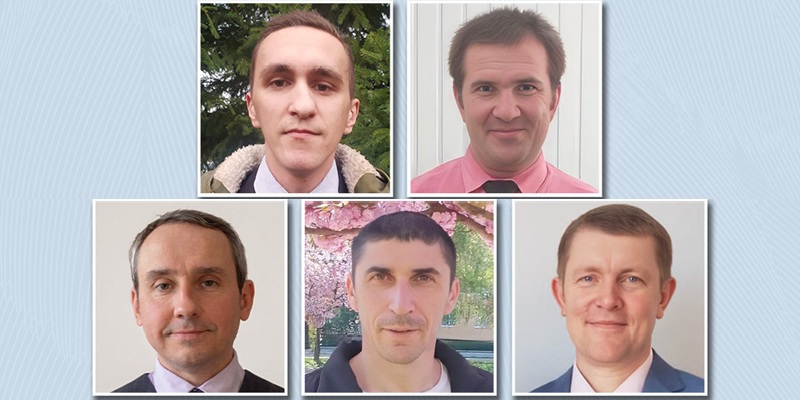
TDAuthorities in Ukraine have imprisoned five more members of Jehovah’s Witnesses between late March and April 2026 for their conscientious refusal to perform military service.
The recent development brings the total number of imprisoned Witnesses in the country to 24.
The cases underscore the growing clash between constitutional guarantees of religious freedom and the state’s wartime mobilization demands.
Recent Cases
- March 27, 2026: Zenovii Zhabiak, 27, began serving a three-year prison sentence after the Zhydachiy District Court of Lviv Region convicted him of evading military service.
His request for alternative civilian service—explicitly guaranteed under Ukraine’s Constitution—was denied.
Before imprisonment, Zenovii reflected on his faith:
“Jehovah is a great source of encouragement for me. When I am struggling, he strengthens me.
“When I feel lonely, he reminds me that I am not alone.
“Throughout this trial, the words at Isaiah 41:10 have helped me to cope with feelings of anxiety and uncertainty.”
- April 7, 2026: The Lychakiyskiy District Court of Lviv placed Kostiantyn Perevozenko, 42, in pretrial detention, refusing bail.
He explained what sustains him:
“Jehovah’s holy spirit helps me to endure under difficult conditions and to continue witnessing boldly to officials and other representatives of the government.”
- April 8, 2026: The same court detained Oleksii Holoviatynski, 49, and Zoltan Demesh, 43.
Oleksii was denied bail, while Zoltan was offered conditional bail requiring him to live inside a military facility.

He declined on grounds of conscience and remains in custody. Oleksii stated:
“Faith, prayer, hope for the future, and the support of my brothers and sisters help me to remain steadfast.
“They give me the strength to stand firm in my convictions.”
- April 20, 2026: Officials arrested Mykhailo Diavoliuk, 47, who was placed in pretrial detention by the Zaliznychnyi District Court of Lviv later that day.
Legal and Human Rights Concerns
What makes these cases particularly troubling is that Kostiantyn, Mykhailo, Oleksii, and Zoltan were initially taken by force to military compounds and enrolled as soldiers against their will.
If convicted, they could face harsher sentences of up to ten years for “not complying with military orders.”
Jehovah’s Witnesses maintain that Ukraine’s Constitution guarantees the right to alternative civilian service.
The provision was designed to protect citizens whose religious or moral convictions prevent them from bearing arms.

Human rights observers argue that denying this right violates both domestic law and international standards.
Such standards include the International Covenant on Civil and Political Rights, which recognizes conscientious objection as part of freedom of thought, conscience, and religion.
International watchdogs have repeatedly raised concerns about Ukraine’s treatment of conscientious objectors.
They warn that such prosecutions risk undermining democratic principles and eroding trust in the rule of law.
Broader Context
Jehovah’s Witnesses have long faced persecution in various countries for their refusal to participate in military service.

The stance is rooted in their interpretation of biblical neutrality.
Ukraine is constitutionally bound to provide alternative civilian service.
However, the pressures of ongoing conflict have led to stricter enforcement of conscription laws, often at the expense of religious rights.
Observers note that these imprisonments highlight the tension between national security imperatives and individual freedoms.
For many, the issue is not simply about military service but about whether a state can override conscience in times of crisis.
Outlook
As the number of imprisoned Witnesses rises, the cases highlight ongoing tensions between Ukraine’s military requirements and the religious convictions of conscientious objectors.
Supporters of the imprisoned men express confidence that their faith will sustain them, citing biblical promises of “endurance and comfort.”
Advocates for religious freedom are expected to continue pressing Ukrainian authorities to honor constitutional guarantees and international obligations.
Meanwhile, families of the detained men call for solidarity and prayer, emphasizing that their loved ones are enduring imprisonment not for crimes, but for their faith.
Summary: Five more Jehovah’s Witnesses have been imprisoned in Ukraine for refusing military service, raising the total to 24.
Courts in Lviv and surrounding regions denied requests for alternative civilian service, placing several in pretrial detention with potential sentences of up to ten years.
The cases have drawn concern from human rights advocates, who warn that Ukraine’s actions undermine constitutional protections and international standards on freedom of conscience.