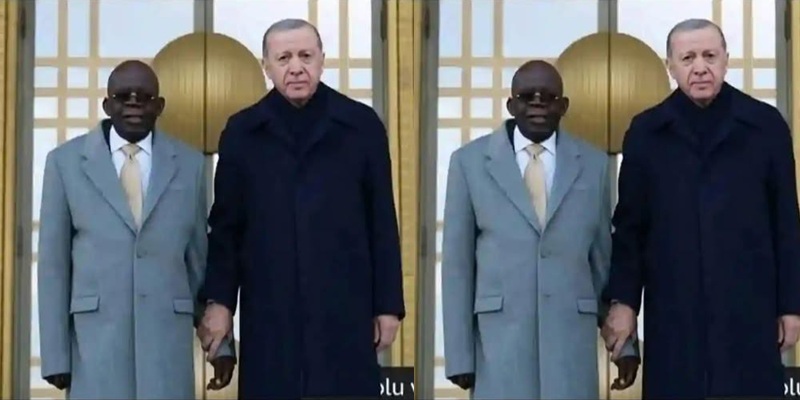
TDPresident Bola Ahmed Tinubu’s recent state visit to Turkey has ignited a storm of debate across Nigeria, after viral videos showed him appearing disoriented and physically assisted by Turkish President Recep Tayyip Erdogan during official proceedings.

The footage, widely shared on social media, has intensified concerns about the president’s health and ability to lead Africa’s largest democracy.
The Incident in Turkey
In one clip, Tinubu seemed to lose his footing while standing for the national anthem.
Erdogan, standing beside him, reached out to guide him back into position.
In a video footage published by This Dawn on January 27, President Tinubu was seen veering away from his Turkish host before he suddenly tripped and fell.
Another video showed Tinubu wandering briefly before being redirected by the Turkish leader.
For many Nigerians, the imagery was striking: a head of state appearing frail and dependent on another leader for support during a solemn occasion.
One commentator captured the mood with a vivid analogy:
“The last time I was held like this was when I was five years old, about to cross an express road. An elderly man gently held my hand.”
Such remarks have fueled a wave of criticism, with detractors arguing that the president’s physical state undermines his authority and credibility.
Public Outcry
Social media platforms erupted with commentary, memes, and sharp criticism.
Supporters of the opposition mocked the incident.
They point to the irony of chants like “On your mandate we shall stand” for a leader who appeared unable to stand unaided.
Others described the videos as “props and padded clips” that expose a deeper reality about Tinubu’s health.
“This is not just a stumble, senility on display here. It is frailty on display.
“Nigerians must set aside tribalism, religion, and political bias and confront the truth,” one critic wrote.
The incident has also sparked broader conversations about transparency in governance.
Many Nigerians argue that the presidency owes the public clear information about the president’s health, given the demands of the office and the stakes for national stability.
Health and Leadership Debate
Tinubu’s health has long been a subject of speculation.
During the 2023 election campaign, opponents frequently raised questions about his fitness.
They cite occasional lapses in speech and gait.
Supporters dismissed these concerns as politically motivated, insisting that the president remained capable of fulfilling his duties.
However, the Turkey videos have reignited the debate with fresh urgency.
Analysts note that such imagery, regardless of context, reinforces perceptions of weakness and erodes confidence in leadership.
In a country where past leaders’ health crises have disrupted governance, the issue resonates deeply.
Political scientist Dr. Chika Okafor observed: “Leadership in Nigeria is not just about policy; it is about symbolism.
“When citizens see their president appearing frail on the global stage, it affects morale, trust, and the perception of Nigeria abroad.”
Implications for Governance
The controversy comes at a critical time.
Nigeria faces mounting economic challenges, including inflation, currency instability, and widespread unemployment.
Security concerns persist in the north and middle belt, while calls for reform in energy and infrastructure grow louder.
In this context, doubts about the president’s vitality risk undermining both domestic confidence and international partnerships.
Diplomatic analysts warn that repeated incidents could weaken Nigeria’s standing in global negotiations.
“Foreign leaders may quietly question whether Tinubu can sustain the rigors of international diplomacy,” one observer noted. “
That perception alone can shift dynamics in trade and security talks.”
Calls for Transparency
Civil society groups have begun pressing for greater transparency from the presidency.
Some argue that Nigeria should adopt clearer constitutional mechanisms for assessing a leader’s health, similar to practices in other democracies.
Others emphasize the need for succession planning to ensure stability should health issues escalate.
For now, the presidency has not issued a detailed response to the Turkey videos.
Officials have typically dismissed such controversies as distractions, urging Nigerians to focus on policy achievements.
Yet the growing chorus of concern suggests that silence may no longer suffice.
The Turkey incident has become more than a viral moment.
It is a flashpoint in Nigeria’s ongoing debate about leadership, accountability, and the intersection of health and governance.
Whether Tinubu’s supporters can reassure the public, or whether critics will succeed in framing the narrative as one of decline, remains to be seen.
What is clear is that Nigerians are demanding honesty and transparency.
As one commentator bluntly put it: “Let’s face the truth: this man is frail and needs rest. Plenty of it.”