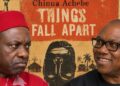



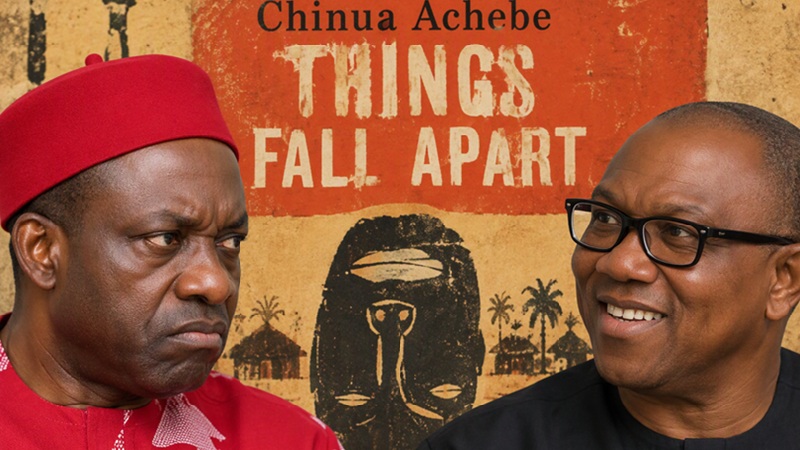

 In Chinua Achebe’s “Things Fall Apart”, there is a scene that still haunts every reader. The Oracle has decreed that Ikemefuna must die. The elders of Umuofia have decided. But Ezeudu, the oldest man in the village, warns Okonkwo privately:
“That boy calls you father. Do not bear a hand in his death.”
Okonkwo hears him. He understands him. Yet when the moment comes, on the journey to the forest, Ikemefuna runs to Okonkwo crying, “My father, they have killed me!“.
And Okonkwo, afraid of being thought weak, afraid of being thought like his father Unoka, draws his machete and cuts him down himself.
That is the tragedy. It was not the Oracle alone. It was not the elders alone. *Okonkwo killed Ikemefuna himself.*
Here lies the problem.
1. The Fear That Kills
Okonkwo did not kill Ikemefuna because he hated him. He loved the boy. Ikemefuna had become part of his household, a brother to Nwoye, a son in everything but blood.

He killed him because he feared what others would think. He feared to appear weak. He feared to appear womanly. He feared to lose his reputation as a man of action.
Achebe writes that Okonkwo was “afraid of being thought weak.” That fear became stronger than love, stronger than wisdom, stronger than fatherhood.
This is the exact sickness that has entered our politics today.
2. Soludo, APGA, and The Killing of Our Own
Today in Anambra, we are witnessing a political Ikemefuna moment.
Peter Obi is not a stranger. He is our son.
He is a son of Anambra, a son of Igboland, a product of APGA’s own political womb, a man who carried the party when it was nothing, who made APGA a name across Nigeria, who governed Anambra for eight years under the APGA banner.

Yet today, Prof. Charles Soludo and the leadership of APGA have taken a stance for Bola Tinubu against Peter Obi.
Like Okonkwo, they did not need to bear a hand in the death. They could have stayed neutral.
They could have stayed silent. They could have, like Ezeudu, warned: “This boy calls us father, do not bear a hand in his death.”
But instead, they have chosen to be the ones to strike the blow themselves.
They have chosen to publicly campaign, endorse, and defend a stance that weakens their own son in the national arena.
Why? Just like Okonkwo, it is fear.

Fear of being seen as not being in the good books of Abuja. Fear of losing federal favour. Fear of being called opposition. Fear of being thought weak before power.
And so, like Okonkwo, they sacrifice the son to prove their manliness before strangers.
3. The Stranger’s Oracle
In the novel, the Oracle demanded the death. In our politics, the “Oracle” is the centre, the ruling power, the fear of being out of favour.
Okonkwo wanted to show the elders that he was not weak. Soludo and APGA want to show Abuja that they are not stubborn, that they are “realistic,” that they are “national.”
But what is the cost? You kill your own to please outsiders. You cut down the boy who runs to you for protection, shouting, “My father, they have killed me!”
That cry is the cry of many Ndi Anambra and Ndi Igbo today. We look at our leaders and ask:
Why must you be the one to do it? If others want to fight Peter Obi, let them fight him. Why must his own father’s house be the hand that holds the machete?
4. The Aftermath: Things Fall Apart
After Okonkwo killed Ikemefuna, things were never the same again.
Nwoye left him. His son could no longer trust his father. His household lost its peace.
Okonkwo himself was haunted, he could not sleep, he could not eat. He had killed the boy to prove he was strong, but he became weaker than ever.
That is the lesson for APGA today.
When you kill your own son to prove loyalty to outsiders, you do not gain strength. You lose your moral authority. You lose your youth. You lose your future.
The Nwoyes of APGA, the young people who believed in the party, will walk away, not because they hate APGA, but because they can no longer trust a father who kills his own.
Achebe teaches us that a man who kills his son to please the village will one day have no village to please, because the village itself will have fallen apart.
5. Conclusion: Here Lies The Problem
The problem was never that Ikemefuna had to die. The problem was that Okonkwo, the father figure, chose to kill him himself.
The problem today is not that Peter Obi has opponents. Every politician has opponents.
The problem is that his own political father-house, APGA under Prof. Soludo, has chosen to be the hand that strikes him.
History will remember this. Just as Umuofia remembered Okonkwo not for his strength, but for the night he cut down the boy who called him father, so will Anambra remember this moment.
Let us learn from Okonkwo before it is too late. Let us not kill our own to prove we are strong.
For as Achebe warned us, when a father kills his son, things fall apart, and the centre cannot hold.