TD A decades-old document from the University of Nigeria, Nsukka has resurfaced with extraordinary allegations about Charles Chukwuma Soludo.
The document offered a glimpse into the bitter student politics surrounding the man who would later become governor of the Central Bank of Nigeria and, eventually, governor of Anambra State.
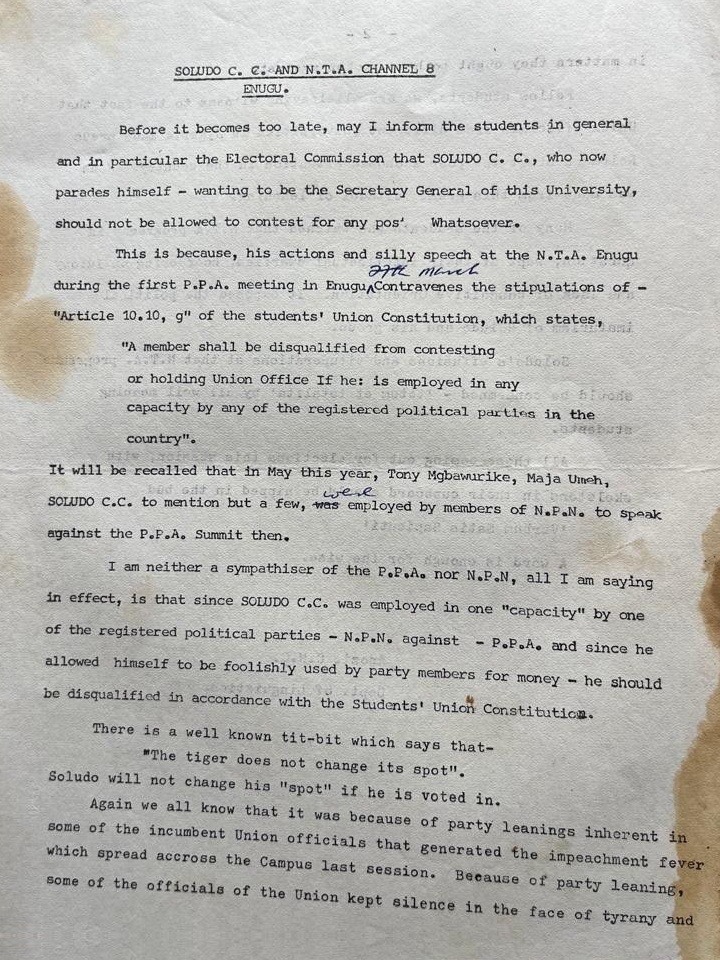
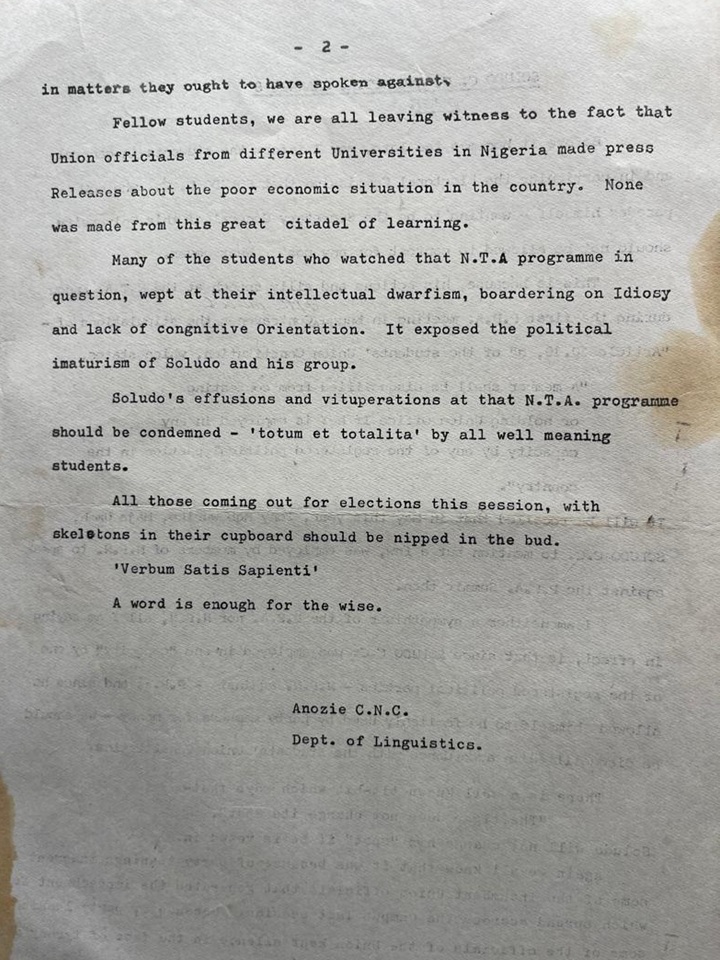
The two-page document supplied to This Dawn was apparently written during Soludo’s university days.
It is, however, not a neutral historical record.
It is an openly hostile political tract written by someone identified on the document as Anozie C.N.C., Department of Linguistics.
Its allegations cannot independently be established from the document alone, nevertheless, its language is remarkable.
The writer accused the young Soludo and associates of engaging in unruly conduct.

They displayed what the document called “political immaturity”, following an appearance on an NTA programme in Enugu.
The author went considerably further, attacking what the document described as Soludo’s “effusions and vituperations” during the television programme.
It urged fellow students to condemn the conduct.
Opponent Wanted Soludo Barred from Student Election
The document headed “SOLUDO C. C. AND N.T.A. CHANNEL 8 ENUGU,” called for Soludo to be prevented from contesting for Secretary-General of the university’s Students’ Union.
Its author alleged that Soludo’s participation in political activities connected with the NPN ran contrary to a provision of the Students’ Union Constitution.

The Constitution barred candidates employed “in any capacity” by a registered political party.
According to the document, Soludo and several other students were engaged by NPN members to speak against a PPA summit.
Those are allegations made by the document’s author.
The surviving pages supplied to This Dawn do not contain Soludo’s response or an electoral commission ruling.
It does not also provide evidence establishing the alleged payment or employment, or proof that the accusation resulted in disqualification.

That distinction matters. But so does the ferocity of the attack.
The author warned fellow students that “the tiger does not change its spot” and predicted that Soludo would not change if elected.
The second page accused Soludo and his group of “political immaturity”.
It called upon students to reject candidates carrying political “skeletons in their cupboard.”
Soludo: Old Attack, Striking Modern Echoes
Whatever the truth of that long-ago campus dispute, its resurfacing comes at an awkward moment for Soludo.
He has recently faced a fresh wave of criticism over his government’s publication of purported debt records relating to former Anambra governor Peter Obi.
The Soludo administration said Obi’s government left outstanding loans and other inherited liabilities.
Meanwhile, critics responding online accused Soludo of bitterness and political distraction.
The episode is not the first time criticism of Soludo has focused as much on political temperament as policy.
An opinion article published by The Source in January 2024 argued that politicians can find their achievements obscured by what voters perceive as arrogance or disrespect toward political stakeholders.
The article discussed Soludo’s political challenges in that context.
Again, that is commentary rather than an independently established finding about his personality.
More recently, Nigeria Education News reported in August 2025 that online critics were questioning whether Soludo’s celebrated academic brilliance had translated into his political leadership.
It described accusations concerning blunt remarks, political manoeuvring and his approach to reelection.
Brilliant Economist, Combative Political Reputation
What makes the rediscovered document intriguing is precisely the contrast.
Soludo went on to build a formidable academic and professional résumé and becoming a professor of economics.
He served as governor of the Central Bank of Nigeria from 2004 to 2009 and later became governor of Anambra State.
Yet the yellowed university document shows that controversy over Soludo’s political manner did not necessarily begin in Government House.
Long before the governorship, long before the Central Bank and long before today’s battles with supporters of political rivals, at least one campus opponent saw through Soludo.
He already depicted Soludo as politically immature, combative and unsuitable for student leadership.
Painting Soludo as immature, unruly and petty, the hostile campaign document established a lifelong personality trait.
As an archival snapshot, it raises a sharper and journalistically defensible question:
Has Nigerian politics changed Charles Soludo, or are today’s political confrontations merely the latest chapter in a combative style that his opponents were complaining about decades ago?
The newly resurfaced pages cannot answer that question.
They do, however, show that the argument is much older than many Nigerians might imagine.
About the archival document
The photographed material consists of two aged, typewritten pages.
The first page bears the heading “SOLUDO C. C. AND N.T.A. CHANNEL 8 ENUGU” and contains handwritten corrections.
The second page ends with the name “Anozie C.N.C.” and “Dept. of Linguistics.”
Neither photographed page visibly supplies a publication date, so This Dawn could not assign the document a precise year.
This medium treats allegation contained in the document as historical claims by its author, rather than independently verified facts.
See the document attached below: