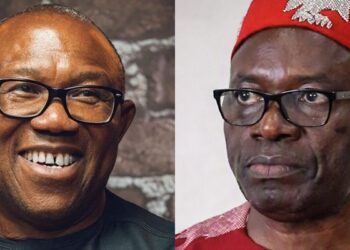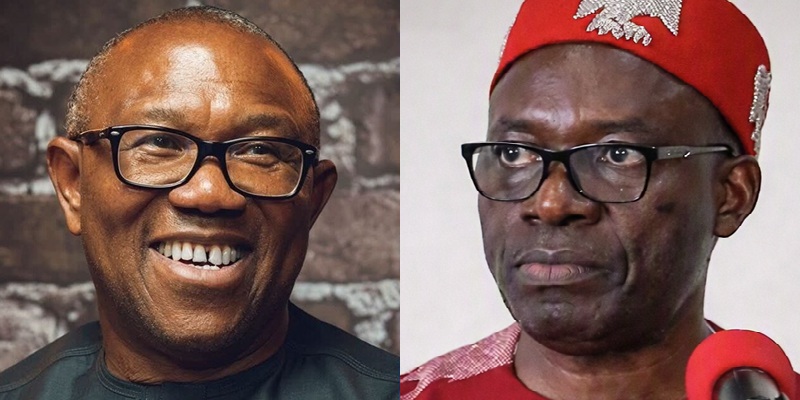
TD Governor Charles Chukwuma Soludo, a man who prides himself on being a Professor of Economics and former Central Bank Governor, has managed to commit one of the most embarrassing blunders in Nigeria’s political history.

In a press statement released by his administration, Soludo claimed that former Governor Peter Obi borrowed a staggering $123 billion in just eight years as Anambra State governor.
See a highlighted screenshot of the document below:
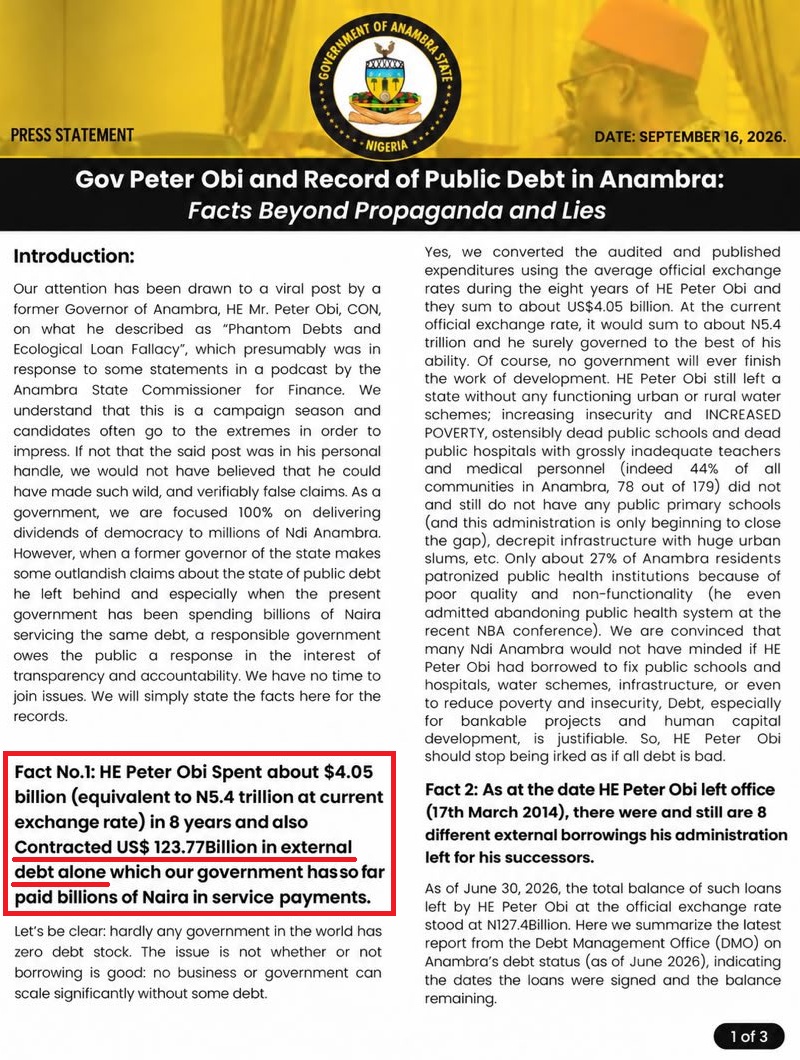
The problem? Nigeria’s entire public debt stock—covering both domestic and external borrowings accumulated over 26 years—is officially $97 billion as of mid‑2025.
How then could one state, under one governor, borrow more than the entire nation?
This is not just a slip of the tongue.
It is a monumental goof that exposes either a deliberate attempt to mislead the public or a shocking lack of grasp of basic fiscal realities.
The Government’s “Evidence”
The Anambra State Government, through Commissioner for Information & Value Reformation, Law Okwu Mefor, released a statement defending Soludo’s earlier remarks.
The statement outlined loans allegedly contracted under Obi’s administration, including projects such as:
- Malaria Control Booster Project
- Third National Fadama Development Project
- Health System Development Project II
- State Education Programme Investment Project
- Nigeria Erosion and Watershed Management Project
According to the Debt Management Office (DMO), the total outstanding balance on these loans as of June 30, 2026, is $92.35 million (₦127.37 billion).
Now, let’s pause here. The government’s own figures show $92 million, yet Soludo is telling Nigerians that Obi borrowed $123 billion.
The discrepancy is not a matter of interpretation—it is a matter of arithmetic so outrageous that it borders on propaganda.
Salary Arrears and Ecological Fund
The statement also accused Obi of leaving behind unpaid salaries, pensions, and gratuities, as well as misrepresenting an alleged ₦2.13 billion ecological fund.
The government insists that the account in question was an Internally Generated Revenue (IGR) Consolidated Revenue Account, not an ecological fund account.
It further dismissed Obi’s claim of leaving ₦75 billion in savings as “phantom.”
But even if these accusations were true, they pale in comparison to the absurdity of Soludo’s headline claim.
The numbers simply do not add up.
The Political Context
This controversy comes at a politically charged moment.
With the January 2027 presidential election approaching, Peter Obi remains a major opposition figure.
Soludo’s government appears intent on discrediting Obi’s record, but in doing so, it has undermined its own credibility.
By inflating figures beyond recognition, Soludo has handed Obi’s supporters a powerful counter‑argument:
“If the Governor of Anambra State cannot distinguish between millions and billions, how can he be trusted to manage the state’s finances or speak authoritatively on national debt?
Public Reaction
The backlash has been swift.
On social media, commentators have ridiculed Soludo’s claim. One viral post by Obiasogu David (@afrisagacity) summed up the outrage:
“Nigeria’s total public debt is $97 billion. But Governor Soludo, a Professor of Economics, is telling Nigerians and the world that Peter Obi borrowed $123 billion in 8 years alone!
“How can a state government’s 8‑year borrowing be far more than its federal government’s 26‑year borrowing?
“Chai, Anambra people have a psycho as a governor!”
This sentiment reflects a growing frustration among citizens who feel insulted by leaders who manipulate figures for political gain.
Conclusion: A Self‑Inflicted Wound
Governor Soludo’s attempt to tarnish Peter Obi’s legacy has backfired spectacularly.
By claiming Obi borrowed $123 billion, he has not only contradicted official DMO records but also embarrassed himself as an economist.
The difference is not minor—it is a thousand‑fold exaggeration.
In politics, credibility is currency.
Soludo has squandered his by peddling figures that collapse under the weight of basic arithmetic.
Instead of discrediting Obi, he has discredited himself, leaving Nigerians to wonder how a man once entrusted with the Central Bank could commit such a colossal blunder.