


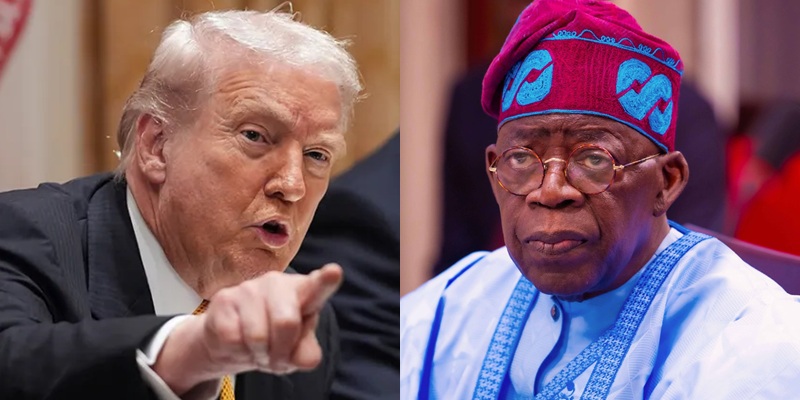

TD A social media post comparing two purported diplomatic letters attributed to U.S. President Donald Trump has sparked fresh debate over the authenticity and presentation of a letter claimed to have been sent to Nigerian President Bola Ahmed Tinubu.
The comparison, shared by X user Von Batten-Montague-York, contrasts what appears to be an official White House letter sent to Argentine President Javier Milei with a text-only version of a purported letter to President Tinubu published by the PBAT Media Centre, a social media platform associated with the Nigerian Presidency.
The post argues that the difference in presentation is “beyond clear,” urging Nigerians to exercise caution before accepting the Tinubu letter as genuine.
Two Letters, Two Different Presentations
According to the post, the letter addressed to Argentine President Javier Milei was released as a scanned document bearing the White House letterhead, date, official formatting and President Trump’s signature.
By contrast, the purported letter to President Tinubu was published only as typed text embedded in a graphic. While the graphic reproduces what is presented as the full contents of the correspondence—including references to Nigeria-U.S. security cooperation and praise for Tinubu’s leadership—it does not include an image of the original signed document.
The author of the post contends that such a presentation is unusual for official diplomatic correspondence.

“We are not saying that a standard diplomatic response letter was never sent to President Tinubu. Nor are we saying that President Tinubu fabricated the purported letter,” the post states.
It adds that although the Presidency could later release a document, “it is unusual for a letter to be quoted in full, including the date and signature block, rather than simply publishing an image of the actual letter itself.”
Security Cooperation Highlighted
The text attributed to President Trump praises Tinubu’s efforts against terrorism and violence affecting Christian communities in Nigeria.
It also references the U.S.-Nigeria 2026 Defence Cooperation Roadmap, describing it as a framework for combating terrorism, and claims that U.S. Special Operations Forces have been deployed to assist the Nigerian Armed Forces with training, intelligence and operational capabilities.
The message concludes with an expression of commitment to continued discussions between both leaders.
Questions Over Verification
The social media criticism centres not on the content of the letter itself but on the absence of a scanned copy showing official White House stationery, signature and formatting.

The comparison argues that releasing only a graphic containing quoted text falls short of the standard typically associated with diplomatic correspondence.
The post concludes by urging Nigerians to remain sceptical until the actual document is made public.
No Conclusive Evidence of Fabrication
At present, there is no conclusive public evidence that the purported Trump letter to President Tinubu is fabricated.
Equally, there has been no independent public verification from the White House confirming the document as released by the PBAT Media Centre.
The Nigerian Presidency has treated the letter as authentic and has publicly cited its contents.
However, unlike the letter to Argentine President Javier Milei—which has circulated as a scanned White House document—the Tinubu version has so far been presented only as a text graphic.

Without the release of the original signed correspondence or official confirmation from the White House, the authenticity of the published format cannot be independently verified.
As a result, while the social media post raises legitimate questions about transparency and presentation, its assertion that “Tinubu is trying to fool you” remains an opinion rather than an established fact.
The underlying concern—that publication of the original document would help resolve doubts—is distinct from any proven allegation of fabrication.