


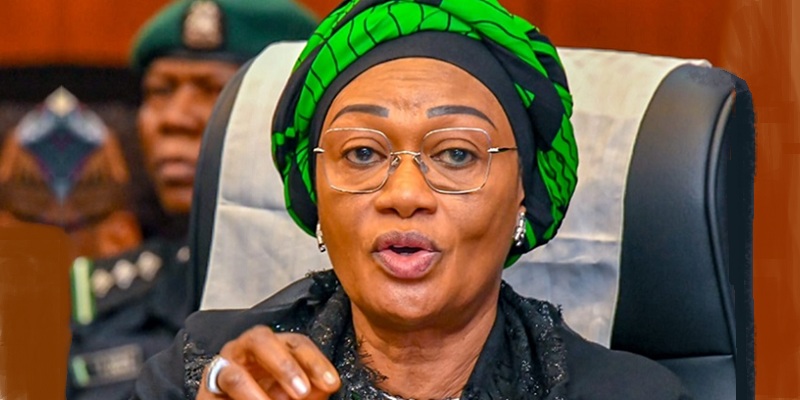

Nigeria’s First Lady, Oluremi Tinubu, has triggered renewed discussion over her past and present comments about the Igbo people after praising Igbos during her visit to Anambra State on Thursday, September 10, 2026.
Tinubu was in Awka for the launch of the National Community Food Bank in the South-East under the Renewed Hope Initiative when she spoke warmly about her personal experiences with Igbo people.
“Igbos are very nice people. My best friend in secondary school is an Igbo girl,” the First Lady said.
Her remarks have attracted particular attention because an old video from the 2019 election campaign has resurfaced on social media.
Critics contrast her current message of friendship and national unity with remarks attributed to her during the Lagos campaign.

“They Said I Look Like an Igbo Girl”
Speaking at the Anambra event, Tinubu recalled that many of her friends and associates during her education were Igbo.
“In high school and tertiary institutions, they are all Igbos. Because they said I look like an Igbo girl,” she said.
She also recalled that some of her schoolmates would speak Igbo to her because they assumed she understood the language.
“So when they are speaking Igbo to me, I say, please, and they tell them so,” she added.
The First Lady subsequently urged Nigerians to travel across the country and become more familiar with people from different ethnic backgrounds.
“Try to know your brothers and sisters across Nigeria,” she said.

The 2019 Video That Has Returned to the Spotlight
The renewed debate follows the circulation of a 2019 video on X by the account @firstladyship.
The post contrasts Tinubu’s latest comments in Anambra with remarks attributed to her at a 2019 campaign event in Lagos concerning Igbo residents and property ownership.
In the resurfaced footage, Tinubu is presented as making a reference to invoking “Lagos deities” in connection with driving Igbos out of Lagos and taking over their properties.
The old footage has not been presented here as evidence that Tinubu currently holds that position.
Rather, its circulation has prompted social media users to juxtapose the earlier campaign-era rhetoric with the First Lady’s conciliatory remarks toward Igbos in Anambra.
A Political Paradox
The contrast has created a striking political paradox.

In 2019, the remarks attributed to Tinubu were framed around a highly charged Lagos election environment and have since been cited by critics in discussions about ethnic politics.
Seven years later, she stood in the heart of the South-East praising Igbos as “very nice people“.
She recountsed close friendships with Igbo classmates and urging Nigerians to regard one another as brothers and sisters.
The two moments have consequently become part of a wider online debate over whether political rhetoric changes with circumstances, audiences and electoral calculations.
From Campaign Rhetoric to South-East Engagement
Tinubu’s Anambra visit also comes as the administration seeks greater engagement with the South-East.
Questions of political representation, economic development and federal-government relations remain significant issues in the region.
The National Community Food Bank launched in the region is intended to support vulnerable Nigerians through food and nutrition assistance, including support for widows, children and other disadvantaged groups.
The initiative also places emphasis on cooperation between federal and state authorities in addressing poverty and food insecurity.
“I’ll Be Back to Campaign Proper”
Tinubu ended her remarks by indicating that her appearance in Anambra should not be regarded as her final political engagement with the state.
“I’ll be back. I’ll be back to campaign proper,” she said.
She then prayed for Anambra State, the South-East and the Federal Republic of Nigeria.
What the Contrast Says About Nigeria’s Politics
The juxtaposition of the two videos has once again placed ethnicity at the centre of political discussion in Nigeria.
Tinubu’s latest remarks emphasise friendship, national integration and familiarity across ethnic lines, while the resurfaced 2019 footage is being used by critics to raise questions about the evolution of political messaging over time.
Whether viewed as evidence of changing political rhetoric or simply as statements made in different political contexts, the contrasting clips are likely to continue generating debate as Nigeria approaches another major electoral cycle.
For many Nigerians, the larger question remains whether political leaders can move beyond campaign-era ethnic rhetoric and consistently promote a national message of inclusion regardless of the audience or political season.