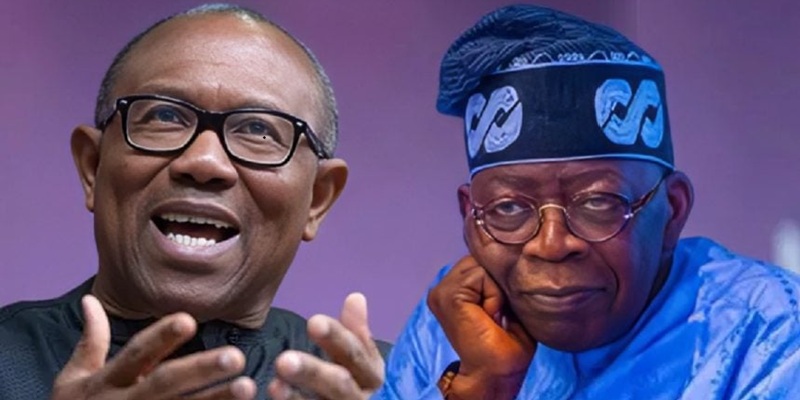

 The Nigeria Democratic Congress (NDC) presidential candidate, Mr. Peter Obi, has challenged President Bola Tinubu to explain how public resources have improved Nigerians’ lives, citing subsidy savings, borrowing and increased government revenue.
In an open letter titled “Good Day, Mr President: Nigerians Deserve Accountability,” Obi raised the questions after Tinubu visited Akwa Ibom State.
Obi congratulated the President on spending a night in a state outside Lagos and Abuja, then urged him to visit other parts of the country.
He said the visit could encourage Tinubu to engage with residents across Nigeria and explain how his administration had used the resources at its disposal.
Obi named ₦15.8 trillion reportedly mobilised through petrol subsidy removal, more than $100 billion in borrowings, higher tax revenue and government earnings that exceeded targets.
The challenge focuses on whether those resources have delivered visible improvements in welfare, education, healthcare, electricity and security.

A report on the letter said Obi made the demand following Tinubu’s Akwa Ibom visit, while the Presidency had announced the trip ahead of time.
Obi asks what Nigerians have gained
Obi called on the President to state how many people had been lifted out of poverty during the period covered by the resources he cited.
He also asked how many out-of-school children had returned to classrooms and how many functional primary healthcare centres had been established.
The former Anambra governor questioned whether electricity supply had improved.
He recalled Tinubu’s earlier pledge that Nigerians should not vote for him if he failed to fix power.
On security, Obi asked the administration to explain what it had done to protect the country, which he said remained among the world’s most terrorised nations.

His letter framed the questions as matters of public accountability.
He argued that Nigerians should be able to assess government performance through concrete outcomes.
“Nigerians deserve answers. They deserve to know what has been done with the resources entrusted to your government,” Obi wrote.
He said accountability, transparency and measurable improvements in citizens’ lives should underpin governance and guide the use of public funds.
The letter concluded with Obi’s call for “a new Nigeria” built on those principles, ending with his campaign phrase, “A new Nigeria is POssible.”
What the ₦15.8 trillion figure represents
The ₦15.8 trillion figure has also featured in the Federal Government’s account of economic reforms, although its meaning requires context.

The Finance Ministry said subsidy savings mobilised ₦15.8 trillion for the Federation between June 2023 and December 2025, with ₦5.4 trillion accruing to the Federal Government.
The remaining ₦10.4 trillion went to states and local governments through Federation Account allocations, according to the ministry’s figures.
The government also reported ₦3.1 trillion in incremental independent revenue and ₦11.9 trillion in incremental borrowing during that period.
Those figures describe public resources across different levels of government; they do not mean the full ₦15.8 trillion was held by the Federal Government in one account.
The ministry’s figures provide a possible accounting frame for Obi’s demand, while his letter asks what the resources have achieved for ordinary Nigerians.
The subsidy savings, borrowing and revenue totals cover specific periods and categories, so comparisons should preserve those distinctions.
Demand centres on public impact
Obi’s statement centres on the relationship between government finances and outcomes citizens can see in their daily lives.
His questions span poverty, school attendance, primary healthcare, electricity and security, placing social services alongside the government’s financial claims.
The letter does not itself provide an alternative accounting of the funds, but challenges the President to publish explanations and measurable results.
The government’s reported allocation breakdown distinguishes the Federal Government’s share from funds distributed to states and local councils.
That distinction matters because responsibilities for schools, health facilities and other services are shared across Nigeria’s different levels of government.
Obi’s demand therefore invites the administration to explain both how federal resources were spent and how citizens benefited from wider public allocations.
The exchange adds to continuing public debate over subsidy reform, government borrowing, rising revenues and the cost-of-living pressures experienced by households.
For Obi, the test of governance is whether public resources translate into practical improvements, supported by figures Nigerians can examine.