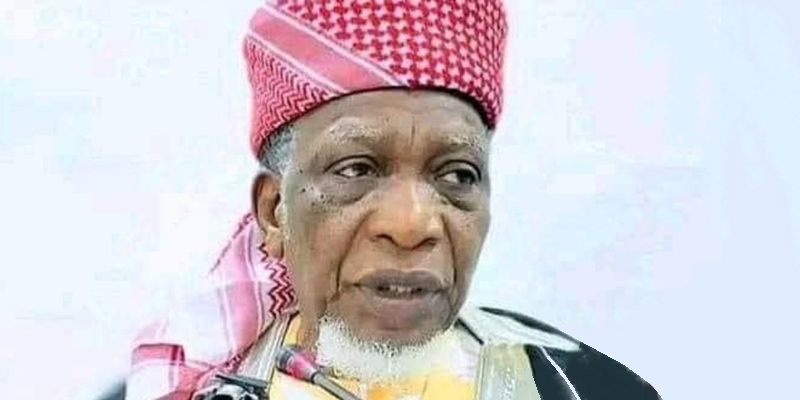
TD The National Chairman of the Council of Ulama of the Jama’atu Izalatil Bid’ah Wa’ikamatis Sunnah (JIBWIS), Sheikh Sani Yahaya Jingir, has triggered renewed controversy over religion and politics in Nigeria.
Sheikh Jingir reportedly advocated the continuation of Muslim-Muslim presidential tickets ahead of the 2027 general elections.
In a video circulating on social media, Jingir is heard arguing that Muslims should continue supporting same-faith presidential tickets.
He linked the political arrangement to what he described as the need to maintain Muslim dominance.
“If not because of Muslim/Muslim ticket, the Christians in Nigeria will think they are more than us,” Jingir reportedly said.
He added: “This is why we must make sure the Muslim/Muslim ticket continue to succeed so that our dominance will remained sustained.”

The remarks have generated criticism from political figures, activists and commentators who say political competition should not be framed as a contest for religious supremacy.
Jingir’s Continued Support for Tinubu-Shettima
The latest controversy comes months after Jingir publicly reaffirmed his support for President Bola Tinubu and Vice-President Kashim Shettima retaining their Muslim-Muslim ticket in 2027.
In February 2026, Jingir reportedly warned that changing the arrangement could cost Tinubu the support of influential Islamic clerics.
He said JIBWIS members voted for the ticket in 2023 because it was a Muslim-Muslim ticket and urged the President not to alter the arrangement.
The APC’s 2023 presidential ticket paired Bola Ahmed Tinubu with Kashim Shettima.
It marked a significant departure from the informal practice of balancing presidential tickets along religious lines.

Jingir’s latest remarks have therefore revived a debate that has remained politically sensitive since the 2023 election.
Fani-Kayode Condemns Language of Religious Dominance
Former Aviation Minister and APC chieftain, Mr. Femi Fani-Kayode, described Jingir’s remarks as provocative.
Fani-Kayode warned against rhetoric capable of aggravating religious tensions ahead of 2027.
His position is particularly notable because he supported the APC’s Muslim-Muslim ticket in 2023.
In previous comments, he argued that his support was based on the individual qualities of Tinubu and Shettima rather than an objective of Islamising Nigeria.
His argument underscores the distinction between supporting a same-faith ticket for political or competence-related reasons and advocating it as a mechanism for maintaining religious dominance.

Dalung: “Who Are the Infidels?”
Former Minister of Youth and Sports Development Solomon Dalung has also been identified among those objecting to the framing of the political debate around religious superiority.
The criticism attributed to Dalung centres on the argument that elections should be about governance rather than determining which religious group exercises political dominance.
He questioned the use of the term “infidels” to describe fellow Nigerians.
He argued that a Muslim-Muslim ticket, irrespective of its religious composition, would not by itself solve Nigeria’s pressing problems.
Such problems, he noted, include insecurity, unemployment, poor infrastructure and the rising cost of living.
Dalung has previously criticised the Tinubu administration over insecurity and accused the government of focusing excessively on 2027 politics.
Activists, Religious Leaders Raise Concern
Human-rights lawyer and activist Deji Adeyanju has reportedly criticised the remarks as divisive.
He urged religious leaders to promote peaceful coexistence in Nigeria’s multi-religious society.
Amnesty International Nigeria Country Director, Isa Sanusi, was also reported to have criticised the rhetoric.
Sanusi described the use of religion for political mobilisation as damaging to both national cohesion and the image of Islam.
Journalist and broadcaster Reuben Abati went further, characterising the remarks as potentially inciting.
Abati questioned why political leaders present at the event did not immediately distance themselves from the comments.
Christian preacher Prophet Isa El-Buba similarly condemned the reported reference to Christians as “infidels.”
Religious Headcount or National Development?
The controversy has exposed a broader question confronting Nigerian politics: should religious identity determine the composition of presidential tickets?
Supporters of same-faith tickets argue that candidates should be selected primarily on competence, political strength and the ability to win elections.
Critics, however, contend that rhetoric portraying elections as a contest between Muslims and Christians risks deepening existing religious divisions.
Nigeria is constitutionally a secular state with a highly diverse religious population.
Consequently, political analysts and civil-society voices have repeatedly warned against turning elections into contests between religious blocs.
The debate is also complicated by the fact that Fani-Kayode himself has previously defended the Muslim-Muslim ticket.
He had simultaneously argued that Nigeria cannot be Islamised through the arrangement.
2027 Raises the Stakes
Jingir’s remarks come as political activity intensifies ahead of the 2027 presidential election.
The controversy is therefore likely to extend beyond the question of whether Tinubu and Shettima should retain their same-faith ticket.
At its core is a larger debate about whether religion should be used as an instrument of political mobilisation.
Also instrumental is whether electoral success should be interpreted as evidence of religious dominance.
For critics, statements about maintaining “dominance” risk reducing Nigerian citizenship to competing religious blocs.
For supporters of the arrangement, the issue remains one of political representation and electoral choice.
What appears increasingly clear, however, is that religion will remain a major fault line in Nigeria’s 2027 political contest—and statements by influential religious figures are likely to receive intense scrutiny.
This Dawn News reports that the controversy highlights the need for political and religious leaders to exercise restraint in their public statements.
It also urged politicians to place national unity, constitutional rights and good governance above rhetoric that could deepen religious divisions.