


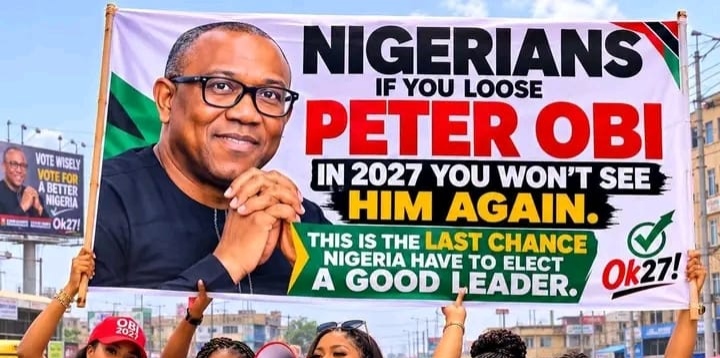

TDA campaign-style image circulating on social media has reignited political conversations ahead of Nigeria’s 2027 general election, with supporters of former Labour Party presidential candidate Peter Obi describing the next election as the country’s “last chance” to elect what they call a credible leader.
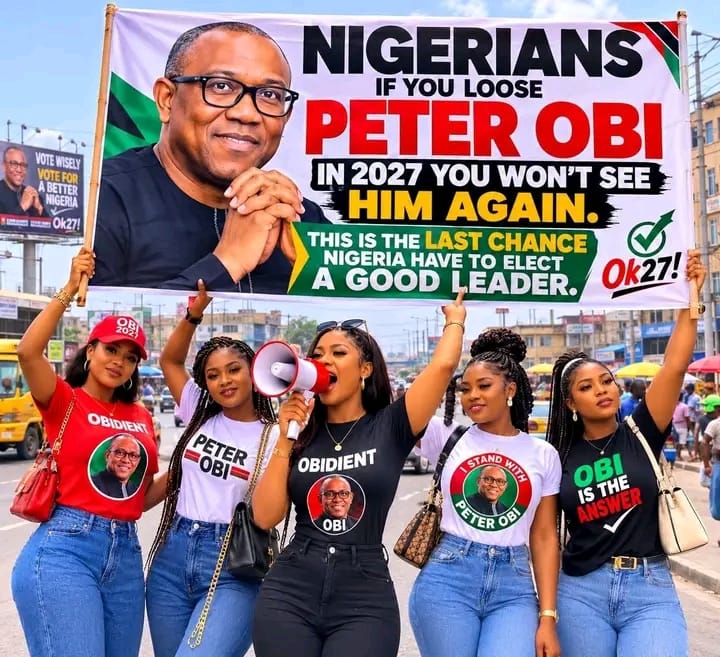
The banner shows five young women walking on a busy street while holding a large banner featuring Peter Obi’s portrait and campaign messages.
The women wear branded shirts bearing inscriptions such as “Obidient,” “Peter Obi,” “I Stand With Peter Obi,” and “Obi Is the Answer,” while one addresses the crowd through a megaphone, suggesting a grassroots mobilisation effort.
The banner carries the bold message: “Nigerians, if you lose Peter Obi in 2027, you won’t see him again. This is the last chance Nigeria have to elect a good leader. Ok27!”
Its political message is unmistakable—urging Nigerians to support Obi in the next presidential election.
Symbol of Growing Political Mobilisation
The banner reflects the continued visibility of the “Obidient” movement, a political support base that gained national prominence during the 2023 presidential election.

Unlike traditional political rallies dominated by party officials, the image portrays young supporters publicly promoting their preferred candidate, highlighting the movement’s continued grassroots appeal among sections of the electorate.
Political observers note that such demonstrations underline the importance of youth participation in Nigeria’s evolving political landscape, especially as preparations gradually begin for the 2027 elections.
“Last Chance” Message Sparks Debate
The phrase “last chance” has become the central theme of the campaign message displayed in the image.
Supporters argue that Nigeria is facing persistent economic challenges, rising living costs, unemployment, insecurity and governance concerns, making the next election particularly significant.
To Obi’s supporters, the slogan expresses urgency rather than a literal prediction, reflecting their belief that the country needs a leadership style focused on accountability, prudent management of public resources and institutional reforms.

However, critics argue that democratic systems should not revolve around any single individual, maintaining that strong institutions ultimately matter more than personalities. They contend that while leadership is important, sustainable development depends on strengthening democratic institutions regardless of who occupies public office.
Obi’s Governance Record Remains Central
Peter Obi’s supporters continue to cite his tenure as governor of Anambra State as evidence of his administrative style, frequently pointing to his emphasis on fiscal discipline, investment in education and healthcare, and relatively conservative borrowing practices.
His 2023 presidential campaign also distinguished itself by focusing heavily on policy discussions, economic reforms and production-driven growth, themes supporters believe remain relevant ahead of 2027.
Youth Engagement in Focus
The image also underscores the increasing role of young Nigerians in political advocacy.
Rather than depicting established politicians, it centres on young women voluntarily displaying campaign materials and engaging with the public, reinforcing the message that youth participation could play a decisive role in future elections.
Analysts have repeatedly observed that social media, grassroots campaigns and volunteer-driven movements are becoming increasingly influential in shaping Nigeria’s political discourse.

Looking Ahead to 2027
As political activities gradually intensify ahead of the next general election, issues such as economic recovery, security, inflation, electricity, education, healthcare and job creation are expected to dominate public debate.
Whether Peter Obi eventually emerges as a presidential candidate or not, the image reflects the determination of some supporters to keep his political message visible long before official campaigns begin.
While the banner describes 2027 as Nigeria’s “last chance” to elect a good leader, that remains a political opinion expressed by supporters rather than an established fact. Ultimately, Nigerians will decide at the ballot box which candidate and vision they believe offers the best path forward for the country.