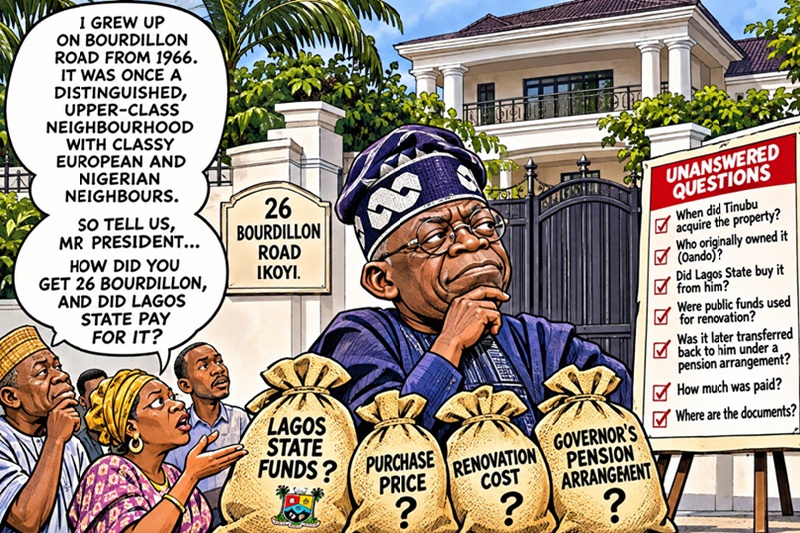

 I know Bourdillon Road, Ikoyi, rather better than most people who write about it. I grew up there.
My family moved to 41 Bourdillon Road in 1966, and for nearly forty years, that address was our family home. I knew the road, its houses, its residents and its character long before Bola Ahmed Tinubu became a household name in Nigerian politics.
Bourdillon Road was once one of the most distinguished residential addresses in Lagos. It was an upper-class neighbourhood in the traditional sense of the expression, a place of elegance, refinement and considerable social standing.
Our neighbours included prosperous Nigerian families, senior professionals, businessmen, diplomats and Europeans who had made Lagos their home.
There was an unmistakable atmosphere of old Ikoyi about the place. Beautiful houses stood behind carefully maintained gardens.
The neighbourhood possessed a certain dignity, and its residents generally understood that wealth and social standing carried responsibilities.

It was a place where successful people lived, but where success did not necessarily have to announce itself through ostentation.
I remember the houses, the families and the changing character of the road over the decades.
I watched Lagos grow, watched Ikoyi change, and watched the old residential neighbourhoods gradually surrender some of their character to the enormous wealth and political influence that came to dominate the city.
It is against that personal history that I now examine the controversy surrounding 26 Bourdillon Road, the famous residence of President Bola Ahmed Tinubu.
For me, this is not simply another story about a politician’s mansion. It concerns a road that was part of my childhood, a neighbourhood I knew intimately and a property whose reported history raises questions that deserve proper answers.
From a Distinguished Residential Road to a Centre of Political Power
Today, 26 Bourdillon Road has become almost a political institution.

Governors, ministers, senators, party officials, businessmen and presidential hopefuls have reportedly made their way to Tinubu’s residence seeking political support, appointments, endorsements and influence.
An address that once belonged to a quiet and distinguished residential neighbourhood has become synonymous with the exercise of political power in Nigeria.
There is nothing inherently wrong with a politician owning an expensive residence in Ikoyi. Wealth is not a crime, and successful Nigerians have lived on Bourdillon Road for generations.
My own family lived there for nearly four decades.
The issue is not whether Tinubu is entitled to own a magnificent house.
The issue is how he acquired it, what he paid for it, and whether the people of Lagos State contributed financially to its acquisition or development.

These are questions that have followed the property for years, and they have never been satisfactorily resolved in the public domain.
The Allegations Surrounding 26 Bourdillon
In November 2012, the Nigerian publication THEWILL reported allegations concerning the acquisition and ownership of Tinubu’s Bourdillon residence.
According to the publication, the property had previously been associated with Oando Plc, the oil company with business connections to members of the Tinubu family.
The report alleged that Tinubu acquired the property and that Lagos State funds were subsequently used for reconstruction or renovation.
More seriously, it alleged that Lagos State later purchased the property from Tinubu for an undisclosed amount before the residence was eventually transferred back to him through arrangements associated with the pension benefits of former Lagos State governors.
These are allegations, not established judicial findings. I have not seen the original conveyancing documents, payment vouchers or land registry records necessary to confirm the reported sequence of transactions.
But the absence of those documents from public scrutiny is precisely why the matter deserves investigation.
If the state purchased the residence, who authorised the purchase?
How much was paid?
Who conducted the valuation?
Was the transaction approved by the Lagos State Executive Council?
Was the expenditure disclosed in the state’s accounts?
And if the property was subsequently returned to Tinubu, what law permitted that transfer?
Surely, these are not unreasonable questions to ask of a man who governed Lagos State for eight years and subsequently became President of Nigeria.

What Did the Property Actually Cost?
By 2012, published estimates placed the value of the Bourdillon residence at more than ₦600 million.
That figure was a reported valuation, not a verified original purchase price.
The actual amount allegedly paid by Lagos State has not been established through publicly available transaction records.
Nor has a complete public accounting been produced establishing whether state funds were spent on reconstruction or renovation.
This is particularly troubling because the distinction between private wealth and public money ought to be one of the clearest principles of government.
If Tinubu purchased the residence entirely with his own resources, there should be documentation demonstrating the transaction.
If Lagos State purchased it from him, the government should be able to identify the amount paid and the public purpose served.
And if it was subsequently transferred back to him, the legal authority for that transfer should be available for examination.
The people of Lagos should not have to depend on newspaper allegations, political accusations or government denials when documentary evidence could settle the matter.
Atiku Abubakar Revives the Controversy
In 2023, former Vice President Atiku Abubakar publicly raised the Bourdillon controversy again.
He alleged that Lagos State had purchased the residence from Tinubu and subsequently returned it to him under arrangements associated with the state’s pension legislation.
Atiku’s accusations do not, by themselves, establish that any wrongdoing occurred. Political opponents frequently make allegations against one another, and those allegations must be tested against evidence.
Nevertheless, the questions are specific enough to be answered.
Either Lagos State purchased the property or it did not.
Either public funds were spent on it or they were not.
Either a subsequent transfer took place or it did not.
There should be a documentary record capable of establishing the truth.
Why has that record not been made available for comprehensive public examination?
The Bourdillon Road I Remember
When I think about Bourdillon Road, I do not immediately think about political meetings, presidential ambitions or the enormous fortunes associated with contemporary Nigerian politics.
I remember my childhood. I remember the beautiful houses and the well-kept gardens.
I remember the European and Nigerian families who lived alongside one another, the professionals who had built successful careers, and the businessmen whose wealth came from commerce, industry and enterprise.
It was an affluent neighbourhood, certainly, but there was a difference between the dignity of established prosperity and the ostentatious display of political influence.
My late father, Chief Godfrey Kio-Jaja Amachree, QC, was a distinguished lawyer, businessman and international diplomat.
He served Nigeria and the United Nations, established successful businesses and contributed his resources to the early development of Rivers State.
He understood that private success and public responsibility were not mutually exclusive.
He also understood something that seems increasingly absent from Nigerian public life: the distinction between what belongs to an individual and what belongs to the state.
I was fortunate to grow up in that environment. I was educated to believe that public office was an honour carrying obligations, not an entitlement to personal enrichment.
That is why I find the unresolved questions surrounding 26 Bourdillon so important.
I do not resent Tinubu for living on the road where I grew up. I question whether the financial history of his residence has been adequately explained to the people whose interests he was elected to protect.
Lagos State Is Not Anybody’s Private Estate
Tinubu governed Lagos State from 1999 until 2007. His political influence in the state continued long after he left office.
During those years, Lagos became the foundation of a formidable political organisation that eventually carried him to the Nigerian presidency.
Political influence, however extensive, does not remove the obligation to account for transactions involving public assets.
Indeed, the greater the influence, the greater the need for transparency.
A governor is entrusted with the resources of the people. Those resources do not belong to his family, his political associates or his party.
They belong to the citizens of the state.
The purchase of a private residence with public money, if established, would demand a clear explanation of its public purpose.
Any subsequent transfer to a former officeholder would require equally rigorous legal justification.
No amount of political influence should place such transactions beyond scrutiny.
A Country Where the Powerful Must Answer Questions
Nigeria has become a country of extraordinary contrasts.
Millions of citizens struggle to pay rent, buy food, educate their children and obtain medical treatment.
Pensioners wait for money they earned over decades of service. Civil servants struggle with salaries that scarcely meet the cost of living.
Young graduates search desperately for employment while the political establishment continues to enjoy privileges far beyond the reach of ordinary Nigerians.
Against that background, allegations that a state government may have purchased an expensive residence from a former governor and subsequently transferred it back to him deserve serious attention.
Not because the allegations have already been proved, but because the possible misuse of public resources is a matter of legitimate public concern.
If the allegations are false, the records should demonstrate their falsity.
If they are true, Nigerians deserve to know who authorised the transactions and whether the law was followed.
The standard must be the same for Tinubu as it would be for any other Nigerian citizen.
Open the Books on 26 Bourdillon
I believe the Lagos State Government should make available the relevant historical records concerning 26 Bourdillon Road.
Let the land registry establish the ownership history.
Let any purchase and sale agreements be examined.
Let the government disclose whether public funds were used for acquisition, renovation or reconstruction.
Let the relevant pension legislation and any transfer documents be scrutinised.
If there was no state purchase, say so and provide the supporting evidence.
If there was no public expenditure, let the financial records demonstrate it.
If the property was never transferred under a former governor’s pension arrangement, let the legal documentation establish that fact.
These are not revolutionary demands. They are the ordinary expectations of transparent government.
A Final Word From Someone Who Grew Up on Bourdillon Road
I have known Bourdillon Road since 1966.
For nearly forty years, my family called it home. It was part of our lives, our history and our identity.
I knew it when it was a distinguished residential neighbourhood occupied by accomplished Nigerian and European families, long before it became internationally associated with the political career of Bola Ahmed Tinubu.
I have no objection to successful Nigerians acquiring beautiful homes.
I grew up among successful people, and I understand perfectly well that wealth, honestly earned, is something to be respected.
But there is a world of difference between wealth created through legitimate enterprise and private benefits obtained at public expense.
Whether that distinction was respected in the case of 26 Bourdillon is a question that can only be answered by examining the relevant records.
Tinubu is now President of the Federal Republic of Nigeria. The responsibilities of that office make transparency more important, not less.
He should welcome the opportunity to put the controversy to rest.
For me, Bourdillon Road will always evoke memories of the Lagos in which I grew up, a neighbourhood of beautiful homes, distinguished families and an understanding that good fortune should be accompanied by good conduct.
It would be a great pity if one of the most famous addresses on that road were remembered not for the achievements of its occupant, but for questions about its ownership that were never properly answered.
I grew up on Bourdillon Road. I know its history. I know what it once represented.
And I believe Nigerians have every right to know the financial history of the most politically famous house on that road.
The question is not whether Bola Tinubu deserves to live in a palace.
The question is whether the people of Lagos State were ever made to pay for it.
Until the records are opened, that question remains unanswered.
Kio Amachree is the President, Worldview International, Stockholm, Sweden.