




 Nigeria | Politics | A social media investigation has raised fresh questions about possible duplicate entries in Nigeria’s preliminary voters’ register.
The controversy followed screenshots shared by an account identified as @mundus01.
The screenshots show a man named Xingkun Zhong appearing seven times in one Abuja polling unit.
Each entry reportedly carries a different voter identification number but displays an identical photograph.
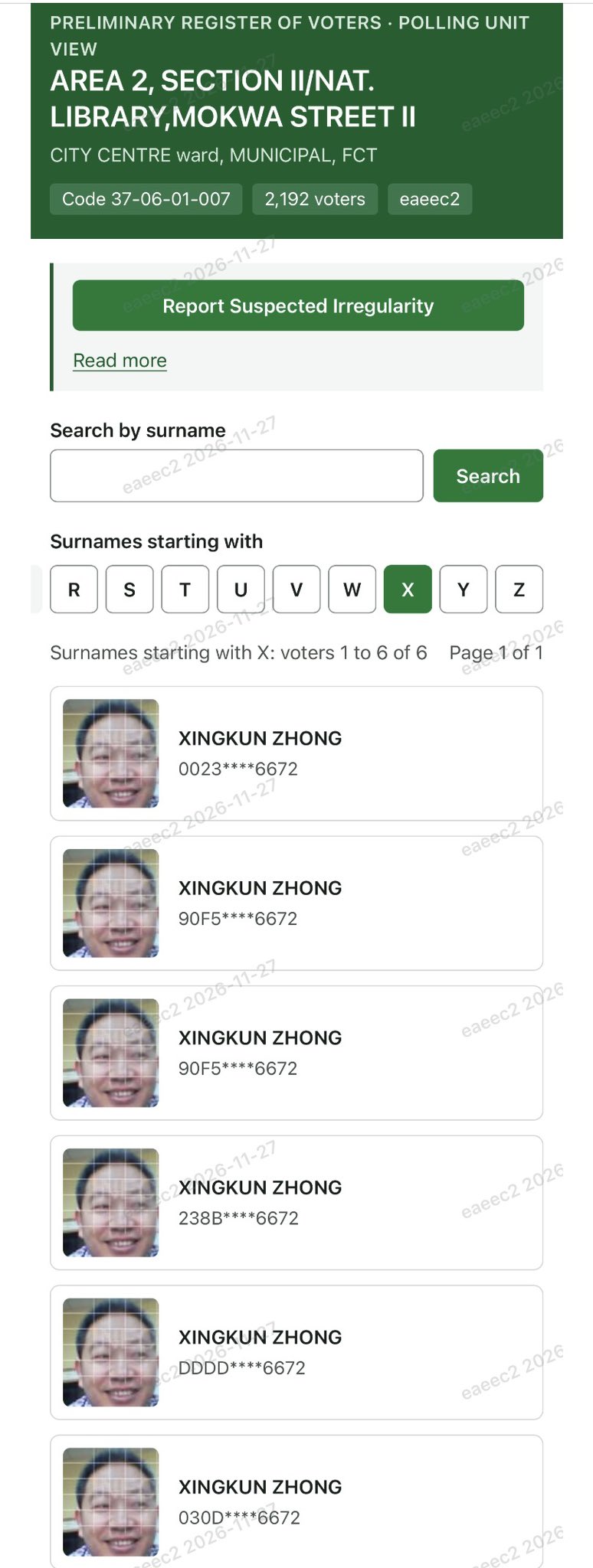
The discovery has prompted questions about how multiple records bearing the same photograph entered the preliminary register.

Another screenshot allegedly identifies a second individual, Thong Frank, with multiple entries.
The records reportedly contain similar registration details and matching photographs within the Federal Capital Territory.
However, the specific seven-entry allegation involving Xingkun Zhong has not been independently verified by this publication.
The screenshots raise questions about the individuals’ nationality or citizenship status.
INEC’s Biometric Screening Under Scrutiny
The allegations have renewed attention on the Independent National Electoral Commission (INEC)’s biometric registration and deduplication processes.
INEC uses an Automated Biometric Identification System (ABIS) to identify suspected multiple registrations.

The commission previously explained that its screening process compares photographs, fingerprints and facial biometrics.
Its 2023 election report documented the use of these methods to identify duplicate registrations.
Confirmed duplicate records are subsequently removed from the voters’ register.
However, the latest allegations raise questions about the effectiveness of those safeguards.
They also highlight the importance of checking identical photographs across different polling units and registration areas.
INEC Reports Removal Of 1.6 Million Invalid Records
The controversy comes weeks after INEC announced a major cleanup of its preliminary voters’ register.

On November 9, 2026, Chairman Joash Amupitan disclosed that the commission removed 1,608,660 invalid registrations.
He said the records were identified through reviews involving the ABIS biometric system.
INEC also removed 873 records belonging to verified deceased persons.
The commission further identified 54 officials for possible disciplinary action over registration irregularities.
The announcement followed public complaints involving duplicate entries, questionable photographs and deceased persons.
INEC said it completed the review following claims and objections received during the register-display exercise.
Questions Ahead Of The 2027 Elections
The latest allegations have intensified calls for INEC to explain how identical photographs could appear against multiple voter records.
Questions also remain about whether each entry could generate a separate Permanent Voter Card.
The effectiveness of biometric accreditation during elections has also become a subject of public discussion.
INEC has maintained that its Bimodal Voter Accreditation System uses facial recognition and fingerprint authentication.
The commission says these safeguards are designed to prevent multiple voting and impersonation.
However, the existence of duplicate-looking records does not automatically establish that multiple votes can be cast.
The commission would need to clarify the records’ status and explain whether its systems identified them.
INEC has not been independently confirmed as having responded specifically to the Xingkun Zhong and Thong Frank allegations.
The commission’s explanation will be important ahead of the 2027 general elections.
The credibility of the final voters’ register remains central to public confidence in Nigeria’s electoral process.