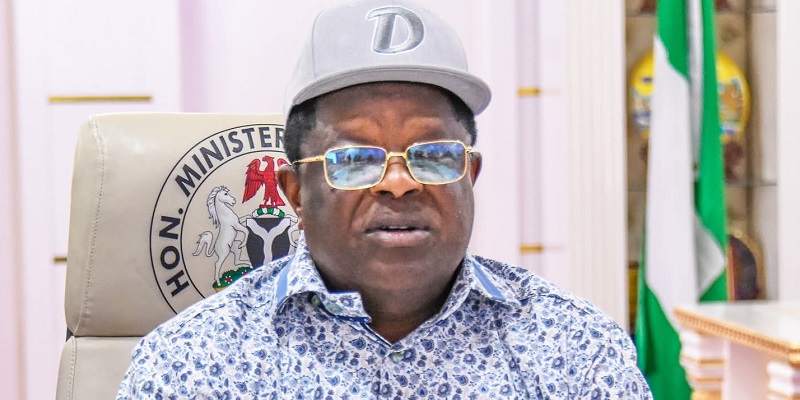
TD Uburu, Ebonyi State – The sudden and mysterious death of Mary Habila, a physiotherapist from Kaduna State, inside the residence of Nigeria’s Minister of Works, Senator David Umahi, has ignited widespread outrage, speculation, and calls for transparency.

Exclusive findings by SaharaReporters revealed that Habila was discovered naked when her body was removed from Umahi’s country home in Uburu, Ohaozara Local Government Area.
The revelation has raised troubling questions about the circumstances of her death.
Conflicting Accounts of Her Role
Minister Umahi confirmed Habila’s death, describing it as “unfortunate” and claiming she was a physiotherapist seconded to his residence from the David Umahi Federal University of Health Sciences (DUFUHS). He insisted that she, along with another woman, Mary Baski, had been officially assigned to provide medical support.
However, police sources familiar with the investigation dispute this narrative. They allege that Habila and Baski were brought from Kaduna State on June 26, 2026, specifically to attend to the minister. Barely 24 hours later, on June 27, Habila was found dead under circumstances investigators are still working to establish.
Discovery and Immediate Response
According to multiple police sources, Jonathan Bawado, a police officer serving as Umahi’s Personal Assistant—and formerly his Aide-de-Camp during his tenure as Governor of Ebonyi State—was responsible for bringing the two women to the residence.
When Habila was discovered unresponsive, Bawado reportedly alerted medical personnel. A doctor and ambulance were dispatched, and the Divisional Police Officer of Ohaozara Division, CSP Tobechukwu Godwin, was notified. The body was subsequently conveyed to a mortuary, with identification tags handed over to the Ebonyi State Police Command as part of the investigation.
Minister’s Statement
In a statement issued by his Senior Special Assistant on Media, Francis Nwaze, Umahi said emergency measures were activated immediately after the incident, including contacting the Chief Medical Director of DUFUHS. He added that the police were promptly notified in line with legal procedures.
Umahi claimed he personally met Habila’s parents, offered condolences, and advised them to consent to an autopsy to scientifically determine the cause of death. According to him, the family initially declined the recommendation.
Police Investigation
The case has since been transferred from the Ohaozara Divisional Police Headquarters to the Ebonyi State Criminal Investigation Department (SCID), Abakaliki. A senior police officer confirmed the transfer but declined to provide further details, citing the ongoing investigation.
As of now, the cause of death has not been officially disclosed, and it remains unclear whether an autopsy has been conducted. SaharaReporters could not independently confirm whether Umahi was present at his residence when the incident occurred.
Silence and Public Concern
Efforts to obtain comments from key officials have been unsuccessful:
- Umahi’s Personal Assistant, Jonathan Bawado, declined to speak, citing his role as a police officer.
- Ebonyi Commissioner of Police, Hope Urunwa Okafor, did not respond to calls.
- Police PRO, SP Joshua Ukandu, said he was unaware of the incident.
- Umahi’s media aide, Francis Nwaze, hung up when contacted.
- Professor Chihurumnanya Alo, Chief Medical Director of DUFUTH, did not respond to inquiries.
Neither the Ebonyi State Police Command nor the Federal Ministry of Works has issued a public statement explaining the circumstances of Habila’s death.
Broader Questions and Public Outcry
The incident has raised troubling questions about why staff from a federal university hospital were seconded to a minister’s private residence. Critics argue that such arrangements lack transparency, accountability, and may represent an abuse of public resources.
Public interest has intensified following reports that Habila was found naked, with photographs independently verified by SaharaReporters. The secrecy surrounding the case has fueled speculation, with many Nigerians demanding a thorough and transparent investigation.
Civil society organizations and commentators have called for the Federal Government to step in, stressing that the matter cannot be left to silence and speculation. The case has also sparked debates about the blurred lines between official duties and personal privileges of public officials.
Conclusion
The death of Mary Habila remains shrouded in mystery. What transpired between her arrival at Umahi’s residence on June 26 and the discovery of her body the following morning is still unclear. With conflicting accounts from the minister and investigators, and silence from key institutions, Nigerians are demanding answers.
Until the police investigation concludes and an autopsy report is released, the circumstances surrounding the young physiotherapist’s death will continue to generate public suspicion, debate, and calls for accountability.