
TD Nigerians following the long-running United States Freedom of Information Act (FOIA) litigation involving President Bola Ahmed Tinubu and American transparency activist Aaron Greenspan are watching the case closely as a key court deadline falls today, September 18, 2026.

The Federal Bureau of Investigation (FBI), Drug Enforcement Administration (DEA) and Tinubu, who is participating in the case as an intervenor, have until today to respond.
The filings were submitted by Greenspan in the continuing records-disclosure dispute before the U.S. District Court for the District of Columbia.
The deadline was confirmed by the Nigerian Presidency in its September 3 clarification of the case.
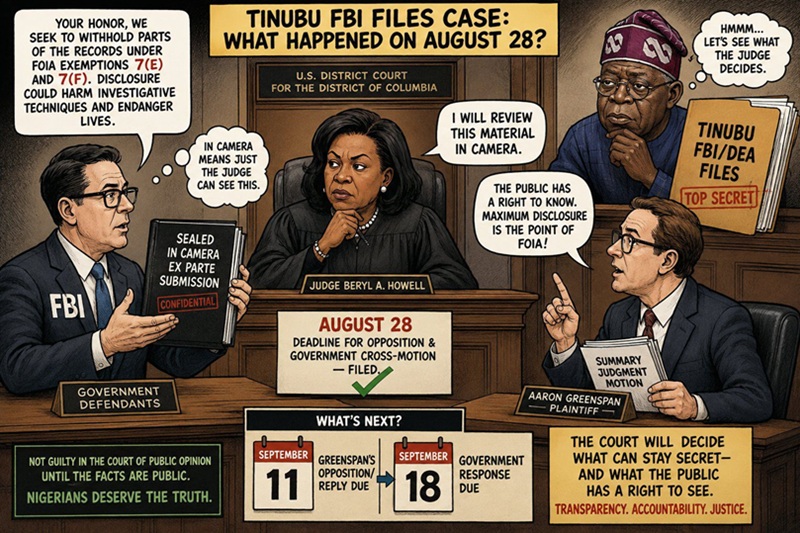
According to the statement, Greenspan was required to respond by September 11.
Following his response, the FBI, DEA and Tinubu were given until September 18 to file their further responses.
The development has generated renewed attention in Nigeria.
Nigerians and observers of the case are waiting to see what the government agencies and Tinubu’s legal team will put before the court.
However, today’s deadline should not be confused with a deadline for the release of new documents or a date for Judge Beryl A. Howell to deliver a final judgment.
The court may receive the parties’ responses before considering the outstanding issues.
What is the Greenspan FOIA case about?
The case, Aaron Greenspan v. Executive Office for U.S. Attorneys et al., Civil Action No. 1:23-cv-01816 (BAH), was filed in June 2023 in the U.S. District Court for the District of Columbia.
Greenspan submitted a series of FOIA requests to U.S. government agencies seeking records concerning historical federal investigations involving Tinubu and Abiodun Agbele.
According to Judge Howell’s April 8, 2025, memorandum opinion, Greenspan filed 12 FOIA requests between 2022 and 2023 with six federal agencies or components.
The agencies include the FBI, DEA, CIA, IRS, Executive Office for U.S. Attorneys and the State Department.
The requests concerned records relating to a federal investigation into a Chicago-area heroin-trafficking and money-laundering operation that operated in the early 1990s.
The requests named Tinubu, Agbele and other individuals.
Among the requests was one seeking the entire FBI file for Bola Ahmed Tinubu.
Another request, meanwhile, sought FBI Form 302 interview records concerning Tinubu for the period 1992–1993.
A DEA request sought records concerning a Nigerian heroin-distribution organisation and another sought the DEA case file relating to Abiodun Agbele.
The ‘Glomar’ responses
The case initially centred partly on what is known in U.S. FOIA litigation as a Glomar response.
A Glomar response allows a government agency, in circumstances permitted by law, to refuse to confirm or deny whether responsive records exist if acknowledging their existence or non-existence would itself reveal information protected by a FOIA exemption.
The FBI and DEA had initially used such responses concerning some of Greenspan’s requests, while the CIA also issued a Glomar response.
In her April 2025 ruling, Judge Howell reached different conclusions for the agencies.
She ruled that the FBI and DEA’s Glomar responses concerning the records at issue were improper and had to be lifted, while sustaining the CIA’s Glomar response.
The ruling therefore required the FBI and DEA to move beyond simply refusing to confirm or deny the existence of the requested records.
It ordered them to address the processing and disclosure of responsive material subject applicable to FOIA exemptions.
FBI and DEA have already produced records
The dispute has since moved from whether the agencies could maintain their initial Glomar responses to whether portions of records already processed can legally remain withheld or redacted.
The Nigerian Presidency said in September that the FBI and DEA had produced 399 pages of records, with portions withheld or redacted under various provisions of U.S. law.
The government agencies have cited protections involving grand-jury material and attorney-client and attorney-work-product privileges.
They also cited law-enforcement interests, personal privacy, confidential sources and investigative techniques.
Greenspan has challenged the withholding and redaction of portions of the records.
That means the central question now is not simply whether records exist, but how much of the responsive material must legally be disclosed.
Also on the top burner is whether the agencies have adequately justified the portions they have withheld.
Tinubu intervened in the case
Tinubu became an intervenor in the litigation in November 2023 after seeking permission to participate in the case.
Judge Howell’s 2025 opinion records that Tinubu moved to intervene citing privacy interests in confidential tax records and federal law-enforcement documents.
He argued that such documents were protected from disclosure under the Privacy Act or FOIA exemptions.
The court granted his request to intervene.
In August 2026, Tinubu’s lawyers filed a fresh response opposing Greenspan’s effort to obtain additional records or remove existing redactions.
The 16-page filing argued that disclosure could violate Tinubu’s privacy rights.
It asked the court to allow the FBI and DEA to maintain certain redactions and withholdings.
What happened in August?
On August 28, Tinubu’s legal team filed its latest submission opposing Greenspan’s motion for summary judgment.
The filing came as the case entered a new phase over the records already processed by the FBI and DEA.
Tinubu’s lawyers argued that the president’s privacy interests remained relevant to the disputed records and opposed Greenspan’s request for broader disclosure.
The development triggered renewed public discussion in Nigeria, particularly because the records concern investigations dating back more than three decades.
Presidency: This is not a criminal case against Tinubu
The Nigerian Presidency has repeatedly stressed that the proceedings should not be described as a criminal prosecution of Tinubu.
Special Adviser to the President on Information and Strategy, Bayo Onanuga, said the litigation is a civil records-disclosure dispute under the U.S. FOIA.
He also stressed that the existence of the case, or the release or withholding of government documents, does not itself establish criminal liability.
The Presidency said the court has not issued a criminal finding against Tinubu.
It also insisted that the outstanding dispute concerns whether U.S. agencies have lawfully applied FOIA exemptions to the records they have withheld or redacted.
That distinction is important in reporting the case: the FOIA litigation is about access to government records; it is not a criminal trial of the Nigerian President.
What Nigerians are waiting for today
With the September 18 deadline now reached, attention is focused on what the FBI, DEA and Tinubu’s legal team submit to Judge Howell.
The immediate possibilities include further arguments defending the agencies’ redactions and withholdings, responses to Greenspan’s latest filings, or additional material concerning the disputed records.
The filing deadline itself does not mean that previously withheld documents will automatically become public today.
Judge Howell will ultimately determine the legal questions presented by the parties under U.S. FOIA law.
For Nigerians watching the case, however, today’s deadline represents another significant procedural milestone in a litigation that has continued for more than three years.
The case remains open before the U.S. District Court for the District of Columbia, and there is no established date yet for a final ruling on the remaining disputes.
What is established — and what is not
Established by the court record:
- Greenspan filed FOIA requests concerning records held by U.S. agencies.
- The requests included records concerning Tinubu and Abiodun Agbele.
- Judge Howell ruled in April 2025 that the FBI and DEA could not maintain the particular Glomar responses at issue.
- Tinubu was permitted to intervene in the case.
- The FBI and DEA have produced records, with portions withheld or redacted.
- The current dispute concerns the legality of those withholdings and redactions.
- The FBI, DEA and Tinubu have a September 18, 2026 response deadline.
Not established by the FOIA case itself:
- That Tinubu has been convicted of a drug-trafficking offence in the United States.
- That today’s deadline means new records will automatically be released.
- That Judge Howell has already determined that all disputed records must be disclosed.
- That the court has made a criminal finding against Tinubu.
The next developments in the docket will therefore be closely watched as the court considers the parties’ latest submissions.