





Lagos, Nigeria – A live cross-check dashboard comparing SmartBallot polling unit results with data published on the Independent National Electoral Commission (INEC) Result Viewing Portal (IReV) has identified discrepancies in several polling units during the oversight of the former INEC Chairman, Prof. Mahmood Yakubu.
The comparing also reveals that more than half of all polling units nationwide have yet to be verified.
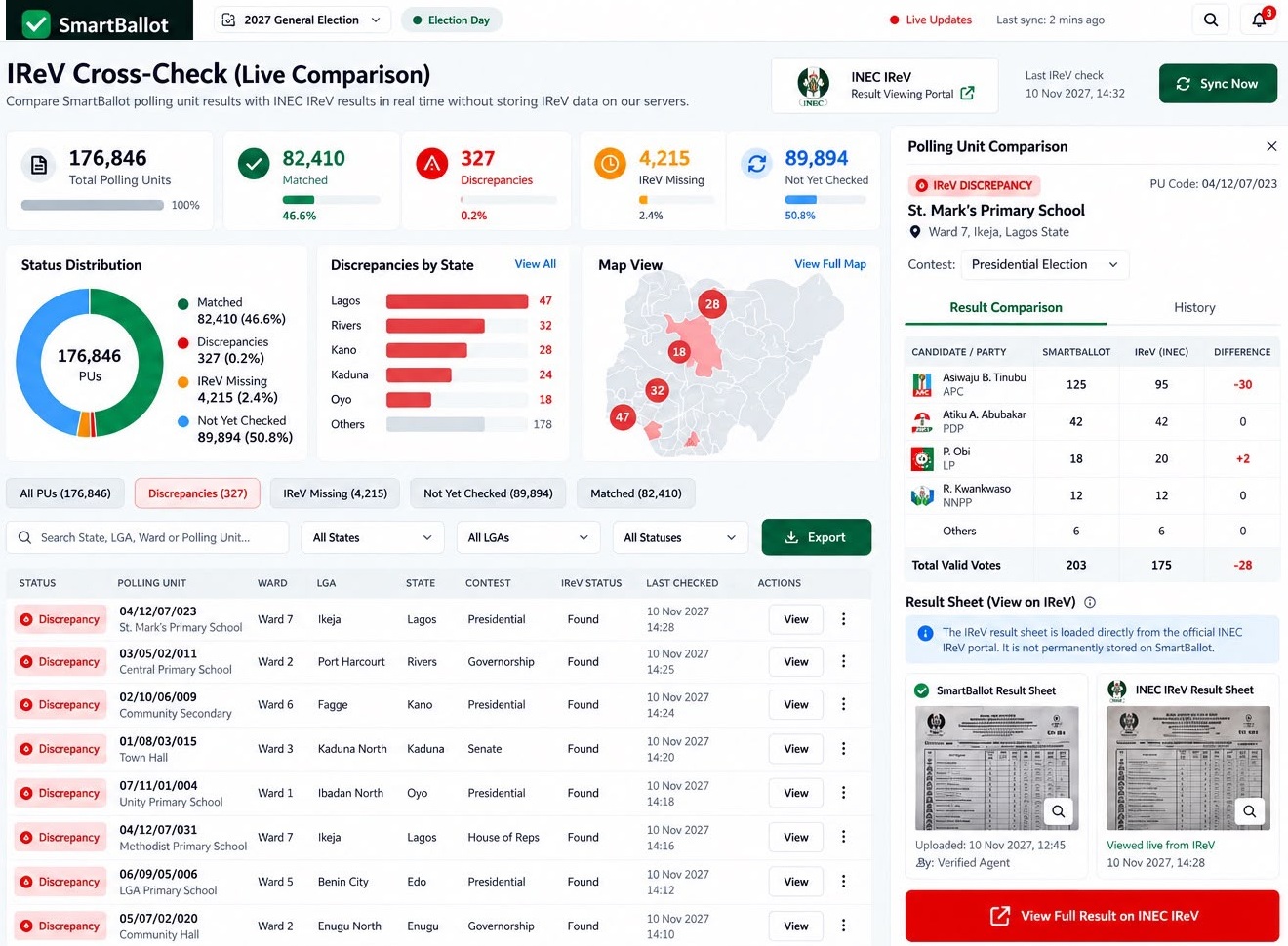
The SmartBallot IReV Cross-Check platform, displayed in the dashboard screenshot, is designed to compare polling unit results against those published on INEC’s IReV portal in real time.
The system presents verification statistics, highlights mismatches, and tracks polling units where results are unavailable.
Overall Verification Status
According to the dashboard figures, Nigeria has a total of 176,846 polling units listed for verification.

The current verification status shows:
- ✅ 82,410 polling units (46.6%) have matching results between SmartBallot and INEC IReV.
- 🔴 327 polling units (0.2%) show discrepancies between the two records.
- 🟠 4,215 polling units (2.4%) have no results found on IReV.
- 🔵 89,894 polling units (50.8%) have not yet been checked.
The number of identified discrepancies remains relatively small compared to the total polling units.
Meanwhile, the large volume of unverified units means the verification exercise is far from complete.
States Recording the Highest Number of Discrepancies
The dashboard’s state-by-state analysis shows that discrepancies are concentrated in a number of key states.
The states with the highest recorded discrepancies are:
- Lagos State – 47 cases
- Rivers State – 32 cases
- Kano State – 28 cases
- Kaduna State – 24 cases
- Oyo State – 18 cases
All other states combined account for 178 discrepancy cases.

The map displayed on the dashboard visually highlights these locations, with Lagos recording the highest number of flagged mismatches.
Example of a Flagged Discrepancy
One of the highlighted cases involves St. Mark’s Primary School, Ward 7, Ikeja, Lagos State.
There the platform identified differences between SmartBallot records and results published on the INEC IReV portal for the presidential election.
The comparison shows:
| Candidate/Party | SmartBallot | IReV | Difference |
|---|---|---|---|
| APC (Bola Tinubu) | 125 | 95 | -30 |
| PDP (Atiku Abubakar) | 42 | 42 | 0 |
| LP (Peter Obi) | 18 | 20 | +2 |
| NNPP (Rabiu Kwankwaso) | 12 | 12 | 0 |
The dashboard further indicates that:
- Total Valid Votes on SmartBallot: 203
- Total Valid Votes on IReV: 175
- Difference: 28 votes
The discrepancy has been flagged for review.

However, election observers and verification experts caution that a mismatch between datasets does not automatically constitute proof of electoral fraud.
Differences may arise from data entry errors, document quality issues, uploading delays, transcription mistakes, or other administrative factors that require investigation.
Major Concern: Unverified Polling Units
Perhaps the most significant finding from the dashboard is not the number of discrepancies detected, but the large number of polling units that have yet to undergo verification.
With 89,894 polling units, representing 50.8 percent of the national total, still unchecked, more than half of the available polling unit records remain outside the current verification exercise.
This means the present statistics offer only a partial picture of nationwide result validation efforts.
See examples of the discrepancies from the attached screenshot of Smartballot dashboard below:
Recommendations
Election stakeholders, civil society organisations, political parties and independent observers may consider prioritising:
- Verification of the 89,894 outstanding polling units.
- Detailed investigation of the 327 flagged discrepancies.
- Reconciliation of the 4,215 polling units with missing IReV results.
- Independent validation of all findings using original election documents and official records.
Conclusion
The SmartBallot IReV Cross-Check dashboard provides an important monitoring tool for comparing election records and identifying areas that may require further scrutiny.
The current figures show a high number of verified matches.
It further shows a relatively small number of detected discrepancies, and a substantial pool of polling units awaiting review.
The dashboard highlights potential verification gaps that deserve attention.
In the meantime, experts emphasize that the figures should be independently verified.
They also demand that they be thoroughly investigated before any conclusions are drawn regarding the accuracy, integrity, or credibility of any election outcome.