
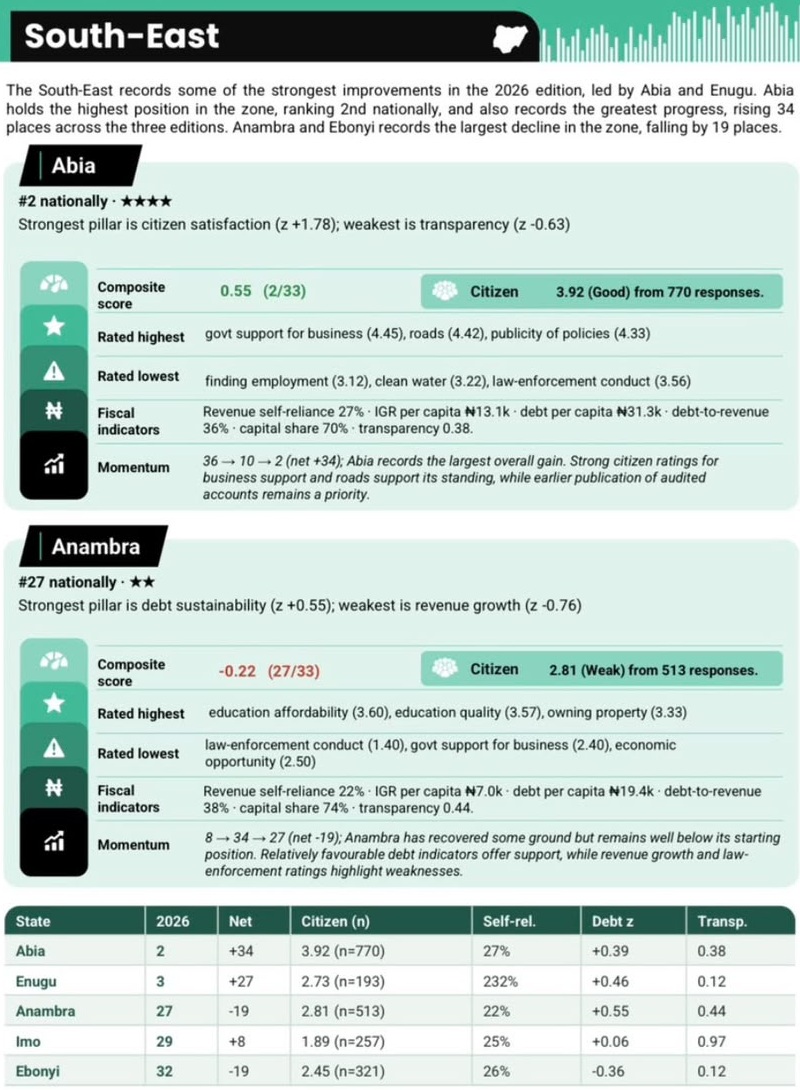
TD Anambra State has been ranked 27th out of Nigeria’s 36 states in the revised 2026 pcl. State Performance Index (pSPI), with a composite score of -0.22, according to the latest assessment by Phillips Consulting.
The ranking places Anambra well behind fellow South-East states Abia and Enugu, which occupy the second and third positions nationally respectively.
The figures contained in the 2026 assessment provide a detailed picture of the state’s current performance across citizen satisfaction, fiscal indicators, debt sustainability, revenue self-reliance and transparency.
The report also records a 19-place decline for Anambra across the three editions of the index.
However, an important clarification is necessary: the PCL data shown in the accompanying graphic does not establish that Anambra moved directly from first to 27th. The comparable PCL series shows Anambra at 8th in 2024, 34th in 2025 and 27th in 2026. The “from first to 27th” description has been used by Peter Obi’s media aide, Valentine Obienyem, in his criticism of the state’s current performance.
The Three-Year Trajectory
The latest PCL graphic provides the following trajectory:

| Año | Anambra’s national position |
|---|---|
| 2024 | 8th |
| 2025 | 34th |
| 2026 | 27th |
The 2025 edition represented a dramatic fall from the previous year’s eighth position. Contemporary reporting on the 2025 assessment also noted that the Anambra State Government disputed PCL’s methodology and described the findings as methodologically weak and misleading.
The state’s recovery from 34th to 27th in the 2026 assessment therefore represents a seven-place improvement from the immediately preceding edition, even though it remains below its 2024 position.
This distinction is significant because PCL itself revised its methodology for the 2026 report. The consulting firm said the new edition separates current performance from rank trajectory, rather than relying on a single momentum score. It also incorporated FY2025 audited financial statements and revised its approach to debt sustainability and financial transparency.
What the 2026 Data Shows
According to the attached PCL assessment, Anambra’s key figures include:
- National ranking: 27th
- Composite score: -0.22
- Citizen satisfaction: 2.81, classified as “Weak”
- Citizen responses: 513
- Revenue self-reliance: 22%
- IGR per capita: approximately ₦7,000
- Debt per capita: approximately ₦19,400
- Debt-to-revenue: 38%
- Transparency: 0.44
The report identifies debt sustainability as Anambra’s strongest pillar, with a standardised score of +0.55.
Its weakest pillar is identified as revenue growth, with a standardised score of -0.76.

The citizen-satisfaction component also presents a mixed picture.
Residents gave the highest ratings to education affordability (3.60), education quality (3.57) and property ownership (3.33).
The lowest ratings were recorded for law-enforcement conduct (1.40), government support for business (2.40) and economic opportunity (2.47).
These figures are important because the PCL methodology combines objective fiscal and administrative data with citizen perceptions rather than relying exclusively on government statistics. The 2026 assessment uses the revised methodology developed by PCL following a review of its initial July report.
South-East Contrast
Anambra’s position becomes more striking when compared with other states in the South-East.
The revised 2026 PCL assessment places:

Abia — 2nd nationally
Enugu — 3rd
Anambra — 27th
Imo — 29th
Ebonyi — 32nd
Abia recorded the largest improvement nationally, moving from 36th in 2024 to 10th in 2025 and second in 2026 — a net gain of 34 places.
Enugu also recorded a substantial improvement.
PCL said the South-East recorded some of the strongest improvements in the 2026 edition, led by Abia and Enugu, while Anambra and Ebonyi recorded the largest declines in the region over the three-edition trajectory.
The Revenue Question
The debate over Anambra’s ranking has inevitably raised questions about the resources available to the state.
Peter Obi’s media aide, Valentine Obienyem, argued that the decline should be considered against what he described as a substantial increase in resources available to the state under the current administration.
He compared an estimated ₦25 billion monthly in current receipts with approximately ₦3 billion monthly available to previous administrations, arguing that increased resources should translate into measurable improvements in public services and development outcomes.
Those figures, however, require some qualification.
Available FAAC data shows that Anambra received ₦199.88 billion in FAAC allocations during 2025, an increase of 49.59% from ₦133.62 billion in 2024. That 2025 figure represents an average of about ₦16.66 billion per month, although monthly allocations fluctuate and can include different revenue components.
The state’s own 2025 approved budget projected ₦319.76 billion from the Federation Account, demonstrating that budgeted FAAC receipts and actual monthly distributions should not automatically be treated as identical measures.
Consequently, the claim that Anambra currently receives an average of ₦25 billion every month should be presented as a claim requiring a defined period and revenue components, rather than as an established annual average.
See the attached table below:
More Money Does Not Automatically Mean Better Outcomes
The broader issue highlighted by the PCL assessment is the relationship between state revenues and measurable outcomes.
FAAC distributions to Nigerian states have increased substantially in recent years. The Federal Ministry of Information reported that FAAC distributed ₦2.30 trillion among the three tiers of government from May 2026 revenue alone.
PCL’s assessment, however, attempts to examine what states are doing with available resources by considering factors such as revenue self-reliance, debt sustainability, transparency, capital expenditure and citizen experience.
For Anambra, the latest figures suggest that revenue growth and citizen perceptions remain significant areas of concern, even though the state performs comparatively better on debt sustainability.
Soludo Administration’s Position
The findings have already attracted criticism from supporters of former Governor Peter Obi, while the Soludo administration has previously challenged PCL’s assessments.
Following the 2025 ranking, the Anambra government questioned the methodology and sample size used by PCL, arguing that the findings did not accurately reflect the state’s development record.
The administration has also pointed to its own record of expenditure and projects.
In its 2026 budget presentation, the Soludo administration reported extensive investment in roads, education, healthcare, water, youth development and other sectors. It said more than 900 kilometres of roads were under construction, 600 kilometres had been asphalted, and hundreds of primary healthcare centres were being renovated or equipped. It also reported the recruitment of more than 8,000 teachers and expansion of free education.
Those claims represent the administration’s own account of its performance and are separate from PCL’s assessment.
PCL Also Revised Its Own Methodology
The 2026 ranking should not be interpreted without considering an important development: PCL revised its own 2026 assessment.
The initial 2026 index, released in July, used a single Momentum Index. Following a subsequent review, PCL said it identified methodological and interpretation issues and revised the model.
The new edition uses a Performance Snapshot to show where a state currently stands and a Rank Trajectory to show how its position has changed across the 2024, 2025 and 2026 editions.
PCL also replaced FY2024 financial data with newly available FY2025 audited accounts and changed its approach to debt sustainability and transparency.
This means that comparisons involving the 2026 assessment should be understood within the methodology used for each respective edition.
What the Numbers Mean
The latest figures do not by themselves establish why Anambra moved from eighth in 2024 to 34th in 2025 and then 27th in 2026.
They do, however, establish a measurable change in the state’s position within the PCL assessment.
They also show that Anambra’s 27th-place ranking is not the lowest point in the three-edition series: the state was ranked 34th in 2025 before moving seven places upward in the latest edition.
At the same time, the state’s current position remains 19 places below its 2024 ranking, according to the trajectory presented in the 2026 PCL report.
The contrast with Abia and Enugu is also notable. Abia moved from 36th to second across the three editions, while Enugu emerged third nationally in the latest assessment.
The Bigger Accountability Question
The central issue raised by the figures is therefore not simply whether Anambra is 27th or whether it was previously ranked higher.
It is whether the state’s available financial resources are translating into measurable improvements in the areas that directly affect citizens — employment, business opportunities, security, infrastructure, education, healthcare, water and other public services.
The PCL assessment provides one data-driven framework for examining that question. The Soludo administration’s reported projects and expenditure provide another set of evidence.
For citizens, the significance of the latest ranking lies in putting both sets of claims under scrutiny: government spending, independently measured performance and citizens’ actual experiences.
The numbers provide a basis for that conversation. The interpretation remains a matter for scrutiny, competing evidence and public debate.