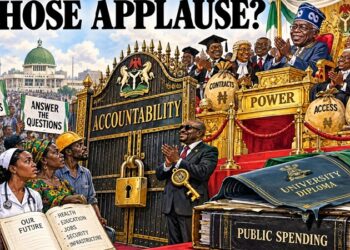
 STOCKHOLM — I did my national service in Nigeria during the Shagari years, inside the National Assembly and the presidency, close enough to power to learn how it sounds. It sounds like applause.
Ministers are cheered, loyalty is declared, and the noise is mistaken, by the men at the centre of it, for the country’s opinion of them.
I think of that whenever I watch the ceremonies that now surround President Bola Tinubu.
The politicians who praise him have reasons to. They have access, contracts, protection.
The woman in Mushin who cannot afford a bag of rice has none of those things, and nobody is asking her to clap.
So the question I keep returning to is not whether Nigerians respect their president.

It is whether they still believe that what they think of him makes any difference.
The answer, on the evidence, is that they mostly don’t.
In a survey conducted in 2024 and published last year, Afrobarometer found that 80 percent of Nigerians believed corruption had grown worse.
Nine in ten rated the government’s handling of it as poor.
Only one in ten thought a citizen could report corruption without fear of retaliation. These are opinions, not verdicts.
But a country in which nine out of ten people assume that honesty will be punished is not a country that expects to be heard.

What it has instead is a system in which loyalty functions as insurance.
I cannot see into the motives of every presidential ally, and I don’t pretend to.
But when a politician’s usefulness to the campaign appears to count for more than the unanswered questions about public money that follow him, or her, Nigerians are entitled to draw their own conclusions.
Take the Ministry of Humanitarian Affairs.
In January 2024, the minister, Betta Edu, was suspended after a memo came to light directing that 585 million naira, about $661,000 at the time, be paid into a private bank account.
Her office said procedure had been followed. Mr. Tinubu ordered an investigation, and he was right to.

By that April, the Economic and Financial Crimes Commission said its inquiry into the ministry, which covered past officials as well as current ones, had recovered 32.7 billion naira and a further $445,000, roughly $29 million all told.
Not all of that can fairly be attached to Ms. Edu, who denied any part in it.
But money on that scale demands a public account of who took it and what happened to them. No such account has been given.
On Aug. 22 this year, the presidency announced that Ms. Edu would serve as director of women mobilisation on Mr. Tinubu’s 2027 re-election campaign.
Asked the same day about her case, the commission told the newspaper Peoples Gazette that the investigation, nearly three years old, was still ongoing.
A campaign spokeswoman later told Channels Television that who the party puts on its council is a party affair and not the public’s business.
An open investigation is not a finding of guilt. I would say the same of anyone.
But a government that brings a suspended minister back into the front rank before it has explained why she was suspended is telling the country something about the going rate for accountability, and the country is listening.
The Lagos–Calabar coastal highway tells the same story from another direction.
In May 2024, Bloomberg reported that the project, then priced at $13 billion, had gone to Hitech, a company owned by Gilbert Chagoury, a businessman who has been close to Mr. Tinubu for decades.
TheCable found that the president’s son, Seyi Tinubu, was listed as a director of another Chagoury company.
Atiku Abubakar, the opposition leader, called it a conflict of interest. The government calls the highway essential.
Both things can be true. Thirteen billion dollars is a price, not a theft, and I will not pretend otherwise.
But a government that asks Nigerians to bear the pain of subsidy removal and a collapsing naira owes them the paperwork on a contract that size: how it was awarded, what it costs per kilometre, who checked.
The refusal to produce it is not neutral. It is a choice.
Then there is the president’s own past, which his defenders would prefer were off limits.
In 1993, a federal court in Chicago ordered the forfeiture of $460,000 held in an account in Mr. Tinubu’s name, in a civil case concerning the proceeds of heroin trafficking.
There was no conviction. Mr. Tinubu has always denied wrongdoing. It was American money, not Nigeria’s.
All of that is so, and none of it makes the record disappear. What disturbs me is not that ordinary people shrug at this.
It is that the lawyers, the accountants, the professors, the communications men do.
They know the difference between a criminal conviction and a conflict of interest, between a court’s silence and a clean sheet.
They know, too, the difference between a deal under discussion and a deal done.
In September 2023, the president’s spokesman announced that a meeting in Abu Dhabi had lifted the Emirati visa ban on Nigerians and restored Emirates and Etihad flights with immediate effect.
A U.A.E. official told CNN that nothing had changed. Emirates came back to Lagos in October 2024, more than a year later.
The educated men who celebrated the first announcement never got round to correcting it.
A university should teach a person to question power. When it teaches him to write its excuses instead, the degree is a disgrace.
A system that pays for loyalty will always find people willing to sell it, and the ones who come cheapest are those who measure the nation’s progress by the growth of their own accounts.
Hospitals can rot and they will prosper. Their cheering is sincere. It just isn’t about Nigeria.
I should say where I stand. I am Yoruba on my mother’s side and Kalabari on my father’s.
I owe Mr. Tinubu no deference on that account, and neither does anyone else.
The attempt to recast criticism of the president as an assault on the Yoruba people collapses on the arithmetic: in 2023 he took more votes from the North-West than from the South-West, and he lost Lagos and Osun.
His government is a national coalition, and the whole coalition owns its record.
A hungry family gains nothing from sharing a surname with the man in Aso Rock. Nor is it fair to call Nigerians cowards.
People did march, in August 2024, and Amnesty International recorded what was done to them for it.
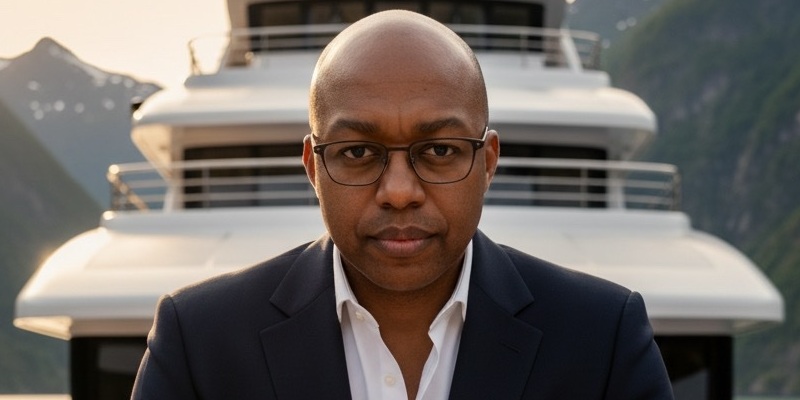
It is easy to demand courage from a safe distance. I write from Stockholm. I know what that distance is worth, and what it costs.
The work is slower and duller than a protest: registering, voting, suing, reporting, asking the same questions after the news cycle has moved on.
Nigerians deserve published findings, open contracts and consequences where guilt is proved. Exhaustion is not consent.
They deserve officials who can answer a question without treating the questioner as an enemy of the state.
And the applause of the people who are paid to applaud should never be mistaken for the voice of the country.
Kio Amachree is a Swedish-Nigerian writer and the founder of Worldview International. He writes the Letters from Stockholm series.